Carbon Dioxide in WASP-39 b: Measurement and Atmospheric Inference
Separate the observed 4.3 μm CO2 feature from model-based interpretations of the wider atmosphere.
Publication & corrections: infostoa · Editorial standards
Individual author and specialist reviewer information is not provided for this article.
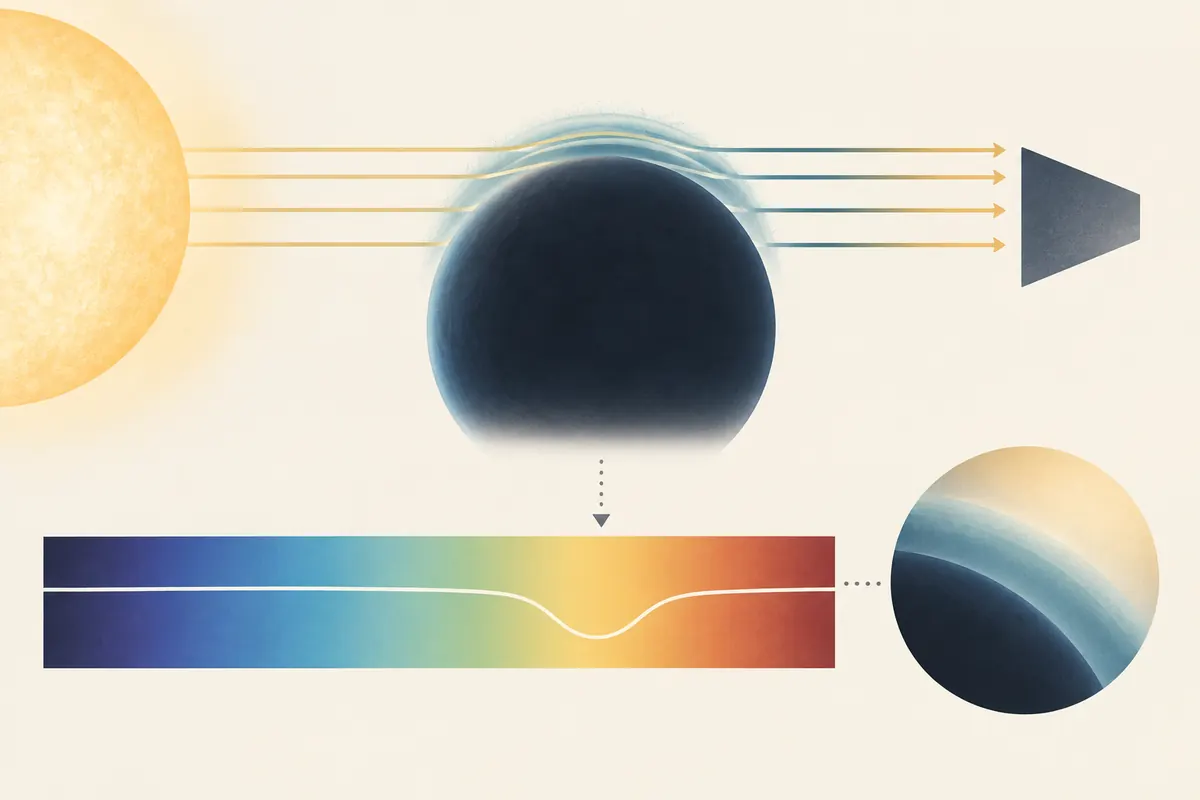
The reported carbon-dioxide (CO2) feature in the atmosphere spectrum of WASP-39 b does not mean that one molecule reveals the whole planet. The JWST team measured wavelength-dependent changes in starlight; broader atmospheric composition was interpreted by comparing the data with atmospheric models. Keeping measurements separate from model inference is essential.
A transmission spectrum measures small changes in starlight
When a planet crosses its star, it blocks some starlight while some passes through the planet’s atmosphere. Molecules absorb different wavelengths, so comparing brightness across wavelengths can reveal absorption features. This does not collect atmospheric material or photograph every constituent at once. Clouds, temperature, atmospheric structure, and the instrument’s observed range all shape interpretation.
The CO2 feature reported from Webb observations
Ahrer and colleagues analyzed WASP-39 b observations from JWST’s Early Release Science program. Their paper reports a CO2 absorption feature near 4.3 micrometers at 26-sigma significance in data spanning 3.0–5.5 micrometers. NASA’s mission explainer says NIRSpec observed the planet on July 10, 2022 and describes a CO2-related feature between 4.1 and 4.6 micrometers. This is a clear feature reported in that analysis, not a complete inventory of the atmosphere.
A detected molecule and an inferred composition are different
The researchers compared the observed spectrum with one-dimensional radiative-convective-thermochemical equilibrium models. A model with 10-times-solar metallicity and moderate cloud opacity fit the overall spectrum; that model predicted water, carbon monoxide, hydrogen sulfide, and little methane. These are model results, not a claim that every gas was independently detected at the same level as CO2. A small feature near 4.0 micrometers was tentative and was not reproduced by those models.
What the result says about formation—and what it does not
CO2 can help constrain metallicity and formation processes in a gas giant. One feature does not uniquely establish every elemental ratio, cloud structure, or formation history. Readers need to ask how well other model assumptions explain the spectrum and what additional wavelengths could resolve. This study did not detect life or establish habitability.
The analysis uses a transmission spectrum: starlight filtered through the atmosphere during a transit. The 26-sigma value therefore describes statistical evidence for the feature analyzed in that spectrum; it is not a direct measurement of an exact atmospheric CO2 percentage. Abundance and formation history require interpretation of the broader spectrum under model assumptions.
Expert perspective: distinguish signal significance from model certainty
The paper’s 26-sigma value describes the reported CO2 spectral feature. It does not mean that each modeled gas abundance or formation scenario is established with the same significance. NASA’s explainer describes how wavelength-dependent starlight helps infer atmospheric composition, but those interpretations still depend on the transmission spectrum and models. Keep “CO2 feature detected” separate from “other gases and formation interpreted.”
Questions to ask when reading the result
Check the wavelength range and instrument, the location of the measured feature, its reported significance, and the model’s metallicity and cloud assumptions. Do not turn tentative features or model predictions into a confirmed list of molecules. Read the result within the paper’s date and observation range; later data may refine interpretations of the same planet.
A transmission spectrum shows wavelength-dependent attenuation by the atmosphere, not a direct map of its layers.
Sources
- Ahrer et al., Identification of carbon dioxide in an exoplanet atmosphere (2022) — full original JWST/NIRSpec transmission-spectrum and modeling paper.
- NASA, Webb Detects Carbon Dioxide in Exoplanet Atmosphere — mission explanation of transmission spectroscopy and the CO2 feature; updated September 21, 2026.