What volcanic lightning can reveal—and what it cannot
Separate stroke counts from eruption events in the Bogoslof record. Learn why missing lightning does not mean missing ash and how to compare different monitoring signals.
Publication & corrections: infostoa · Editorial standards
Individual author and specialist reviewer information is not provided for this article.
1. Strokes and eruption events are different units
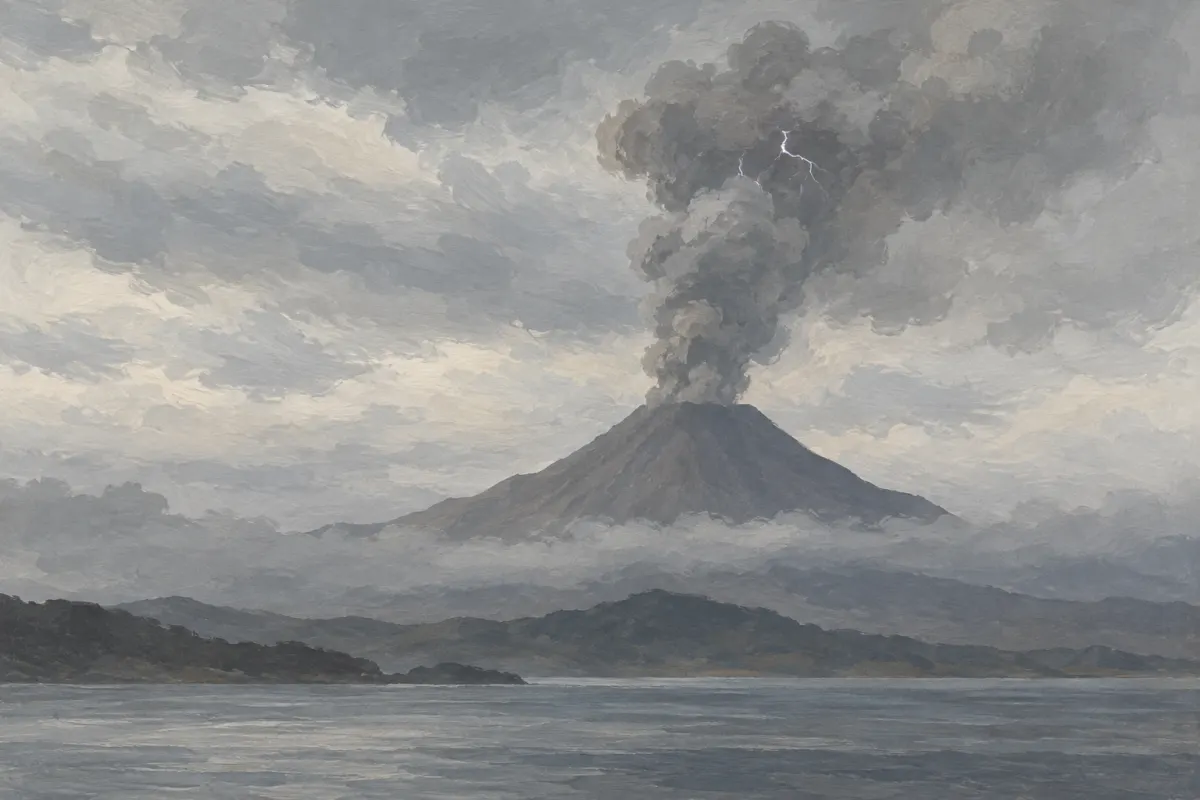
Volcanic lightning signals charge separation and discharge. Van Eaton and colleagues' Bogoslof study reports over 4,550 strokes in nine months during 2016–2017, but detectable lightning in 32 of 70 explosive events. Stroke count is neither eruption count nor ash mass. The approximately 46% represented by 32/70 describes this period and its networks, not a universal detection rate.
2. Plume height and ice charging
The researchers compared satellite, photographic, acoustic and lightning observations with plume modeling. Detected lightning tended to begin after plumes exceeded an atmospheric altitude associated with about −20°C. This does not redefine water's equilibrium freezing point of 0°C; it describes the atmospheric conditions used to examine ice-related charging.
They inferred contributions along a continuum from silicate collisions near the vent to ice charging in upper plumes. Distinguish the observed timing from a mechanism interpreted using models. It is not a rule that every plume above a fixed altitude produces lightning.
3. Reading a missing signal
In a hypothetical monitoring display, a satellite plume without recorded lightning should prompt a check of observation time and location, not deletion of the plume. The other 38 events in this study lacked lightning detections; they were not missing eruptions. The record alone does not identify every reason for non-detection.
Conversely, compare a detected discharge's time and location with satellite plumes, seismic records and infrasound. Lightning networks measure electromagnetic signals, seismometers ground motion and acoustic sensors pressure waves: these are not repeated measurements of one quantity. Do not directly convert strokes into ash concentration at an aircraft.
4. Use it as an additional monitoring input
Tripathy-Lang's specialist account attributes combined lightning, satellite and acoustic monitoring to USGS volcanologist Alexa Van Eaton. Separate the original paper's numerical evidence from this attributed explanation of use. Assess a particular route with official volcanic-ash and aviation-weather information, not lightning alone.
5. Sources
- Van Eaton et al. (2020), Bulletin of Volcanology: Bogoslof observations and charging interpretation.
- Alka Tripathy-Lang, Temblor: attributed specialist account of combined monitoring.