Why Venus Spins Retrograde and Why Its Measured Day Length Varies
Retrograde describes Venus’s spin relative to its orbital direction. Distinguish a 2006–2020 radar estimate from NASA’s reference-table value, and separate sidereal rotation from the solar day.
Publication & corrections: infostoa · Editorial standards
Individual author and specialist reviewer information is not provided for this article.
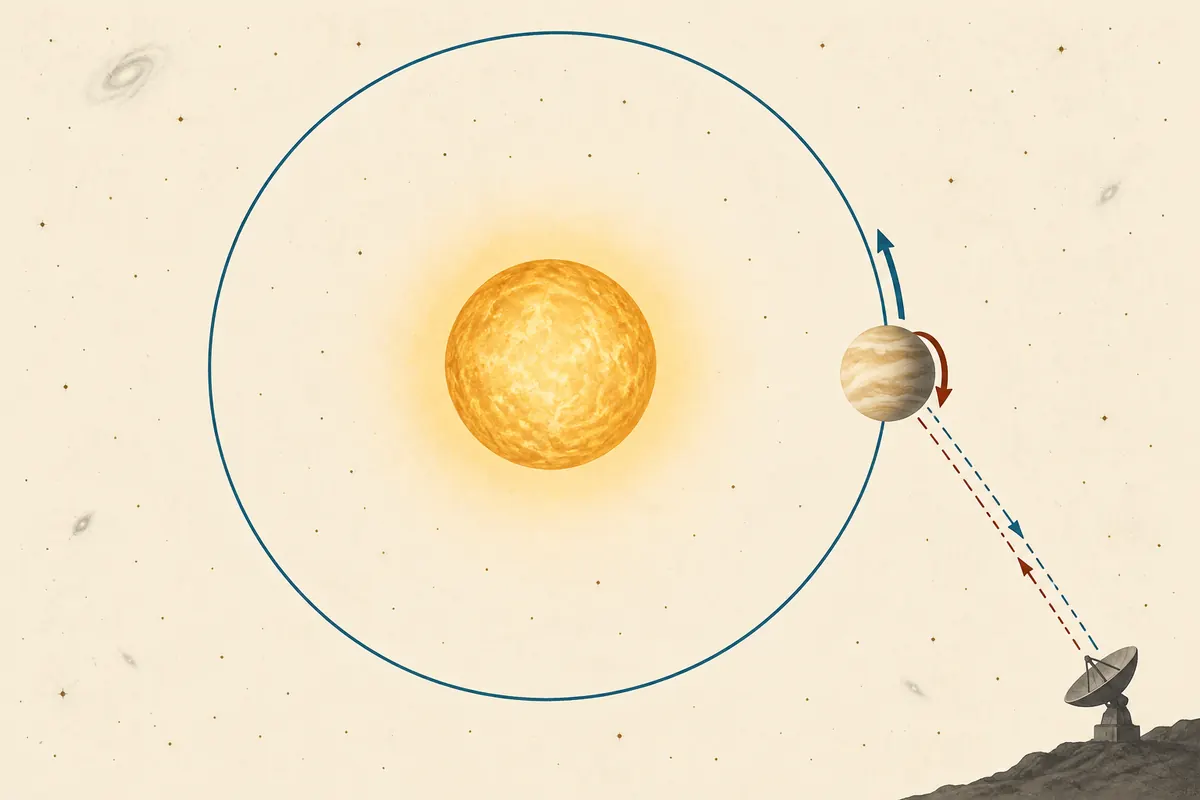
What does “retrograde” mean?
A planet’s rotation is commonly described relative to its direction of orbit. Venus rotates in the opposite direction, so its spin is called retrograde. NASA’s NSSDCA fact sheet lists its sidereal rotation period as −5832.6 hours. Under that table’s convention, the minus sign marks retrograde rotation; it does not mean that Venus is not rotating or that the value is an error estimate.
“Day” can refer to different intervals. A sidereal rotation period is the time for a planet to turn once relative to a distant stellar reference. A solar day is the interval until the Sun returns to the same apparent position over a location. Because a planet also moves along its orbit while it spins, the solar day is not the same as the sidereal rotation period. This distinction helps explain why NASA’s tabulated Venus day length and rotation value are different.
Expert research perspective: how radar measurements estimate the spin
The paper by Margot and colleagues uses Earth-based radar observations to track echoes from Venus over multiple years. From observations spanning 2006–2020, the authors estimate an average spin period of 243.0226 ± 0.0013 Earth days. This is an average for that observation interval, not an immutable value at every moment. Earlier estimates averaged over different time spans can differ slightly, which is why their observation windows should be compared.
The paper reports variation of roughly 61 parts per million, equivalent to about 20 minutes in the rotation-period estimate. This is variation across observations, not a fixed daily increment. Radar sampling intervals, sparse observations, and analysis uncertainty also matter when interpreting the result.
Exchange between atmosphere and solid planet
Venus’s atmosphere circulates much faster than the surface, a phenomenon known as super-rotation. The researchers examine the relation between spin measurements and atmospheric motion and discuss transfer of angular momentum between the atmosphere and solid planet. They interpret the observed variation as consistent with such exchange, but do not establish one simple cause for every detail of the changing spin.
A careful summary therefore says that atmospheric torque may contribute to the variation, while separating observation from interpretation. Radar measures reflected signals from which spin state is estimated; coupling between atmosphere and interior is a physical explanation considered alongside those results. The paper does not justify presenting every period or internal interaction as fully settled by one diagram.
Why the solar day is about 116.75 Earth days
NASA’s table gives a sidereal rotation period of −5832.6 hours, whose magnitude is 243.025 Earth days, and an orbital period of about 224.7 days. Its ‘length of day’ is 2802 hours, or 116.75 Earth days. NASA defines that quantity as the average return from noon to noon at an equatorial location, not the interval from sunrise to sunset. Table definitions
For an explanatory calculation with constant mean angular rates, retrograde spin makes the spin and orbital rates add in the Sun’s motion relative to the surface. Thus 1/solar day ≈ 1/243.025 + 1/224.701; taking the reciprocal gives about 116.752 days, consistent with the table’s rounded 116.75 days. This is a simple relationship using reference values, not a calculation of daily radar variations or sunrise times at a particular latitude.
If the Sun were visible, it would rise in the west and set in the east on Venus, as NASA explains. Western sunrise is not the misconception; treating it as a familiar 24-hour, Earth-daily event is. Retrograde spin also does not mean Venus travels backward around its orbit. NASA on direction
Sources and references:
- Spin state and moment of inertia of Venus — Jean-Luc Margot, Donald B. Campbell, Jon D. Giorgini, Joseph S. Jao, Lawrence G. Snedeker, Frank D. Ghigo, Amber Bonsall; received 2020-10-14, published 2021-04-29
- NASA Venus Fact Sheet — David R. Williams, NASA GSFC/NSSDCA; updated 2024-01-11
Note: The NTRS acquisition date, February 23, 2022, is not the journal publication date.