Sous-Vide Chicken Breast: What Time and Temperature Studies Do—and Do Not—Show
A close reading of two chicken-breast studies, USDA’s consumer temperature advice, and the FDA’s retail model code. Their findings do not provide universal schedules for other meats or home equipment.
Publication & corrections: infostoa · Editorial standards
Individual author and specialist reviewer information is not provided for this article.
What the chicken-breast evidence covers
Sous vide is a method of sealing food and heating it in a water bath. The phrase “low temperature, long time” is not, by itself, a safety instruction. Heat must reach the food’s center and remain under controlled conditions; food type, thickness, starting temperature, packaging, and equipment all matter. The two research papers discussed here studied chicken breast. Their results should not be turned into cooking schedules for beef, pork, fish, or every chicken portion.
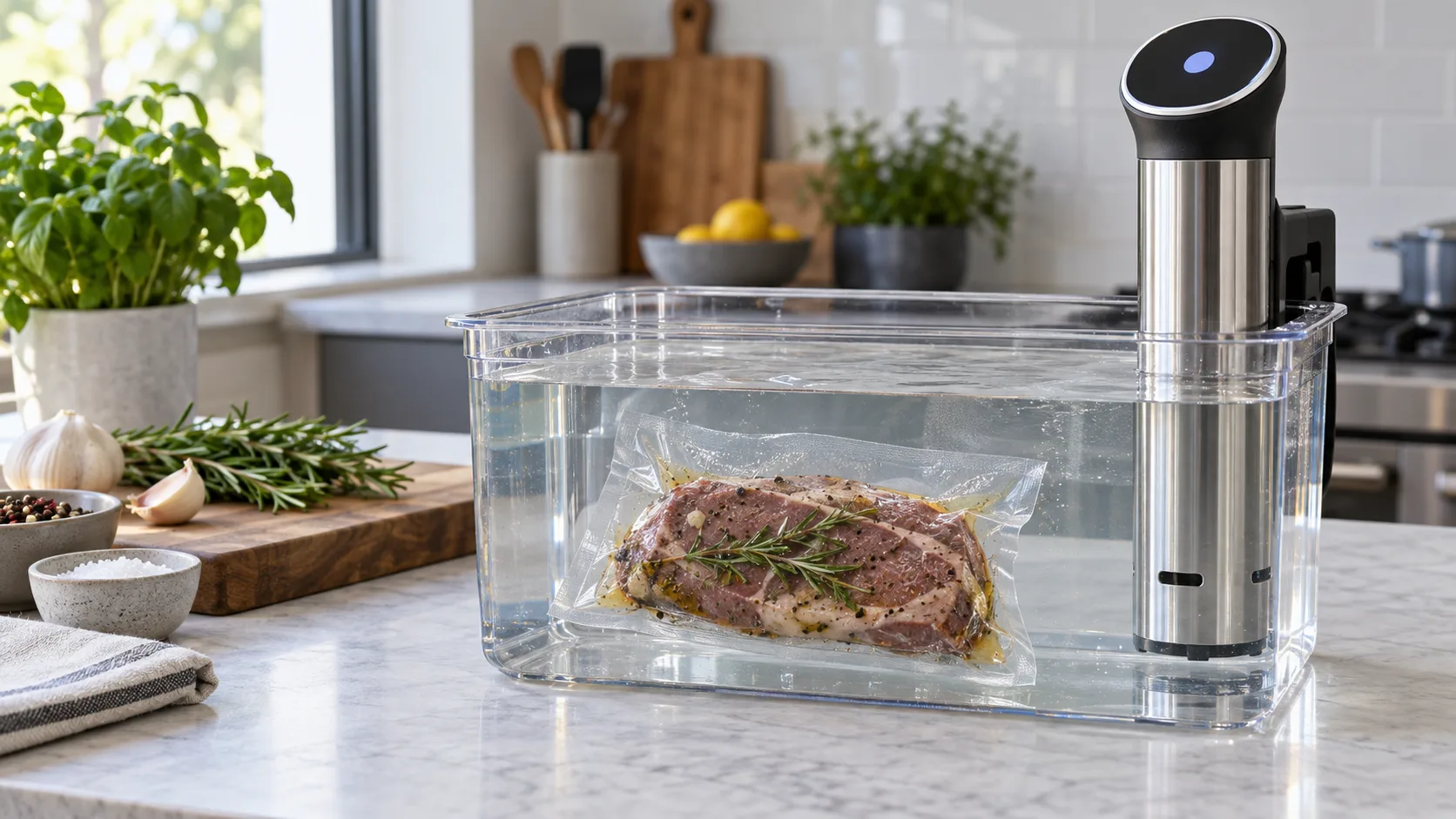
What the experiments actually tested
Hasani and colleagues’ 2023 study vacuum-packed inoculated chicken breast and compared 60°C for 120 minutes with two-step combinations of 50°C and 60°C over the same total time. It used *Enterococcus faecalis* as the microbial indicator: the one-step treatment inactivated it, while the two-step treatments produced reductions greater than 3 log. The researchers also compared 21-day storage at 4°C, 10°C, and −20°C; outcomes at 10°C differed from those at 4°C and −20°C for microbial stability, oxidation, and odor. These findings belong to the tested chicken and process, not a schedule for other pathogens, meats, or equipment. Read the study record and abstract
The 2022 paper compared chicken-breast quality and calculated pasteurization values under one-step and two-step sous-vide treatments. Some quality measures, including texture and cooking loss, favored the two-step treatment. The authors reported similar calculated pasteurization values for vegetative *C. perfringens* and *L. monocytogenes* under their study conditions. These were calculated values, not a challenge test directly demonstrating kill of every pathogen, and they do not make the tested combination a home-cooking recommendation. Read the 2022 study
Use safety guidance without confusing the endpoints
USDA FSIS lists 165°F (73.9°C) as the minimum internal temperature for poultry in its consumer chart. This is the straightforward consumer recommendation. A lower bath temperature paired with a longer hold is a different process: the bath display alone does not show when the coldest point in a piece has reached the intended time-temperature exposure. A validated schedule must account for product dimensions, initial temperature, heat transfer, and equipment performance. The two chicken-breast papers above do not supply enough evidence to calculate a safe schedule for every food. Do not infer Salmonella D-values, z-values, or a “6.5D/7D” target from those studies when they did not directly establish those figures. USDA FSIS safe-temperature chart.
Vacuum packaging is not a kill step. By reducing oxygen, it can change which organisms grow and how spoilage appears. The FDA Food Code 2026 is a model used by U.S. jurisdictions to regulate retail and food-service operations. Its reduced-oxygen-packaging controls are relevant to commercial cook-chill and sous-vide processes, including hazard analysis, time-temperature limits, and monitoring. It is not a universal home-cooking chart, and the enforceable rules depend on local adoption. A restaurant planning to chill or distribute sealed portions needs a process validated for its food, packaging, cooling equipment, storage, and jurisdiction. FDA Food Code 2026 and its scope.
How to use the specialist reference
Douglas Baldwin’s practical guide keeps poultry, fish, and meat in separate tables and states assumptions such as starting temperature and thickness. That is useful because it makes clear that time depends on the product and heat-transfer conditions. The tables are the author’s calculations from cited studies and a stated model; they are not government certification of every appliance, cut, or recipe. Treat the guide as a technical reference, not a personalized safety guarantee. For people at higher risk of foodborne illness, commercial service, or extended refrigerated storage, use current local guidance and a process reviewed by a qualified food-safety professional. Compare the consumer baseline in the USDA chart with the assumptions in Baldwin’s guide.
Sources and references
Effect of Two-Step Sous Vide Cooking and Storage on Microbiological and Oxidative Stability of Chicken Breast / Effect of Combination of Time and Temperature on Quality Characteristics of Sous Vide Chicken Breast / Safe Minimum Internal Temperature Chart / FDA Food Code 2026 / A Practical Guide to Sous Vide Cooking