Eclipse Shadow Paths and Safe Solar Viewing
See how the umbra, penumbra, and the Moon’s apparent size change an eclipse by location, with clear boundaries for direct viewing and projection.
Publication & corrections: infostoa · Editorial standards
Individual author and specialist reviewer information is not provided for this article.
Why the same eclipse looks different by location
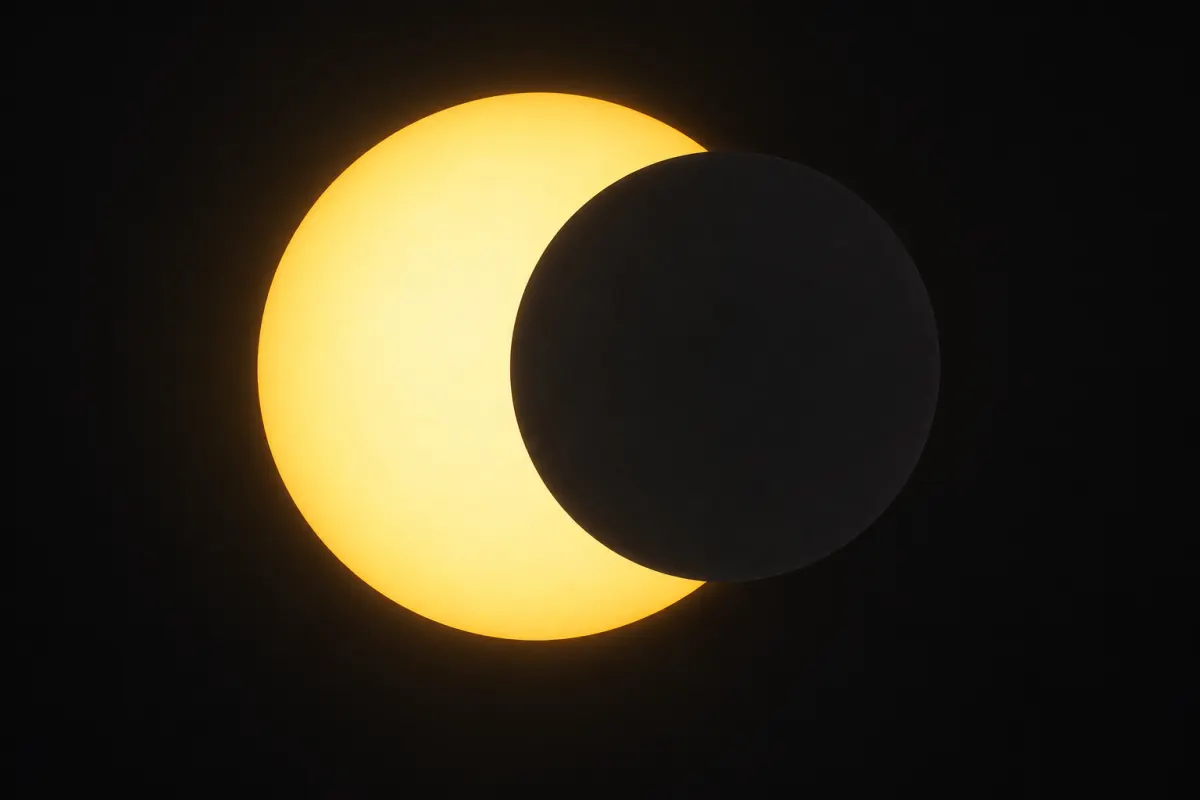
Even when the Moon passes between the Sun and Earth, its shadow reaches only a limited area. Inside the dark umbra, observers can see a total eclipse; in the surrounding penumbra, they see a partial eclipse. If the Moon is farther from Earth and appears smaller than the Sun, the umbra does not reach the ground. An annular eclipse is then visible within the extended shadow. Your location relative to these paths determines what type you see.
Choose a viewing location
Check NASA’s path map and the local start, maximum, and end times for the specific eclipse. A site outside the total or annular path may see only a partial eclipse. Clouds are a separate local condition, so check the forecast as well. This comparison is illustrative, not an observation: if Site A lies on the totality path and Site B lies only in the penumbra, A may have a brief total phase while part of the Sun remains visible from B throughout.
Protect your eyes during direct viewing
Never look at a partial or annular eclipse with unprotected eyes at any phase. Even inside the path of totality, use a viewer during the partial phases before and after totality. Direct viewing without a viewer is limited to the brief moment when the Moon completely covers the Sun’s bright face; put the viewer back on as soon as any bright surface reappears. This exception applies only to unaided viewing, not cameras, binoculars, or telescopes. Use an undamaged eclipse viewer that meets ISO 12312-2; discard it if scratched or torn. Ordinary sunglasses are not a substitute. Do not look through a camera, binoculars, or telescope while wearing eclipse glasses or using a handheld viewer. Optical equipment needs its own correctly fitted solar filter on the front; seek expert guidance before using it.
Use indirect projection
A pinhole projector avoids looking directly at the Sun. With your back to the Sun, project light through a small opening onto a bright surface and look only at the projected image. Never look through the pinhole. Small gaps in a colander or between leaves can also project crescent-shaped images during partial phases.
Sources and scope
NASA explains eclipse geometry and viewer safety; the American Astronomical Society (AAS) provides additional viewer guidance. Use the official map for the date and location you plan to observe.
Sources: NASA eclipse geometry · NASA viewing safety · AAS eye safety