Earth’s Tilt, Daylight, and the Seasons
How Earth’s axial tilt changes sunlight angle and day length between hemispheres, and what solstices and equinoxes do—and do not—mean.
Publication & corrections: infostoa · Editorial standards
Individual author and specialist reviewer information is not provided for this article.
Seasons result from Earth’s axial tilt changing the Sun angle and daylight duration in each hemisphere.
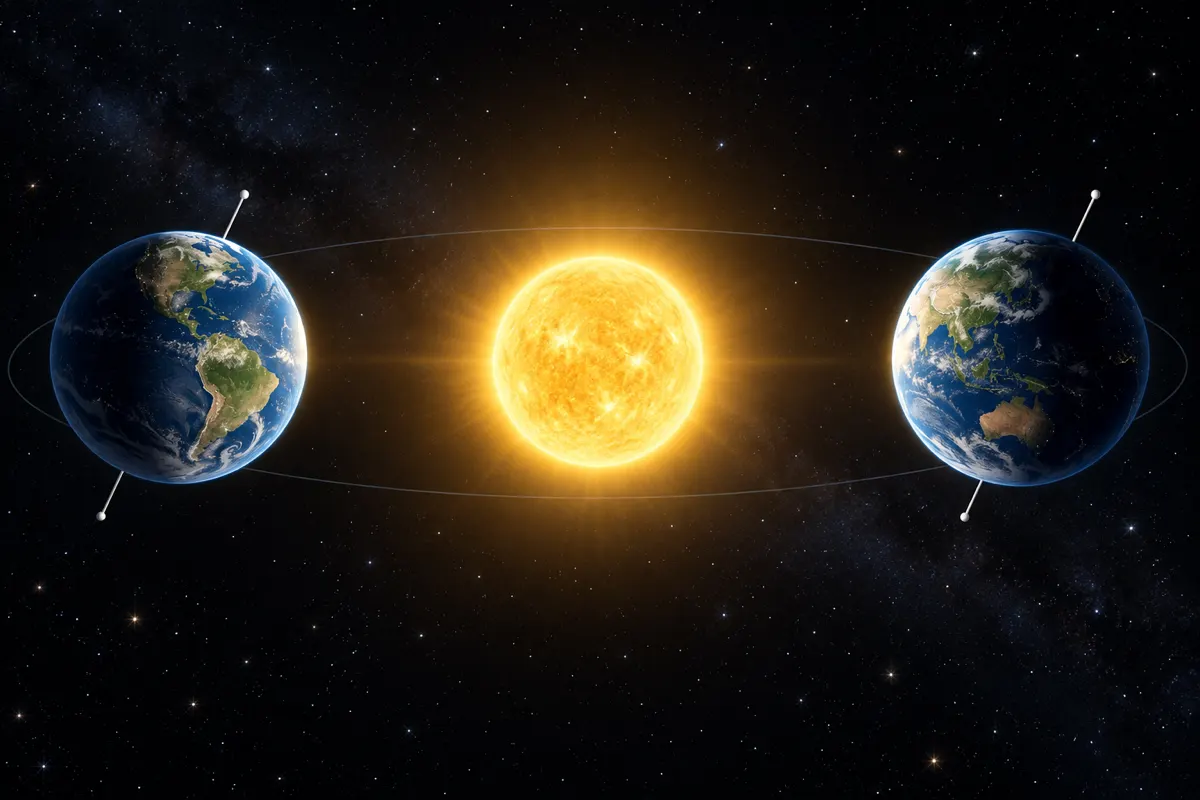
1. Seasons are not simply about distance from the Sun
Because July is warm and January is cold in the Northern Hemisphere, it may seem that Earth’s changing distance from the Sun causes seasons. NASA explicitly rejects that as the explanation. The central factor is Earth’s axis, tilted about 23.5 degrees from the normal to its orbital plane, with its orientation in space staying broadly pointed in the same direction as Earth travels around the Sun.
2. Sunlight angle and day length change together
When a hemisphere tilts toward the Sun, sunlight arrives at a higher angle and its energy is concentrated over a smaller surface area. Daylight also lasts longer. These conditions support summer in that hemisphere. The opposite hemisphere tilts away, receives sunlight at a lower angle over a broader area, and has shorter days, supporting winter. This is why the two hemispheres have opposite seasons at the same time. Tilt describes the broad seasonal pattern, while oceans, atmosphere, and local geography also shape actual weather and climate.
3. Solstices mark the farthest seasonal tilt
The National Weather Service describes solstices as the moments when Earth’s tilt toward or away from the Sun reaches its maximum. Around the June solstice, the Northern Hemisphere has its longest daylight and the Sun reaches a higher midday elevation; around the December solstice, daylight is shortest there. The pattern is reversed in the Southern Hemisphere. A solstice does not have to coincide with the hottest or coldest day. Land and oceans store and release heat with a delay, and local conditions vary.
NOAA describes the Sun as directly overhead at the Tropic of Cancer around the Northern Hemisphere’s summer solstice and at the Tropic of Capricorn around its winter solstice. At the equator, it is directly overhead at noon on the equinoxes. These latitude markers make clear why “summer” cannot mean the same daylight duration or Sun angle everywhere on Earth. The hemispheres experience opposite seasons at the same time, and local solar elevation still varies with latitude.
4. An equinox is not exactly twelve hours everywhere
At an equinox, Earth’s axis points neither toward nor away from the Sun, and daylight and darkness are described as nearly equal. “Nearly” matters: it does not mean every location gets precisely twelve hours of daylight. The apparent size of the Sun, atmospheric refraction, and the convention used to define sunrise and sunset affect measured day length. Equinoxes and solstices are astronomical instants, not direct measurements of local temperature.
NOAA’s National Weather Service notes that daylight near an equinox is not exactly 12 hours because atmospheric refraction and the time the Sun takes to cross the horizon affect sunrise and sunset. Its examples are about 12 hours 6.5 minutes at the equator, 12 hours 8 minutes at 30° latitude, and 12 hours 16 minutes at 60°.
5. Keep orbital distance separate from seasonal geometry
Earth’s distance from the Sun does change during its orbit, but NASA and NOAA do not identify that change as the primary cause of the seasons. Axial tilt changes how sunlight is distributed between the hemispheres and how long each hemisphere receives daylight; orbital distance is a separate feature of the path. A region’s hottest or coldest day is also not the astronomical definition of its season. Keeping these ideas separate helps explain why weather varies within a season without replacing the underlying geometry.
6. Expert perspective: compare hemispheres with a model
A globe model only demonstrates this mechanism if its axis remains tilted instead of being held upright. Keep the axis pointing in the same direction while moving the globe around a lamp: for part of the orbit the Northern Hemisphere leans toward the light, and for another part it leans away. On a spherical surface, light arriving at a higher angle is concentrated over a smaller area than light arriving obliquely. Longer daylight and the angle of illumination therefore change together. At the same time, the other hemisphere experiences the opposite orientation.
This model describes broad seasonal illumination, not daily weather or the climate of a particular place. Oceans, atmospheric circulation, latitude, elevation, and terrain affect local temperature and precipitation. Astronomical season explanations and weather records answer different questions; keeping those scopes separate avoids attributing every regional variation directly to axial tilt.
At one location, record daylight duration and the Sun’s elevation at local noon across seasons. These observations track how long sunlight lasts and the angle at which it arrives; include the date and latitude when comparing locations.