Reading radiocarbon ages and calibrated calendar ranges
Calibration connects a laboratory measurement to calendar possibilities; sample history still determines what event it can date.
Publication & corrections: infostoa · Editorial standards
Individual author and specialist reviewer information is not provided for this article.
A radiocarbon age is not directly a calendar year. Calibration compares it with dated reference records to produce a calendar probability distribution, which may contain several separate ranges rather than one date. IntCal20 calibration-curve paper OxCal explanation of result ranges
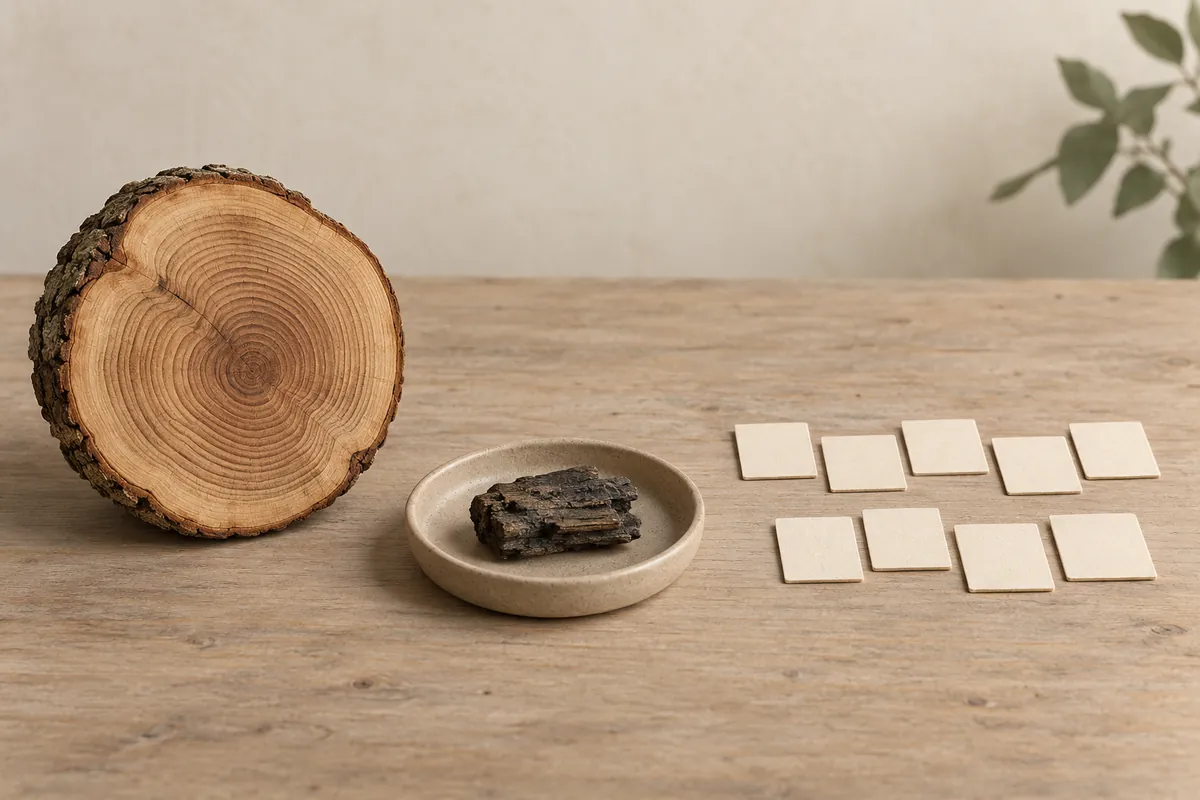
Why BP needs another step
BP means before present, with 1950 as its reference year. It is a conventional radiocarbon timescale, not a count back from today. Atmospheric carbon-14 has varied, so subtracting the reported age from 1950 is not calendar calibration. Labels such as cal BP distinguish calibrated calendar results. Laboratory timescale explanation
The reference records have independently established ages. Hogg and colleagues’ 2020 SHCal20 paper describes tree rings dated through replicated chronologies: their radiocarbon measurements record past atmospheric carbon. The paper also documents differences between hemispheres. Thus calibration is an evidence-based comparison, not a correction obtained solely from radioactive decay. SHCal20 paper
How one measurement becomes several possibilities
Both the sample measurement and the calibration curve have uncertainty. OxCal’s methodological documentation includes both in the calendar likelihood. The curve’s radiocarbon value changes with calendar time; a value can correspond to more than one calendar position. OxCal likelihood
OxCal describes its ranges as areas of a probability distribution. For modeled results, the posterior depends on the observations and the prior assumptions. Its manual warns that a mean or median cannot replace ranges for a distribution with several peaks. OxCal distributions
Suppose, purely as a report-reading illustration, a result lists two separated calendar intervals. Their listed probability shares contribute to the combined level reported for that result. That combined level does not belong to each interval individually. Beta Analytic’s calibration explanation distinguishes those shares; neither interval should silently disappear from a summary. Laboratory range explanation
Choose the curve by carbon source
IntCal20 concerns Northern Hemisphere atmospheric carbon and appropriate terrestrial samples reflecting it. A find’s geography alone does not establish suitability. OxCal separately lists Southern Hemisphere atmospheric curves and a marine curve. Marine calibration needs an appropriate local reservoir adjustment, rather than treating ocean-derived carbon as if it had the atmospheric history. OxCal curve scope
A reproducible calibration also needs the actual input. OxCal’s single-date interface takes an identifier, radiocarbon measurement and uncertainty, with a selected calibration curve. When reading a report, retain this combination alongside the calendar result. OxCal input
Expert perspective: laboratory precision and archaeological meaning
SGS Beta’s laboratory guidance distinguishes counting error from added uncertainty related to sample homogeneity and chemistry. Read a small reported measurement uncertainty as applying to that measurement, not as a guarantee of calendar-age accuracy or an explanation of the sample’s later history. Laboratory uncertainty
Wood makes the distinction concrete. A ring dates its growth, which can precede felling, use or burning. In an explicitly hypothetical case, an old timber reused in a later fire would retain its earlier growth age. Beta Analytic describes delayed use and reuse as old-wood problems: the sample’s age is not necessarily the event’s date. Old-wood explanation
Contamination is a separate question again. Carbon introduced by roots, soil substances or conservation materials can alter a sample’s measured composition. Beta Analytic’s procedure explains physical and chemical pretreatment and the need to adapt it to material and possible contaminants. Calibration works on the resulting measurement; it does not substitute for establishing sample quality. Laboratory pretreatment
Read a chronological claim with its assumptions
A chronological model may add information beyond a single measurement. OxCal distinguishes the ages supplied to it, groupings of events and constraints about their order. A modeled interval therefore answers a question conditioned on those relationships. Compare a simple calibration with a modeled result only after identifying which contextual information entered the latter. OxCal analysis
Preserve the method as well as the dates. OxCal asks users to cite the calibration curve, software version and nonstandard options, with additional references for specialized models. Its caution about unintended model bias explains why a narrower result needs a traceable rationale. OxCal reporting guidance
Sources
- Beta Analytic — Radiocarbon Tree-Ring Calibration
- Hogg et al.; Radiocarbon — SHCal20 Southern Hemisphere Calibration
- University of Oxford; Christopher Bronk Ramsey — OxCal Specification of Information
- University of Oxford; Christopher Bronk Ramsey — OxCal Analysis Details
- Beta Analytic — Calibration of Carbon 14 Dating Results
- University of Oxford; Christopher Bronk Ramsey — OxCal Calibration Curves
- University of Oxford; Christopher Bronk Ramsey — OxCal Input of Information
- SGS Beta — Standard Deviation
- Beta Analytic — Understanding the Old Wood Effect
- Beta Analytic — Sample Contamination and Pretreatment
- University of Oxford; Christopher Bronk Ramsey — OxCal Analysis
- University of Oxford; Christopher Bronk Ramsey — OxCal Manual Contents
- The IntCal20 Northern Hemisphere Radiocarbon Age Calibration Curve (0–55 cal kBP)