Insulin Resistance and Androgen Excess in PCOS
A family study and an endocrinologist’s explanation show how insulin resistance, androgen signaling, and ovulatory features can intersect in PCOS without becoming a personal diagnosis or treatment rule.
Publication & corrections: infostoa · Editorial standards
Individual author and specialist reviewer information is not provided for this article.
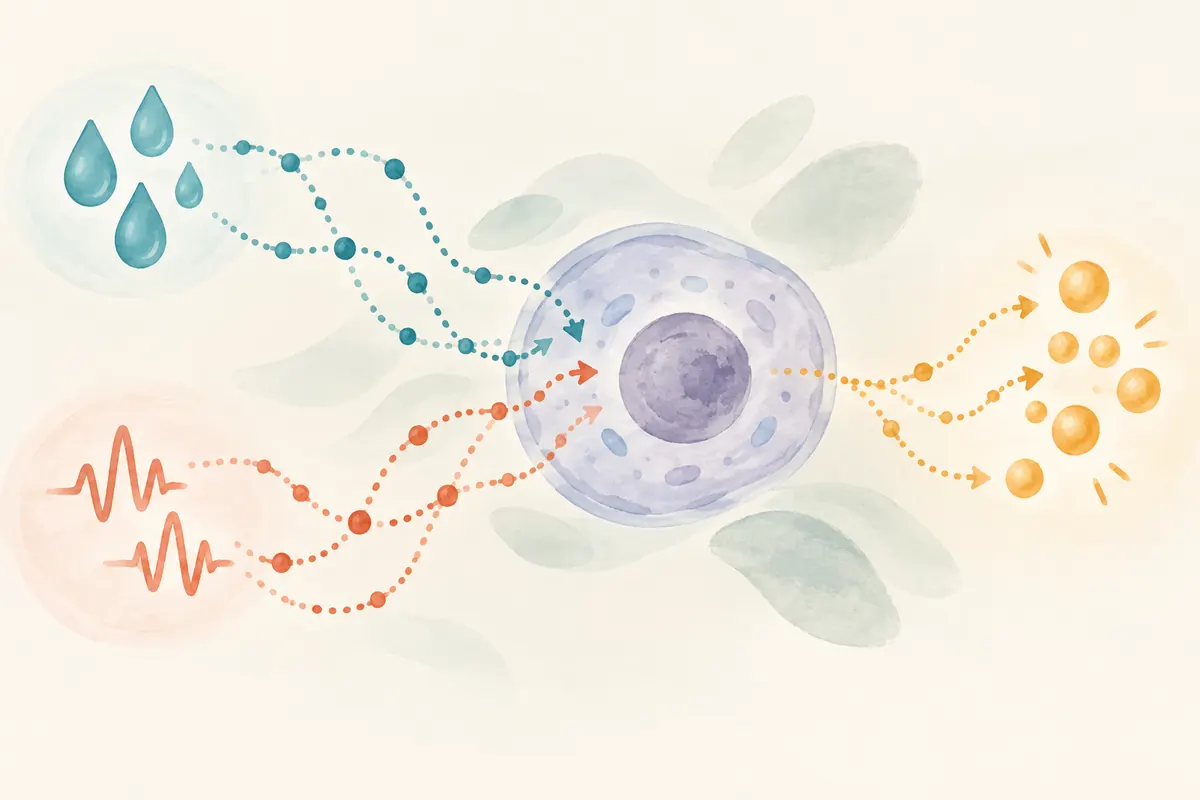
Polycystic ovary syndrome (PCOS) is heterogeneous: reproductive and metabolic features can occur together, but not in one uniform pattern. Insulin resistance is observed in many patients, yet it does not explain every feature through a single cause or one-way pathway. In an NIDDK interview, endocrinologist Andrea Dunaif explains that insulin may stimulate ovarian androgen production together with luteinizing hormone (LH), while noting that how metabolic abnormalities lead to diabetes remains under study. This mechanism is not an individual diagnosis or glucose-risk prediction.
Several biological features can coexist
PCOS can involve irregular or infrequent ovulation, androgen excess, and metabolic features such as insulin resistance. Their combination and degree vary across people. A menstrual pattern alone cannot establish how insulin is acting, and appearance alone cannot establish androgen status. This article is not a symptom checklist for self-diagnosis; it explains how different physiological systems may be related.
When tissues respond less strongly to insulin, more insulin may be secreted to help regulate glucose. Dunaif’s NIDDK interview describes insulin as a reproductive hormone that can directly stimulate ovarian androgen production in synergy with LH. Insulin signaling may also affect ovulatory control in the brain, although part of that explanation comes from animal models. A plausible biological pathway does not establish the cause of every person’s anovulation.
What a family study observed—and its limits
Legro and colleagues compared women with PCOS, their sisters, and controls, examining insulin-resistance markers alongside reproductive phenotypes. In the sister group, fasting insulin and glucose-to-insulin measures were associated with hyperandrogenemia rather than menstrual irregularity itself. The authors interpreted this as a clue that metabolic and androgen-related traits can cluster within PCOS families. A comparison at one point in time cannot establish that insulin resistance came first and caused PCOS.
Participants came from selected families and were predominantly non-Hispanic White. Statistical adjustment for age and body mass index cannot remove every possible confounder in an observational study. The authors discuss further research into menstrual cyclicity, insulin sensitivity or secretion, obesity, and other factors. A group-average association should not be converted into an individual test result or probability of future disease. Its magnitude may also differ with sample composition and measurement methods, so later research and current clinical context must be considered separately.
Androgen and metabolic markers are not interchangeable
Insulin can be related to sex hormone-binding globulin (SHBG), which can affect the bioavailability of circulating androgens. But hyperandrogenemia or ovulatory changes do not mean that a person’s insulin concentration must be at a particular level. Signals in different tissues, hormone concentrations and secretion, and ovarian responsiveness all contribute. One laboratory measure or symptom cannot represent the entire relationship.
NIDDK’s interview describes the relationship between PCOS and type 2 diabetes as continuing research. Obesity can increase metabolic risk, but Dunaif notes that risk is also observed in patients with PCOS who are not obese. This is a reason not to infer metabolic status from body size alone, not a personal screening schedule or treatment recommendation. Clinical assessment depends on symptoms, history, testing, and consideration of other possible causes.
An expert perspective separates mechanism from diagnosis
The expert perspective is to avoid the simplified claim that insulin resistance causes PCOS. Legro’s study reports associations among selected family phenotypes; Dunaif’s interview explains a possible physiological route involving insulin, LH, and ovarian androgen production while identifying open research questions. One is an observation in a defined population and the other is specialist interpretation. Together they inform the biology but do not complete a causal account or replace diagnosis.
Decisions about glucose or reproductive health depend on age, pregnancy status, other conditions, medicines, family history, and the clinical context of tests. This article therefore gives no medication regimen, diagnostic threshold, or lifestyle prescription. The supported conclusion is narrower: reproductive and metabolic features can interact, while their strength and clinical meaning differ across people and study designs.