Parkinson Disease: Dopamine Loss and Alpha-Synuclein
How substantia nigra neuron loss, dopamine-circuit changes, and alpha-synuclein pathology help explain Parkinson disease—and where the model has limits.
Publication & corrections: infostoa · Editorial standards
Individual author and specialist reviewer information is not provided for this article.
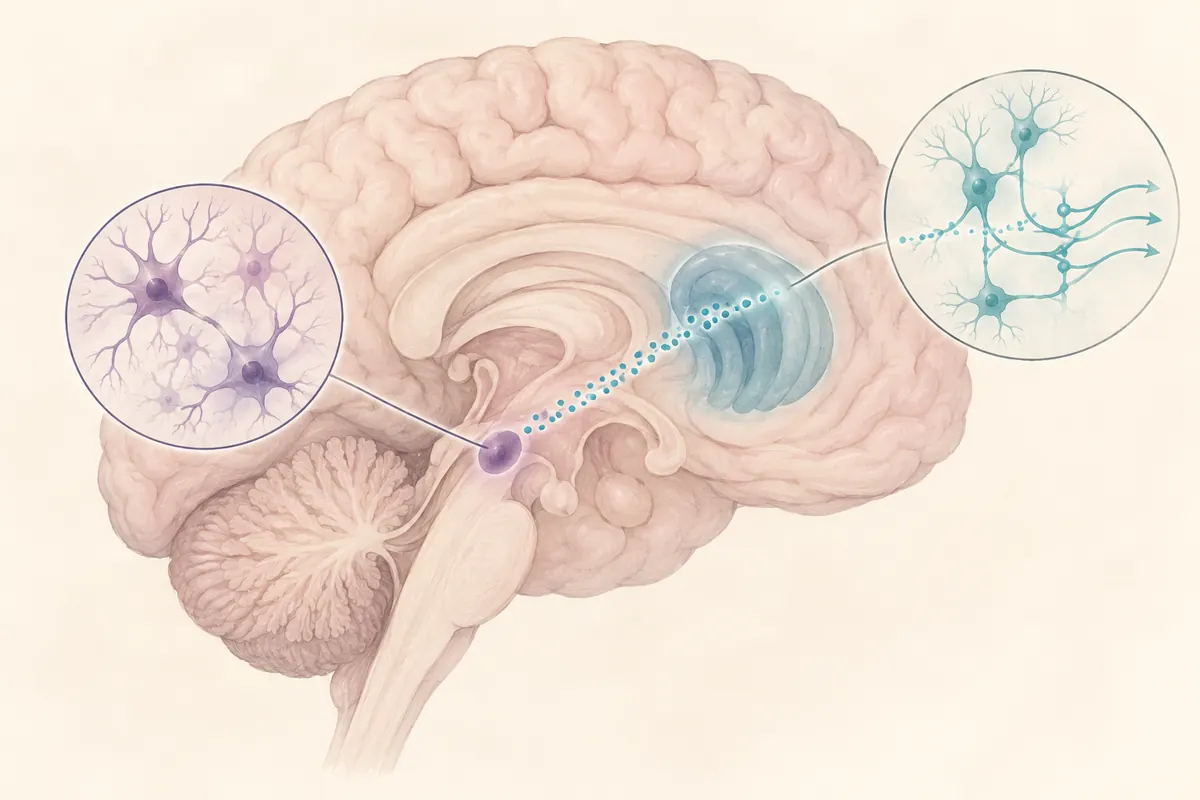
From the substantia nigra to the striatum
The motor features associated with Parkinson disease are linked to progressive loss of dopamine-producing neurons in the substantia nigra and reduced dopamine signaling in the striatum, including the putamen. The substantia nigra communicates with basal-ganglia circuits that help initiate and scale movement. When dopamine input falls, circuit balance changes; slowness of movement, rigidity, and resting tremor can emerge. This is a useful biological model, not a complete explanation of every symptom in every person.
Presentation varies. Motor and nonmotor features may coexist in different combinations, and progression is not identical across people. Sleep, smell, mood, pain, and autonomic functions may also be affected. A symptom list should not be treated as a checklist that diagnoses an individual or reveals a precise stage.
Alpha-synuclein and Lewy pathology
In some affected neurons, alpha-synuclein aggregates into structures called Lewy bodies and Lewy neurites. The NINDS Parkinson’s Disease Biomarkers Program page describes disease-associated alpha-synuclein as a research feature in Parkinson disease and related parkinsonisms. The Merck Manual Professional explains substantia nigra neuron degeneration and dopamine loss. Their coexistence helps researchers characterize the disease, but it does not prove that one observed aggregate alone caused every symptom or that the sequence of events is fully settled.
Alpha-synuclein is also a protein found in normal neurons. The presence of the protein is not the same as evidence of disease-associated aggregation. Nor does a discussion of Lewy pathology mean that a routine blood test can independently confirm Parkinson disease. Tissue pathology, circuit physiology, and clinical diagnosis answer different questions.
What dopamine loss means for movement
Bradykinesia is more than a subjective sense of moving slowly. It can involve difficulty initiating movement, reduced amplitude during repeated actions, and progressive shrinking of a repeated motion. Rigidity and resting tremor may occur, but not everyone has the same combination. The dopamine–basal-ganglia model explains why loss of a particular input can disrupt motor control; it does not imply that all symptoms arise from a single circuit or that the model predicts an individual’s course.
Nonmotor problems such as constipation, reduced sense of smell, sleep changes, pain, or mood symptoms can also occur. Each has many possible causes outside Parkinson disease. They are relevant to the broader clinical picture, but none should be converted into a stand-alone self-diagnosis rule. The mechanism is best understood as one part of a heterogeneous neurological condition.
Clinical diagnosis is not a mechanism diagram
Clinicians assess the history and pattern of movement findings, perform a neurological examination, and consider medicines and other explanations. Tests or imaging may help evaluate alternatives in selected situations, but no single laboratory result answers every diagnostic question. A diagram of substantia nigra neurons or dopamine signaling describes disease biology; it cannot determine whether a reader has Parkinson disease.
New or worsening movement symptoms deserve assessment by a qualified clinician. A person should not infer the diagnosis from tremor alone, and absence of one textbook feature does not rule it out. This article explains general mechanisms and is not personal diagnostic or treatment advice. Medication choices, doses, and procedures require individualized clinical care and are intentionally outside this discussion.
Expert perspective: what clinical sources establish
Dopamine-neuron loss and alpha-synuclein aggregation are important research findings, but researchers have not completely explained why disease processes begin in particular people or how aging, genetic susceptibility, and environmental exposures combine. Similar pathological features can also accompany different clinical patterns. It would therefore overstate the evidence to present one trigger or a single inevitable progression pathway for everyone.
The sources below serve different roles. The NINDS Parkinson’s Disease Biomarkers Program page presents research goals and hypotheses about alpha-synuclein biomarkers; it is not proof of a routine validated test. The Merck Manual Professional provides clinical context for neuroanatomy and dopamine circuits. Neither source turns population-level knowledge into a personal diagnosis, and mechanisms may be refined as research develops.
Sources
- Assessing skin biomarkers for preclinical diagnosis of PD and non-PD Parkinsonism — NINDS Parkinson’s Disease Biomarkers Program, NIH; principal investigators listed; page date not stated
- Parkinson Disease — Alex Rajput, MD; Eric Noyes, MD; peer reviewed by Michael C. Levin, MD; Merck Manual Professional Edition, review March 2026, updated June 2026