Biliary Cholesterol Supersaturation and Gallbladder Hypomotility in Cholelithiasis
How bile composition and incomplete gallbladder emptying relate to gallstones, and what current institutional sources leave uncertain.
Publication & corrections: infostoa · Editorial standards
Individual author and specialist reviewer information is not provided for this article.
Why bile composition matters
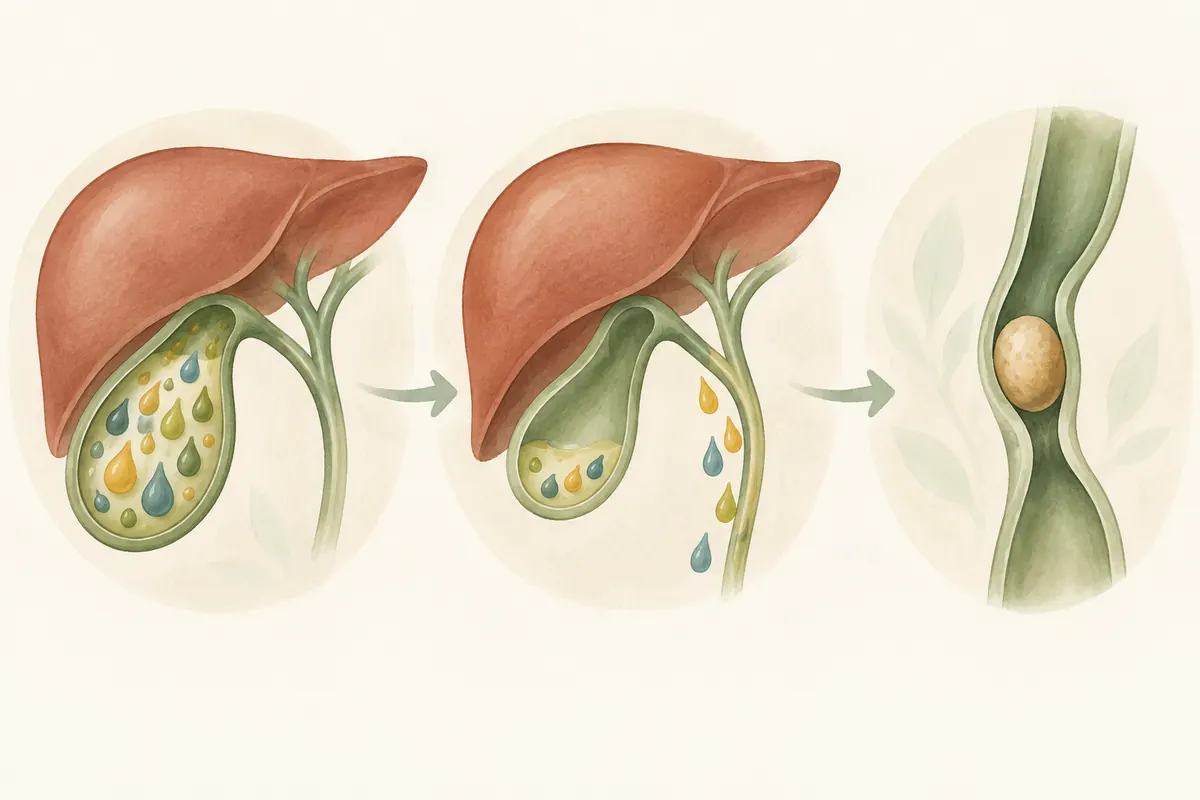
Bile made by the liver contains several components, including cholesterol, bile salts, and bilirubin. The National Institute of Diabetes and Digestive and Kidney Diseases (NIDDK) says stones may form when bile contains too much cholesterol or bilirubin, or too few bile salts. Cholesterol stones are common, but not every stone has the same composition; pigment stones involving bilirubin are a different category.
Cholesterol does not dissolve readily in water, while bile is a mixture whose components help keep lipids dispersed. Bile salts and phospholipids contribute to that environment. When the balance changes, cholesterol may be less effectively held in solution and can contribute to stone formation. This describes a broad chemical relationship, not proof that one enzyme or one laboratory number explains every person’s stones. The NIDDK patient page does not trace a universal cellular sequence from a particular enzyme through microscopic crystals to a mature stone, so this article does not present that level of detail as settled for all cases.
When the gallbladder does not empty fully
The gallbladder stores bile and releases it into the small intestine. NIDDK identifies incomplete or infrequent emptying as another circumstance in which gallstones may form. If bile remains in the gallbladder longer, its components can become more concentrated and crystals may have more opportunity to remain and grow. Cleveland Clinic’s clinician-reviewed educational page also describes sluggish gallbladder emptying and bile stasis as relevant to gallbladder disease.
This is not a claim that every person follows one sequence or has one cause. NIDDK explicitly says researchers do not fully understand why the changes in bile occur. Risk associations—such as certain weight changes, pregnancy, or other health conditions—do not diagnose an individual and do not mean a stone is inevitable. Someone may have risk factors and never develop symptomatic disease; a short risk-factor checklist cannot determine what happened in one person.
A stone may be present without symptoms
An attack after a heavy meal does not mean that the meal created the stone. NIDDK describes bile-composition changes and incomplete emptying as possible formation factors, while post-meal pain is part of the pattern of an attack associated with duct blockage. The conditions that contribute to formation and the circumstances that make an existing stone symptomatic are different questions.
NIDDK says most people with gallstones have no symptoms; silent stones that do not block ducts do not stop the gallbladder, liver, or pancreas from working. Its statement that silent stones do not need treatment should not be generalized to a person with pain or obstruction. Whether a stone is truly silent and whether bile flow is blocked are separate clinical questions.
NIDDK says an attack may cause upper-right abdominal pain, sometimes after a heavy meal in the evening or at night, and can last several hours. Further attacks may follow a first one, but meal timing, pain location, or duration cannot establish the cause. Fever or chills, vomiting, jaundice, tea-colored urine, or light-colored stools may signal infection or inflammation involving the gallbladder, liver, or pancreas and warrant prompt assessment. NIDDK also notes that these symptoms overlap with other conditions. This is not a self-diagnosis checklist or a guide to choosing tests or treatment.
Professional perspective: read the mechanism as a framework
Cleveland Clinic links stone composition, gallbladder emptying, and bile flow, while NIDDK describes possible formation factors and the limits of current understanding. Cholesterol supersaturation and reduced emptying are useful explanatory themes, not a proven pathway for every patient. Clinically, distinguish the presence of a stone, obstruction, and symptoms or complications: a stone that does not block a duct may be silent, while persistent blockage can lead to serious complications. Clinicians assess these questions with examination, history, and tests; this overview is not individual diagnosis or treatment advice.