Caring for Museum Ceramics and Glass: Handling, Display, and Cleaning
A material-specific guide to handling, environmental care, and cautious cleaning decisions based on Canadian Conservation Institute guidance.
Publication & corrections: infostoa · Editorial standards
Individual author and specialist reviewer information is not provided for this article.
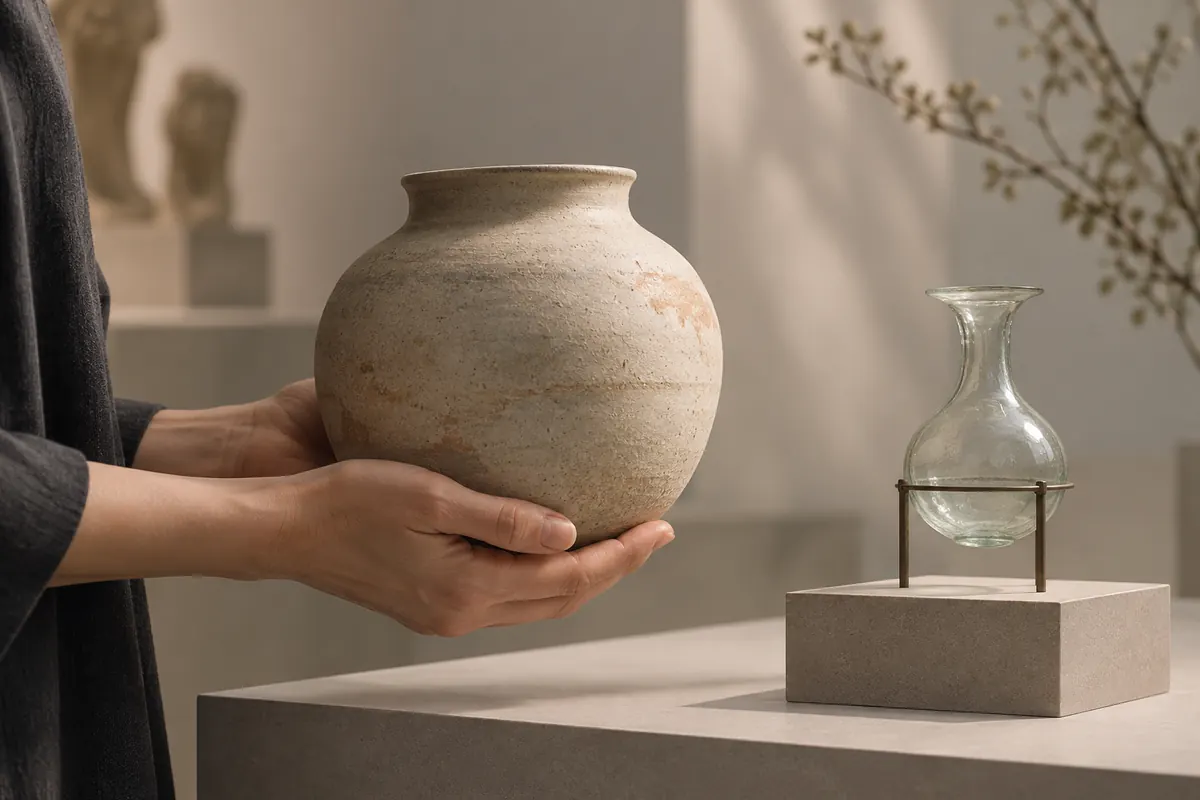
Ceramics and glass may look rigid and durable, yet a blow, a fall, or pressure concentrated at a narrow point can crack or break them. Handles, spouts, thin rims, joins, and old repairs may be weaker than the main body. The Canadian Conservation Institute (CCI) advises handlers not to lift ceramic or glass objects by handles or spouts, to use two hands, and to avoid touching applied labels or decoration. These are baseline ways to reduce avoidable stress, not a claim that every object has the same construction or condition. A vessel with a hidden repair or a flaking surface needs a different risk assessment from a sound, simple form.
1. Assess the object and the route before moving it
Before lifting, look for cracks, loose components, old fills or adhesives, unstable decoration, and lids that could shift. Some repairs are difficult to see and may have weakened over time. Clear the route and prepare the destination before the object leaves its support. Keep doors, shelves, and nearby objects from becoming obstacles, and use a stable tray or padded support when appropriate. For a large, awkward, or unstable object, agree on a team lift and who will guide the route. CCI’s general advice is to handle ceramics and glass with clean, dry hands and without gloves because gloves can reduce control. Sharp fragments, contamination, site safety rules, and an object’s surface may require other precautions; follow the collection’s handling plan.
2. Set display conditions for the material and its condition
CCI treats relative humidity, temperature, and light as factors in the care of ceramics and glass. A single number should not be treated as a universal target for every object. The composition of the body and glaze, surface decoration, previous damage, repair history, and the stability of the room all matter. Avoid direct sunlight and unnecessary environmental swings; keep the object away from vibration, traffic, and accidental contact. A mount or shelf should prevent rocking and tipping without putting concentrated pressure on a handle, rim, or repaired join. Objects should not be crowded where they can strike one another. Record the conditions and changes over time so a new crack, flake, or movement can be compared with the object's prior state rather than guessed at afterward.
3. Do not treat every mark as removable dirt
A stain may be part of a ceramic object's use history, a manufacturing trace, or evidence of a former repair. CCI specifically warns against using bleach or acid formulations to remove stains: the cleaning agent may dissolve or damage parts of the artifact as well as the mark. It recommends consulting a conservator when cleaning is important. Water, solvents, and household products can penetrate cracks, affect porous bodies, disturb overglaze decoration, or weaken old adhesives. A surface that appears dirty is not by itself proof that treatment is necessary. Photograph and describe the condition first; if the material, coating, or residue is uncertain, stop before applying a liquid, abrasive, or adhesive.
4. Expert perspective: separate handling from conservation treatment
A practical collection procedure is to inspect the object, support its body with both hands, keep the route clear, and return it to a stable support. If a fragment becomes detached, retain it with the object and report the event; do not discard it or make an improvised repair. Photograph the object from a consistent angle before and after a move and note existing cracks, flakes, and joins; this helps staff distinguish a new change from an old condition. Check for vibration or contact when a mount is changed or a case is opened. Do not decide to clean from color or appearance alone: identify the body, glaze, decoration, and repair history first. Such documentation does not replace diagnosis, but gives the responsible staff member evidence to assess condition and handling risk. The American Institute for Conservation explains that conservators receive extensive training in art history, science, studio art, and related subjects. That professional context supports referring treatment decisions to a trained conservator; it does not establish a treatment result for a particular artifact. The CCI note is general care guidance, not an object-specific diagnosis or authorization to restore. Decisions about cleaning, repair, or display should account for the artifact's materials, condition, significance, and the institution's conservation policy.