Caring for Museum Basketry: Handling, Dust, Light, and Humidity
Practical collection care for plant-fiber baskets, including support during movement, cumulative light exposure, dust, and humidity-related risks.
Publication & corrections: infostoa · Editorial standards
Individual author and specialist reviewer information is not provided for this article.
1. Do not lift a basket by its rim or handles
A basket can look sturdy even when its plant fibers have weakened through age, use, light, or changing moisture. The Canadian Conservation Institute (CCI) says never to lift a basket by its rim or handles; support its base with both hands. Areas that once carried weight may have become brittle and can fail under a small load. Before moving an object, look for compressed areas, loose strands, breaks, and vulnerable attached decoration. Use a padded tray or trolley when needed, keeping the basket supported as it moves. Do not put fingers through an opening to pull a basket into shape or tug a rim to test its strength. If the object is large or unstable, plan the move with another handler rather than improvising a grip.
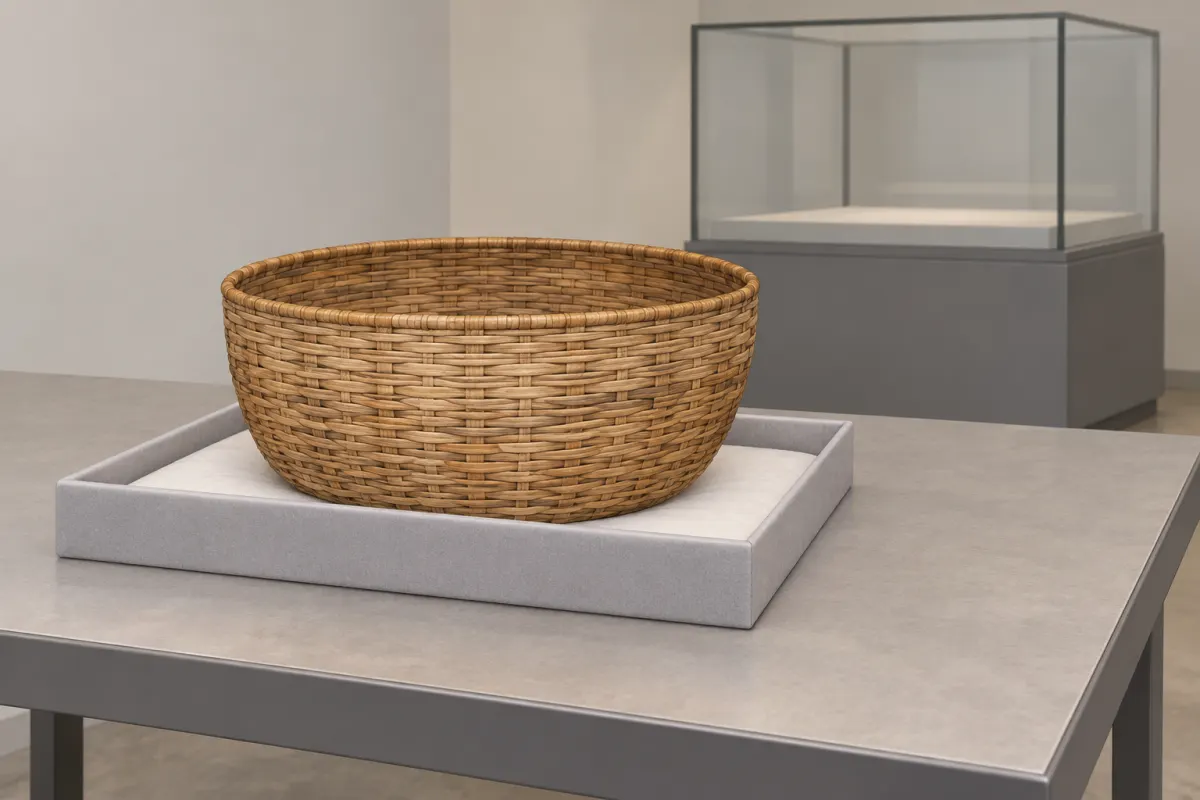
2. Dust affects more than appearance
CCI explains that dust can be abrasive and, depending on its components, can react with moisture, accelerate chemical deterioration, or provide nutrients for insects and mould. In storage, closed cabinets or dust covers over open shelves can reduce accumulation; a closed case can help during display. Dust also hides surface details and becomes harder to remove the longer it remains. A cover or enclosure must not press on the basket, snag fibers, or trap moisture. Inspect the storage area and case routinely, and address housekeeping before dust settles on the object. Direct brushing or vacuuming is not a default response: fragile fibers and attached material may be pulled loose, so the condition and safe method must be assessed first.
3. Light exposure is cumulative and irreversible
Dyes used in basketry can be especially light-sensitive. CCI warns that light damage accumulates and cannot be reversed. Keep baskets in darkness when they are not being viewed, switch off storage lights when possible, and keep display illumination as low as practical. CCI gives a recommendation of 50 lux and less than 75 µW/lm of ultraviolet radiation for dyed basketry; treat that as material-specific guidance from the cited note, not a universal legal limit or a guarantee against fading. Exposure duration matters alongside measured intensity. A planned rotation, recorded display dates, and a log of light conditions help limit exposure and make later changes easier to assess. Protecting an object between exhibitions is part of managing access, not a reason to disregard the value of display.
4. Read humidity figures as risks, not automatic set points
CCI notes that relative humidity above 65% can promote mould and below 40% can increase desiccation and brittleness. Basketry held tightly against a rigid material can also be damaged when plant fibers expand and contract as humidity changes. These observations do not mean that every basket should be moved or humidified whenever one reading crosses a number. Consider the object's construction, present condition, and the stability of its environment; record where and when measurements were taken. Note visible changes such as cracking, distortion, new mould, or loose elements. If mould or an abnormal environmental condition appears, do not spray a chemical on the object or rapidly dry it. Isolate the issue under institutional procedure and ask a conservator to assess next steps. CCI also recommends keeping the temperature below 25°C because heat can accelerate embrittlement; direct sun or strong spotlights can warm a display case and its contents.
5. Expert perspective: cleaning and treatment limits
CCI cautions that deposits that look like dirt may be evidence of earlier use. Seeds or berry stains, for example, can form part of an object's use history and should not simply be removed. Cleaning is irreversible, so the aim is to remove only material that is necessary to remove. A deposit can carry evidence about use and cultural context; its appearance alone does not establish that it is damaging dirt. Before brushing, vacuuming, or applying a liquid, determine what the material is and whether the fibers can withstand the proposed action. Photograph and document uncertain deposits, and stop if strands are brittle or decoration is loose. The American Institute for Conservation describes conservators as professionals with extensive training in art history, science, studio art, and related fields. Refer treatment questions to an appropriately trained conservator; the general CCI note does not diagnose or authorize treatment of an individual basket.