Moon Phases: Sunlight and Viewing Geometry
How sunlight on the lunar hemisphere and an observer’s angle create the phases, and what the average cycle does not imply.
Publication & corrections: infostoa · Editorial standards
Individual author and specialist reviewer information is not provided for this article.
Lunar phases change as the visible portion of the Moon’s sunlit half changes from Earth.
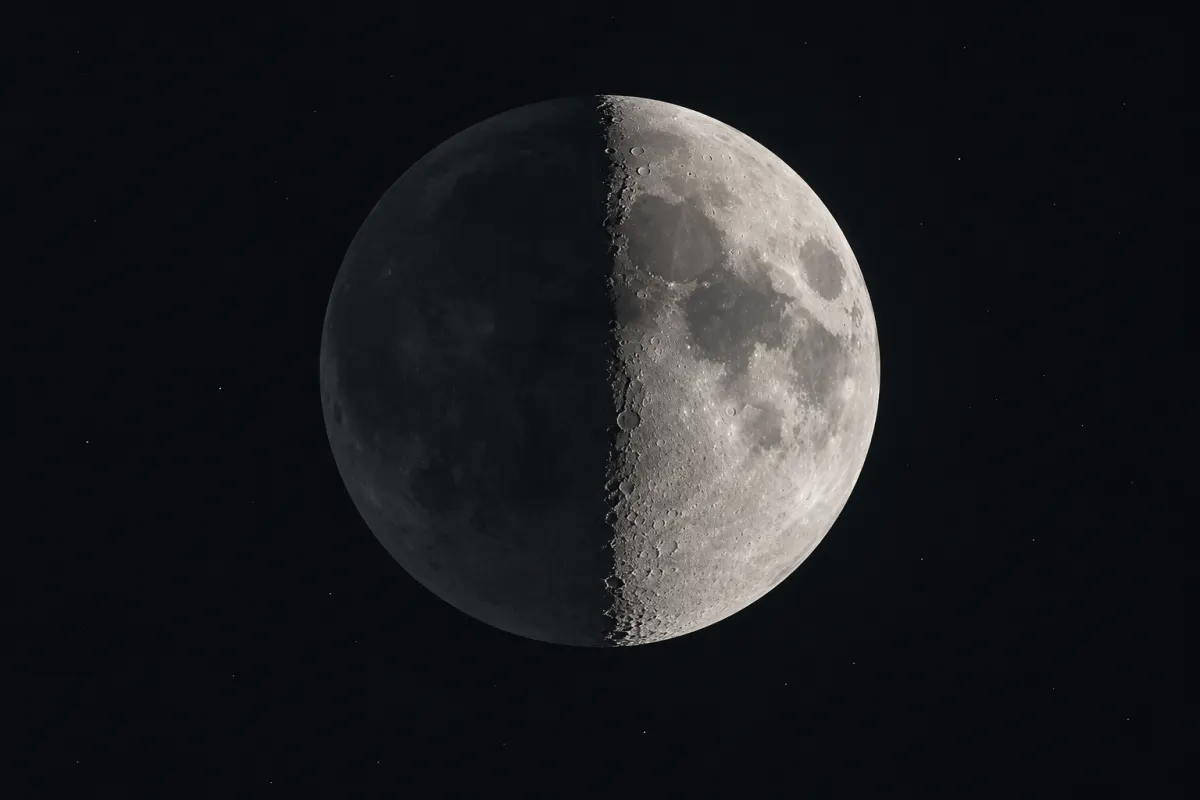
1. Half of the Moon is always sunlit
The Moon does not produce its own visible light; it reflects sunlight. NASA explains that the Sun illuminates one hemisphere of the Moon at a time. The phase we see does not result from the lit half growing and shrinking. As the Moon moves around Earth, our viewing angle changes and we see different fractions of that sunlit hemisphere.
2. Geometry from crescent to full Moon
Near new Moon, the sunlit side faces mostly away from Earth, so the visible face appears dark. As the Moon travels along its orbit, a growing portion of the illuminated side becomes visible: crescent, first quarter, and gibbous, then full Moon. The visible portion later decreases through the waning phases. This monthly sequence is not caused by Earth’s shadow covering the Moon. A lunar eclipse is a separate event that requires a particular alignment of the Sun, Earth, and Moon.
3. Phase and orientation are related
The U.S. Naval Observatory notes that a phase describes both how much of the Moon appears illuminated and the orientation of its bright part. The bright side can appear tilted in different directions depending on the observer’s hemisphere, time, and position in the sky. A fixed diagram is therefore a guide to the geometry, not an absolute left-right rule for every location. To interpret what is overhead, consider where the Sun is relative to the Moon and where the observer stands on Earth.
4. Expert perspective: U.S. Naval Observatory phase data
The U.S. Naval Observatory (USNO) describes phase as the fraction of the Moon’s sunlit hemisphere visible from Earth. The physically illuminated half does not grow from crescent to full Moon. USNO’s illumination percentage refers to the bright share of the apparent lunar disk, a different measure from the half of the lunar surface lit by the Sun. New and full Moon are representative ends of the cycle; at first and third quarter, about half of the visible disk is bright. Changes between named phases are continuous.
USNO notes that a phase and its illuminated fraction occur at the same astronomical instant regardless of the observer’s location on Earth. That does not mean the Moon is above every local horizon at that instant. It may be in the daytime sky or below the horizon, and the tilt of the bright portion can look different with the observer’s hemisphere and the Moon’s position in the sky.
5. A lunar month is an average cycle
A synodic month averages about 29.5 days, so astronomical phase times differ from local moonrise and moonset. The U.S. Naval Observatory says a month with two full Moons, sometimes called a ‘blue Moon,’ occurs on average about once every 2.7 years, not on a fixed calendar schedule.
The U.S. Naval Observatory notes that at new Moon the illuminated side faces away from Earth, so the Moon is generally not visible except during a solar eclipse. The Moon has not disappeared; its sunlit face is simply turned away from the observer.
6. Use phase tables with local observing times
NASA notes that a full Moon rises around sunset and sets around sunrise, while a new Moon is up during the day. To plan a local observation, combine USNO phase times and illumination percentages with a local almanac’s moonrise and moonset times. Record the date, time zone, and location so another observer can compare the geometry. Clouds, buildings, and the horizon affect practical visibility separately from the astronomical phase.
NASA notes that the Moon can continue to look full for a couple of days after the exact full-Moon instant. The calendar date of that instant therefore does not always match the nights when it appears full to the eye.
USNO calls the elapsed days since new Moon the Moon’s “age.” It is a count within a lunation, not the illuminated percentage or a measure of local visibility. The Moon’s apparent disk size also changes as its distance varies along an elliptical orbit; closest and farthest points do not always coincide with the same phases. Bright fraction and apparent size are separate observations.
The Moon can look larger or smaller at the same phase because its distance changes, so record image scale or field of view when comparing photographs.