How mantis shrimp eyes process polarized light
Polarization vision is different from simply seeing more colors. A primary neural-recording study and a specialist review show how mantis shrimp photoreceptors respond to linear and circular polarization—and what the evidence does not establish.
Publication & corrections: infostoa · Editorial standards
Individual author and specialist reviewer information is not provided for this article.
Mantis shrimp eyes respond not only to light intensity and color but also to polarization. Polarization describes how a light wave oscillates in particular directions. Experiments on mantis shrimp show how receptors detect that directional information and pass it into neural signals.
1. Polarization carries information distinct from color or intensity
Light is a wave. In linearly polarized light, its electric field oscillates along a preferred direction, often described by an e-vector angle. In circular polarization, the electric-field direction rotates as the wave travels; the rotation can be right-handed or left-handed. These properties are distinct from wavelength and brightness. Receptors that respond differently to the orientation of the wave can produce a contrast signal that an intensity-only detector would not provide.
2. Specialized receptors in a compound eye
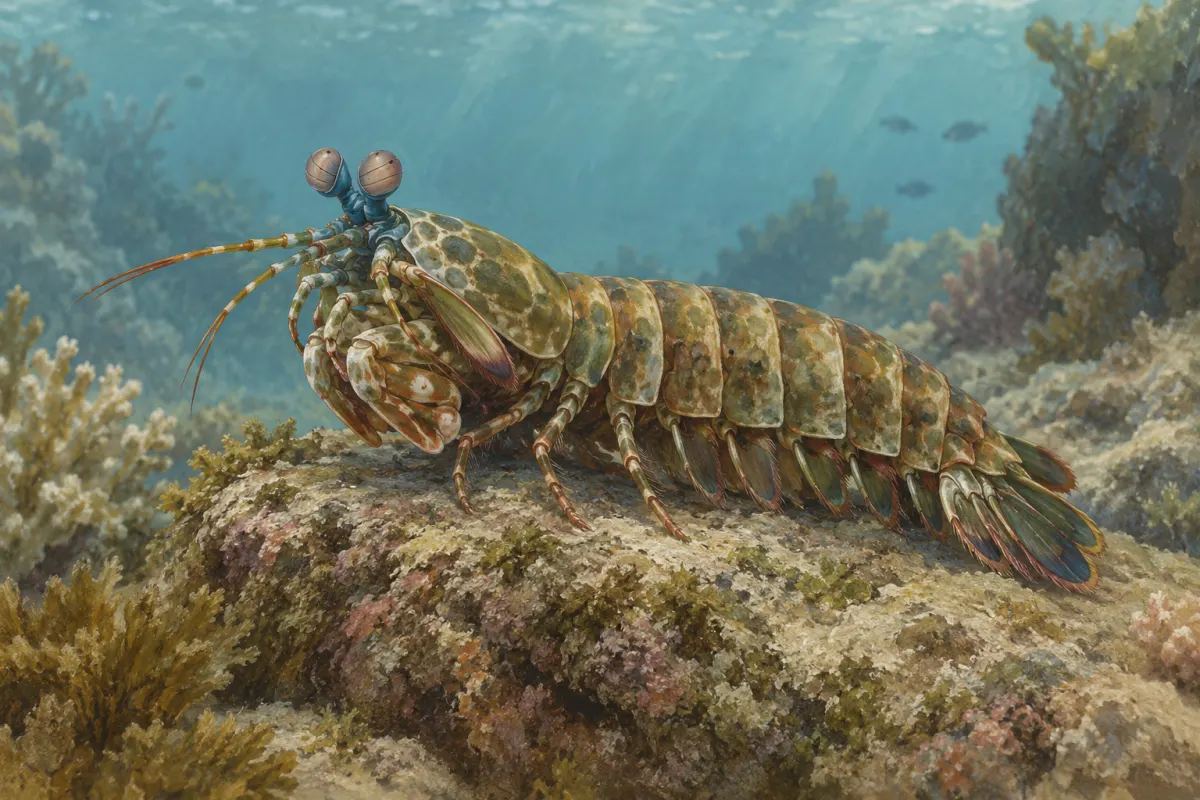
Stomatopods, the group that includes mantis shrimp, have compound eyes with several visual regions, including a central mid-band between two hemispheres. A specialist review describes 16 functional classes of retinal photoreceptors, with roles that include ultraviolet, spatial, color, and polarization vision. Absorbing pigments and optical filters can tune the wavelengths and polarization states to which particular receptors respond. Chiou and Wang’s primary study explains that a distal photoreceptor’s rhabdomere acts as a wave retarder, converting circularly polarized light into a linear signal that linearly sensitive receptors can detect. The count refers to functional receptor classes; it is not itself a measurement that mantis shrimp distinguish more colors than humans or see every color with greater precision.
3. Recording signals in one species
Chiou and Wang presented changing polarized-light stimuli to Haptosquilla pulchella while recording electrical responses from photoreceptors and neurons in the lamina, an early visual-processing layer. Receptors sensitive to circular polarization also responded differently as the e-vector angle of linear polarization changed. Most produced a roughly sinusoidal response as that angle varied. The experiment shows that polarization orientation affects receptor signals; it does not reduce the observation to a simple change in brightness.
4. Neural responses were not identical to receptor responses
Some lamina neurons doubled their response frequency when the angle of linear polarization changed. The authors say these responses resembled a rectified sum of signals from two channels of linear-polarization-sensitive receptors. They also observed a neuron type that remained depolarized for the tested stimuli except right-handed circularly polarized light. These findings support the possibility that linear and circular polarization signals are processed differently at or before the first optic lobe. The experiment did not test which behavior a particular signal causes in the animal’s natural habitat.
5. Specialist perspective: receptor classes are not a vision score
Cronin and colleagues’ specialist review describes 16 functional classes of stomatopod retinal photoreceptors, serving ultraviolet, spatial, color, and polarization functions. Pigments such as carotenoproteins can be packed into vesicles that act as serial filters within a photoreceptor or as lateral filters in overlying optical structures. The review says these filtering mechanisms extend the detectable spectrum farther into the ultraviolet and red. A single retina can pair different pigments with particular receptors, and filtering arrangements vary across and within species with taxonomy and ecology. Some ultraviolet receptors also act as birefringent filters that enable circular-polarization vision. The count of 16 classes therefore does not show that mantis shrimp experience more colors than people or that every species shares one polarization sensitivity.
6. What the experiments do and do not show
The electrophysiology study presented controlled linear and circular polarization stimuli to one species and compared responses in photoreceptors and the lamina. It therefore does not directly answer how mantis shrimp use polarization while finding prey or communicating on a reef. The specialist review compares visual receptors and filters across the group, but it does not claim that the behavioral role of every species-specific arrangement is known. The receptor structures, measured neural responses, and ecological functions are connected questions that require different kinds of evidence.