Brewing Longjing: How Water Temperature Meets Leaf Grade
A Longjing study compared two grades steeped for four minutes at 70–100°C. Its sensory results are useful within those conditions, not a universal recipe; tea type, leaf-to-water ratio, time, and water also matter.
Publication & corrections: infostoa · Editorial standards
Individual author and specialist reviewer information is not provided for this article.
Water temperature can change the bitterness and savory character of Longjing, but a single study temperature is not a universal setting for every tea. Researchers steeped premium and standard Longjing at 70, 80, 90, and 100°C for four minutes. Under the lower-temperature condition, both grades showed higher umami-related scores and lower bitterness and astringency, while the grades differed in their sensitivity to temperature.
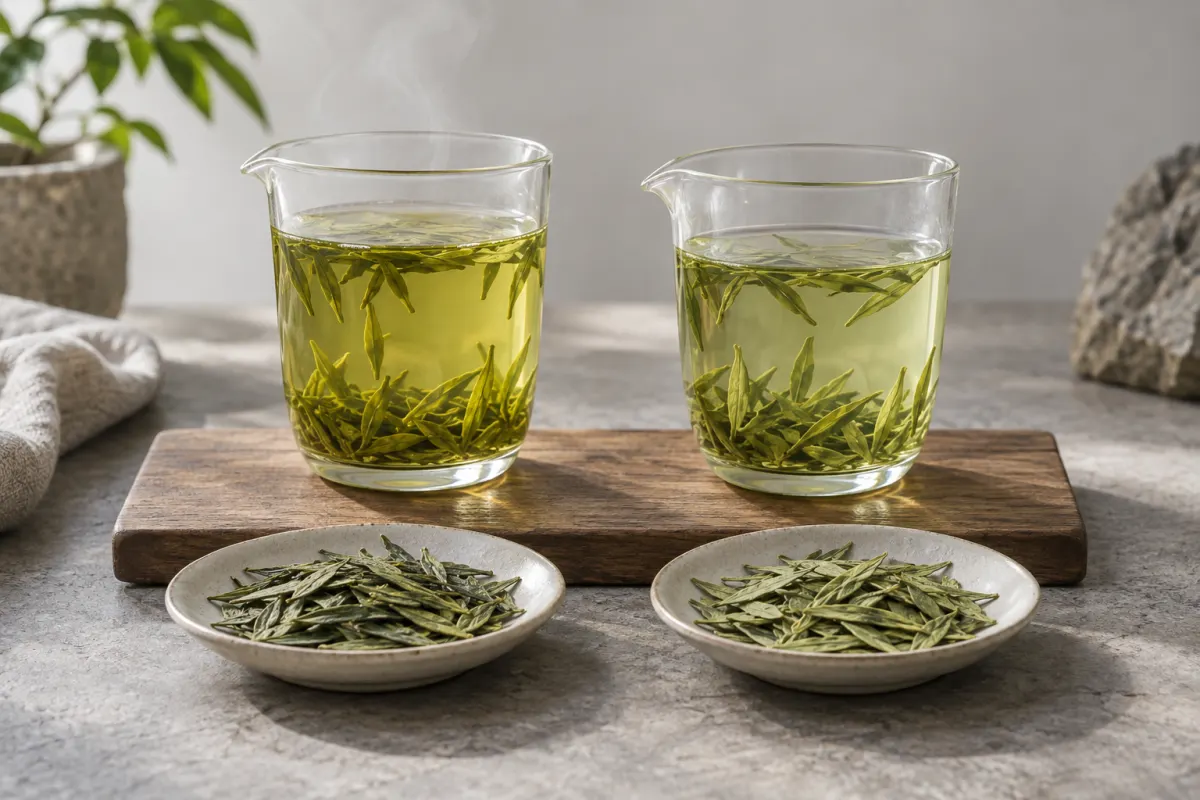
What the Longjing experiment tested
Deng and colleagues obtained premium and standard Longjing samples from the Tea Research Institute of the Chinese Academy of Agricultural Sciences. They steeped each sample for four minutes at four water temperatures, removed the leaves, and brought the infusions to 45°C for sensory evaluation and chemical analysis. Nine trained panelists, each with at least three months of weekly flavor training, rated aroma and taste on a 0–10 scale.
This design let the researchers examine color, sensory traits, and non-volatile compounds across temperature conditions. It was not a survey of all commercial Longjing products or a trial covering many origins, harvests, storage histories, or water types. That boundary matters when applying its findings at home.
The sensory pattern at lower temperature
In the panel’s assessment, both grades brewed at 70°C tended to receive higher umami or mellow-umami scores and lower bitterness and astringency scores than at the other tested temperatures. The researchers also found temperature-related changes in selected amino-acid profiles. Standard-grade tea appeared more sensitive to temperature than premium tea. They discuss leaf tenderness and grade as possible contributors to differences in extraction and taste.
This does not establish 70°C as the best temperature for every person or every Longjing. The test used specified tea samples, water, a four-minute steep, and tasting at 45°C. A home cup also depends on how the tea was stored, the amount of leaf, water characteristics, steep time, and personal preference.
Expert perspective: tea type, time, and water change the comparison
A separate expert review by Unno and colleagues discusses Japanese green teas, especially sencha and gyokuro. It describes infusion as depending on temperature alongside the leaf-to-water ratio, steep duration, and water hardness. The sencha data reviewed used different conditions for the first and later infusions, with substantial portions of theanine, caffeine, and arginine entering the first infusion under its particular protocol. The review also cites prior work in which hard water reduced catechin and caffeine extraction. Gyokuro uses a distinct practice with cooler water and a higher leaf-to-water ratio than sencha.
That review concerns Japanese teas, not Longjing tested in the Chinese study. It cannot justify transferring a gyokuro temperature or ratio to Longjing. Its relevant expert perspective is narrower: do not interpret temperature in isolation; record tea type, leaf amount, time, and water as well.
A practical side-by-side tasting
Use the same Longjing leaves and water, keep the leaf amount and steep time constant, and compare small infusions made at different temperatures. To explore the study’s conditions, you could compare 70°C with a higher temperature while holding the steep to four minutes. This is an at-home comparison inspired by the research, not an exact replication or a universal recommendation. A kettle’s set temperature may differ from the temperature the leaves experience as the water cools.
Taste the cups side by side and record color, aroma, umami, bitterness, and astringency in the same order. If you prefer a softer and less astringent cup, a lower temperature is one condition to test. If aroma or strength seems too faint, adjust another variable separately. Changing temperature and time together makes it harder to tell what caused the difference.
Limits on applying the findings
The Longjing experiment compared two grades, four temperatures, and one four-minute steep protocol. Its trained panel had nine members, and the samples were tasted at 45°C. Those results cannot determine an optimal temperature for every Longjing from different origins, harvests, processing, or storage, nor do they represent the preference of the whole population. Associations between sensory scores and compounds do not establish health effects.
Use the reported conditions as a starting point, then record your own tea, water, leaf amount, and steep duration. If the product or water changes, test again rather than assuming the earlier result transfers. This keeps the study’s measured findings separate from individual preference while making temperature adjustments useful in practice.