How Portal Hypertension and Circulatory Changes Contribute to Ascites in Cirrhosis
A source-grounded explanation of liver resistance, splanchnic vasodilation, effective arterial underfilling, and renal sodium retention, with limits of the model.
Publication & corrections: infostoa · Editorial standards
Individual author and specialist reviewer information is not provided for this article.
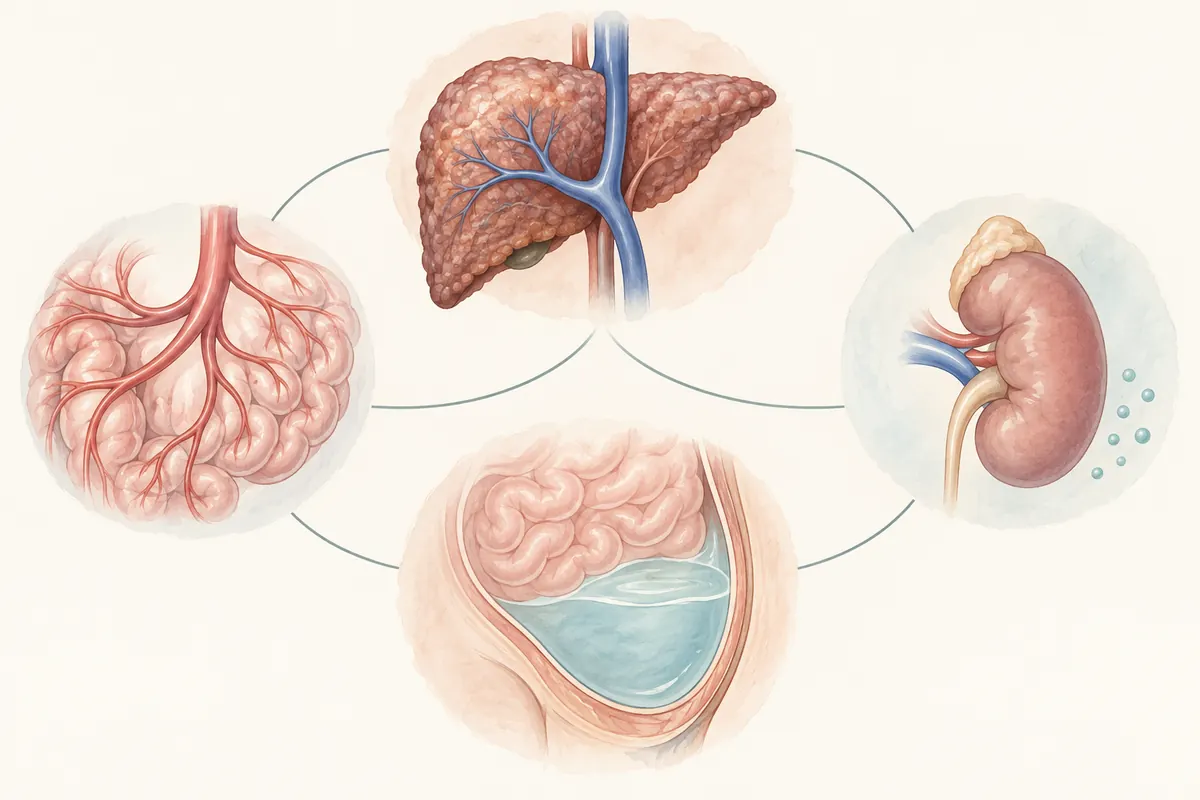
How scarring raises resistance to portal blood flow
Cirrhosis is a state in which chronic liver injury has left accumulated scar tissue and structural distortion. These changes can narrow or disrupt pathways through the liver and increase resistance to blood arriving from the portal vein. As portal pressure rises, blood returning from abdominal organs has more difficulty passing through the liver, setting up portal hypertension and related circulatory changes. The cause and extent of scarring vary, so cirrhosis does not follow one identical course in every person.
Portal hypertension is an important part of the setting for ascites, but fluid does not appear through a single “high pressure makes water leak” step. Resistance within the liver, blood-flow regulation in abdominal vessels, kidney handling of sodium, and the wider circulation interact.
Higher pressure in the portal/sinusoidal circulation and lower effective arterial filling are not contradictory: sinusoids are small vascular channels within the liver, while arterial filling describes a different part of the circulation. The AASLD guidance links increased intrahepatic resistance and sinusoidal pressure with splanchnic vasodilation and arterial underfilling, and also discusses intestinal permeability as a contributor. These pathways can converge on ascites, but their relative contribution may vary with liver injury and coexisting conditions; the guidance does not make one sequence universal.
Splanchnic vasodilation and effective arterial underfilling
The 2021 AASLD practice guidance connects ascites pathogenesis with portal hypertension and splanchnic vasodilation. When vessels supplying abdominal organs dilate, more blood can remain in the splanchnic circulation. Even when total body blood volume is not simply low, the arterial circulation may be sensed as inadequately filled. This is called effective arterial underfilling: it describes the circulation perceived by the body, not a direct measurement that total blood volume is low.
The setting is multifactorial. Intrahepatic resistance and raised venous pressure coexist with changes in splanchnic vascular tone and endothelial, inflammatory, and flow-regulating signals. The guidance presents a clinically useful model; it does not establish that one signal alone accounts for every person’s ascites.
Kidney responses retain sodium and water
When the body senses inadequate arterial filling, it can activate several vasoconstrictor and antidiuretic responses that help defend blood pressure and organ perfusion. These responses can reduce renal sodium excretion, retaining sodium and accompanying water. The guidance describes this renal retention alongside pressure changes associated with portal hypertension as part of ascites formation.
Ascites is therefore better understood as the result of interacting processes—intrahepatic resistance, splanchnic vasodilation, effective arterial underfilling, and renal sodium retention—than as the direct consequence of portal pressure alone. Changes in intestinal permeability and other clinical factors may also matter. This mechanism overview cannot determine the cause of an individual’s abdominal swelling.
These steps influence one another, but their relative contribution can differ with the cause and extent of liver injury and with other conditions. The sequence is therefore a useful connected model, not a claim that every patient follows one inevitable linear path or that one mechanism dominates in every case. It helps explain why portal pressure, vascular regulation, and renal retention are discussed together, while leaving room for clinical context and other causes.
Do not assume every case of ascites is cirrhosis
NIDDK provides a general patient-education overview of cirrhosis, its causes, and complications, but ascites is not unique to cirrhosis. The AASLD guidance also discusses other causes, including heart disease, malignancy, and infection. New abdominal swelling or rapidly worsening symptoms cannot be diagnosed from this mechanism summary; a clinician evaluates the history, examination, and appropriate tests.
The AASLD document is a 2021 specialist-society practice guidance based on literature review and expert-panel consensus. It notes limits in randomized-trial evidence for some clinical questions. The NIDDK page is general education. Neither source replaces an individual assessment or treatment plan; this article explains only the broad physiological links.
Sources
- NIDDK, “Cirrhosis” — U.S. National Institute of Diabetes and Digestive and Kidney Diseases patient education on definition, causes, and complications; reviewed June 2023.
- Biggins et al., “Diagnosis, Evaluation, and Management of Ascites, Spontaneous Bacterial Peritonitis and Hepatorenal Syndrome: 2021 Practice Guidance by the American Association for the Study of Liver Diseases” — AASLD practice guidance published in 2021 (Hepatology 74(2), 1014–1048; DOI 10.1002/hep.31884). It reflects expert-panel literature review and consensus and should not be confused with a formal systematic guideline using graded evidence.