Linux io_uring: Shared Rings, Batching, and SQPOLL
Linux io_uring uses shared submission and completion rings to batch I/O work, with optional SQPOLL to reduce submission-call overhead. Asynchronous behavior and performance depend on the kernel, operation, and workload.
Publication & corrections: infostoa · Editorial standards
Individual author and specialist reviewer information is not provided for this article.
1. What io_uring is designed to do
io_uring is a Linux interface for submitting asynchronous I/O work and receiving completion results. An application describes an operation, such as a read or write, in a Submission Queue Entry (SQE); the kernel processes it and records a result in a Completion Queue Entry (CQE). This provides a path for handling batches of operations, but it does not guarantee that every filesystem, device, or operation completes asynchronously or runs faster.
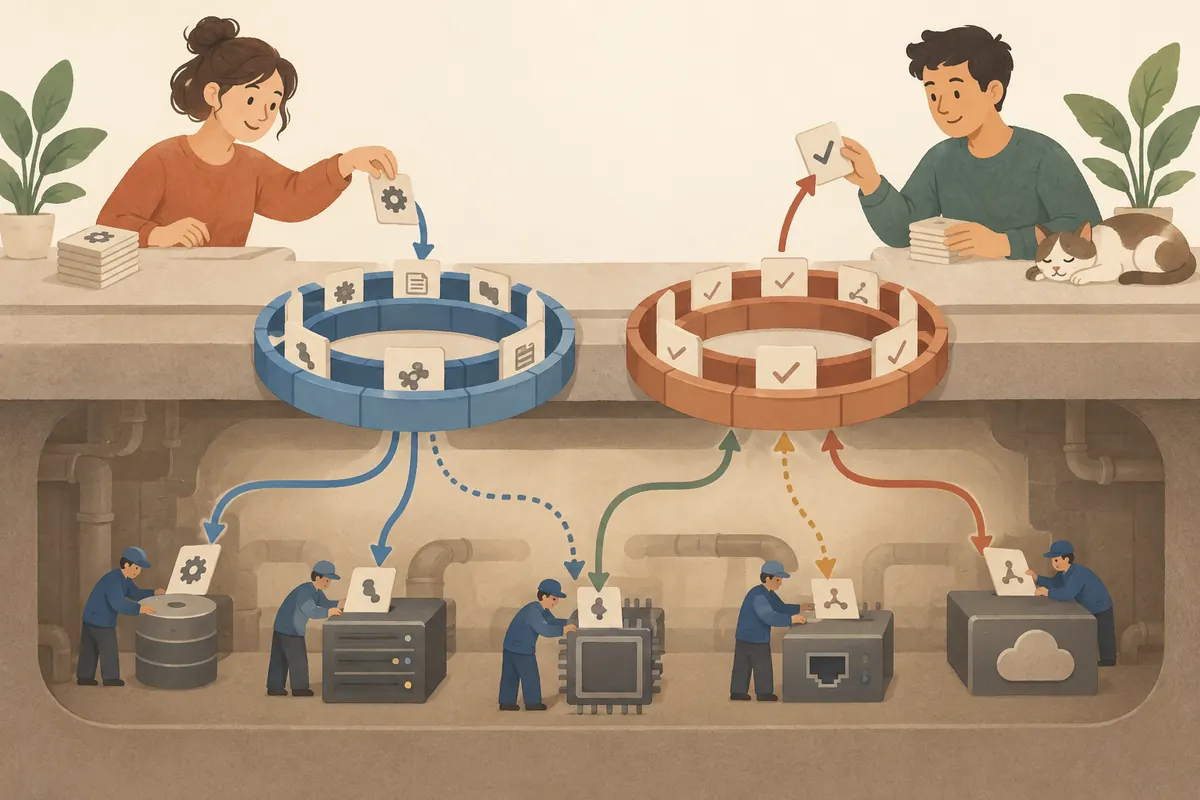
2. Shared submission and completion rings
During setup, io_uring creates submission (SQ) and completion (CQ) rings and related memory structures. User space and the kernel exchange work and completion state through these rings. The application fills SQEs and asks the kernel to process submissions, then reads results from CQEs. The ordinary submission and wait path involves io_uring_enter(). Batching submissions or waits can reduce call overhead, but the benefit depends on the implementation and workload and should be measured.
3. SQPOLL and registered resources
With IORING_SETUP_SQPOLL, a kernel polling thread can watch the submission ring. When work appears, that thread can process it; in suitable conditions, an application may avoid calling io_uring_enter() for every submission. Polling has costs tied to the thread, kernel settings, and workload, so it does not mean system calls disappear or CPU use always falls. Registering fixed files or buffers can also change repeated-operation costs, while affecting resource lifetime and residency.
4. Practitioner perspective: what to validate before adoption
Supported operations and behavior vary with kernel version, file or socket type, flags, and setup. The man-pages and LWN explain the shared-ring model and submission path; they do not certify performance gains or security suitability for a particular server. Compare io_uring with the existing synchronous or asynchronous path on the actual kernel and device, measuring latency, throughput, and CPU use. In multi-user environments, review the exposed operations and kernel attack surface and apply appropriate access controls.
5. Managing batches and completions
An application repeatedly prepares SQEs, submits work to the kernel, and consumes CQEs from the completion ring. A completion result is not merely a success flag: it can report a byte count or an error, so each operation needs explicit result handling, including partial reads or writes where the calling interface permits them. Applications also need to keep track of which request each completion belongs to and release buffers or registered resources only when the corresponding operation is finished. Otherwise, queue capacity and resource lifetime can become the bottleneck that the batching was meant to address.
A useful adoption test starts with a representative workload and compares the existing I/O path with io_uring on the same kernel and storage. Change one factor at a time: batch size, wait strategy, registered resources, or SQPOLL. Record throughput alongside median and tail latency, CPU consumption, and memory held by the process. Repeat under realistic concurrency and failure conditions rather than extrapolating from an empty-ring microbenchmark. The manual and LWN overview describe the interface model; they do not establish that a particular application benefits.
Before deployment, verify the exact operations and flags the application uses on its supported kernels, and test how it handles cancellation, shutdown, and failed submissions. A fallback path may be needed when the target environment lacks a required feature. These checks turn the ring interface into an explicit application contract and make performance claims reproducible instead of assuming that fewer visible calls necessarily mean less work.
Keep a count of submitted and completed requests during tests. At shutdown, account for outstanding work before releasing buffers or file references, and include error paths in the benchmark. This separates genuine savings from work that was skipped or left pending.