Connect Abstract Ideas to Concrete Examples in Teaching
A practical lesson design for connecting abstract concepts with concrete representations, with clear limits on what evidence can establish.
Publication & corrections: infostoa · Editorial standards
Individual author and specialist reviewer information is not provided for this article.
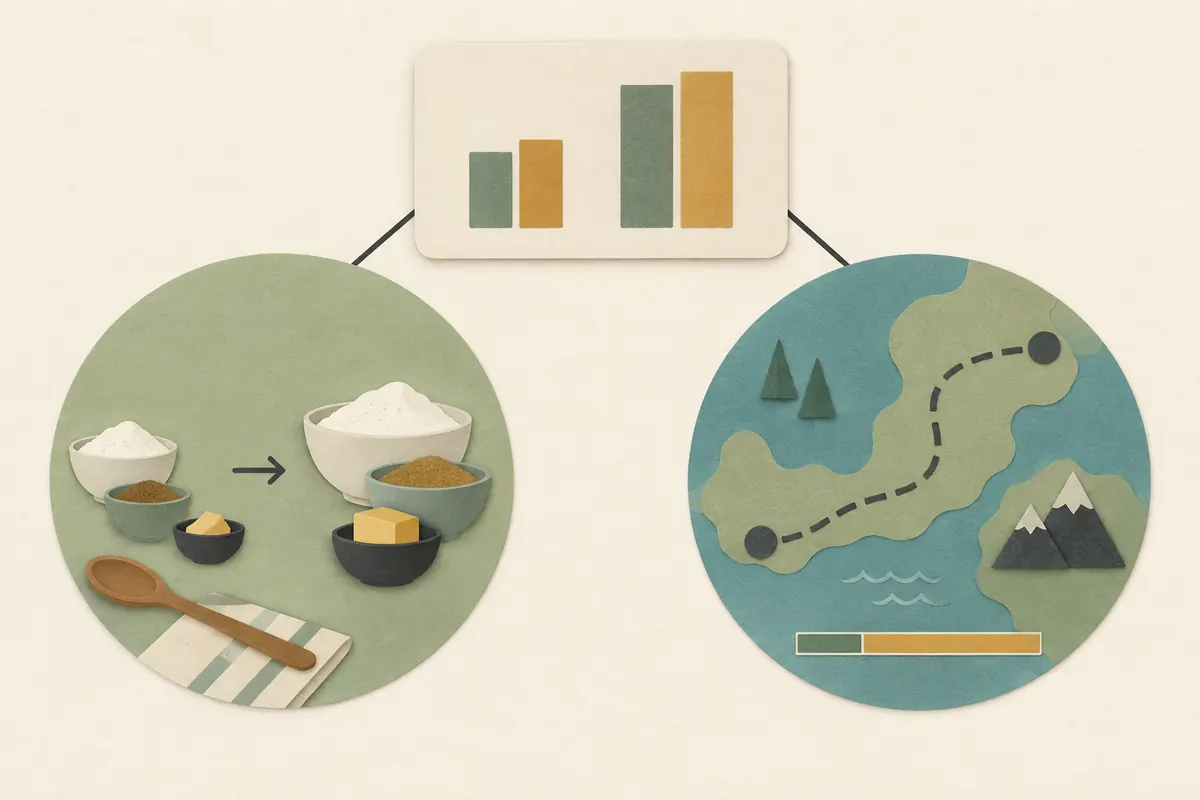
Explaining an abstract idea and showing one example does not establish that students can apply the idea in a new situation. The What Works Clearinghouse (WWC) practice guide released in 2007 recommends connecting and integrating abstract and concrete representations of the same concept, rating the recommendation as supported by moderate evidence. That is a basis for instructional design, not a formula that guarantees transfer for every learner or subject.
Make the central relationship visible
Start by stating the relationship students should understand in words, symbols, or a simple diagram. Then introduce a concrete case where that relationship appears and ask which features matter to the idea. The purpose is not to add decoration or examples for their own sake. Learners should be able to explain how the concrete situation corresponds to the abstract representation.
For example, a lesson on proportional relationships could pair a symbolic relationship between two quantities with different contexts such as scaling a recipe and reading a map scale. These are illustrative teaching examples, not activities claimed to have been tested together by WWC. A teacher can listen for whether students repeat words from the story or identify the shared mathematical relationship.
Compare examples without overstating the benefit
Repeating one example can leave learners unsure which details define a concept and which are incidental. Comparing cases with different surface features creates an opportunity to discuss what stays constant. Adding examples alone, however, does not prove that a learner will transfer the idea to an unfamiliar task. The support and practice needed can vary with the subject, prior knowledge, age, and task format.
The Learning Scientists’ article on interleaving explains that switching among ideas can help learners notice links and differences. It also warns that switching too often may leave too little time with each idea. This is a practical explanation from two learning-science specialists, not a systematic guide for every classroom. Rapidly mixing many contexts should not be treated as effective by definition.
Ask students to explain why cases belong together
A question such as “What relationship makes these two cases examples of the same idea?” can reveal whether a student has identified a shared structure. Next, offer a changed context and ask which principle applies and why. This helps distinguish reproducing a familiar worked example from using an idea under different surface conditions.
Rather than checking only whether the answer is right, listen for the reasoning and any important condition the student missed. Short retrieval prompts or explanation tasks can help identify which connection remains unclear. The Learning Scientists recommend making links while changing ideas and using retrieval practice or elaboration. That is implementation advice, not evidence that a fixed number or sequence works best for all learners.
Check application with a changed task
Begin with the learning goal and what students already know, then choose examples that can meaningfully be compared. If examples differ too little, the boundaries of the concept may stay hidden; if they differ too much, background details can overwhelm the relationship. Give students time to identify both similarities and differences instead of presenting many cases in quick succession.
Success on a familiar example immediately after instruction is not enough to establish transfer. After a delay or in a changed context, observe whether learners can select and explain the relevant idea. The two sources do not predict the result in a particular classroom. Responsible use means distinguishing WWC’s moderate-evidence rating from specialist implementation advice, then checking fit with the actual learners and task.
Sources: What Works Clearinghouse, Organizing Instruction and Study to Improve Student Learning, The Learning Scientists, Learn To Study Using…Interleaving