Check a Claim Before Sharing: Teach Students to Read Laterally
Learn how lateral reading uses outside sources to investigate a publisher and trace a claim to evidence, with practical classroom steps and limits.
Publication & corrections: infostoa · Editorial standards
Individual author and specialist reviewer information is not provided for this article.
Check who is behind a claim before reading the page in depth
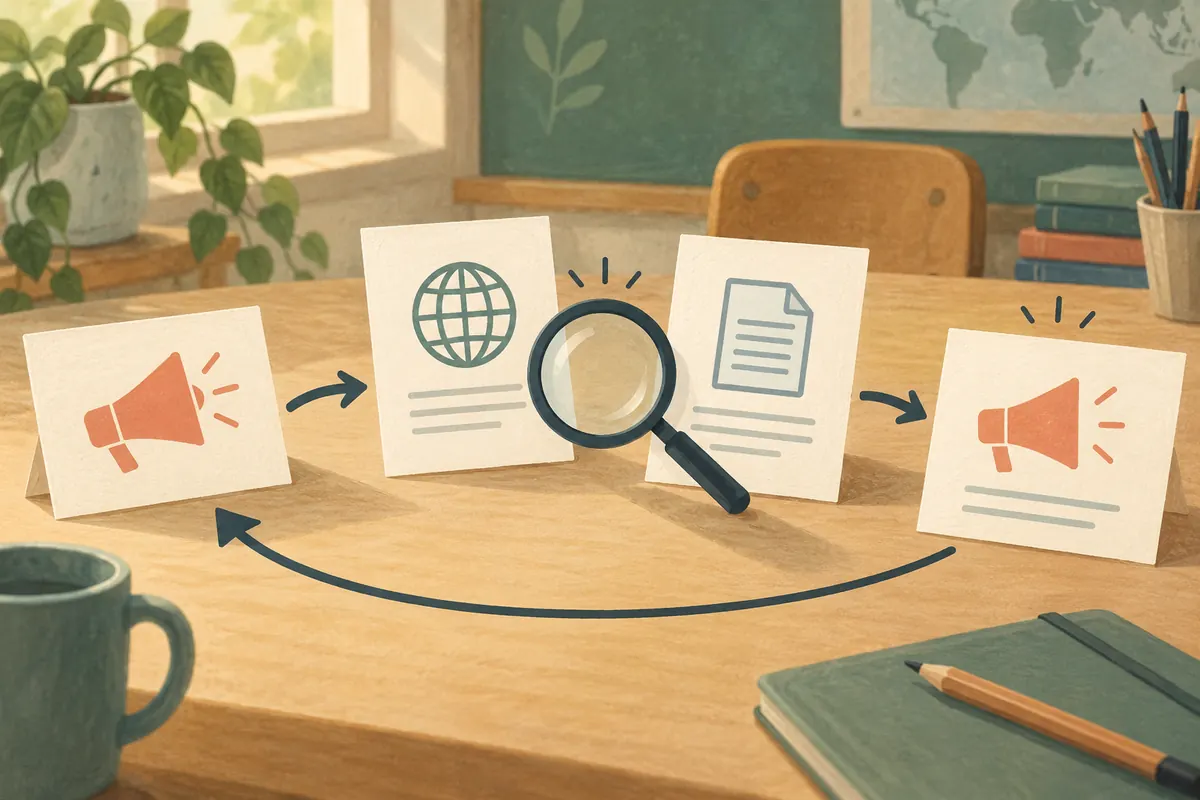
A search snippet and a polished website do not establish that a claim is accurate. If you follow only the page’s own About text and links, you may simply be repeating the account its publisher chose to give. “Lateral reading” is a digital information literacy strategy: leave a page open, use new tabs to investigate who created it and what independent sources say, and then return to the claim with context. The point is to find evidence about the source outside the source itself, rather than spending longer inside a page that is trying to establish its own credibility.
Stanford researchers Sam Wineburg and Sarah McGrew compared how professional fact checkers, historians, and college students evaluated online information. Their study describes professional fact checkers leaving a questionable page to investigate the source elsewhere on the web. That finding does not mean that every outside page is trustworthy. It shows why a publisher’s own description is not enough to judge its reliability. Read the study
Use new tabs to investigate the publisher and the evidence
Search for the organization, author, and report title separately. Ask what the organization does and how independent sources describe its work. Open the reporting, institutional pages, or research records themselves instead of relying on a search result’s first line or a knowledge panel. Check names, locations, domains, and author biographies: organizations can share similar names, and a page can imply an affiliation without establishing it.
Then trace the claim to its underlying evidence. If a post cites a study, look for the paper or report and check whether it supports the same conclusion, for which participants, and under what conditions. For a statistic, identify the denominator, time period, population, and comparison. Separate what the source observed from what the post infers. If you cannot locate the underlying material, mark the claim as unverified rather than treating the citation as proof.
A useful question is not simply “Can I find another page saying this?” Several sites may repeat the same press release or copy one another. Look for independent reporting or the original dataset, document, or study. When sources disagree, compare their evidence and dates instead of counting how many search results support each side.
Teach students to explain how they reached a judgment
A yes-or-no question such as “Is this page trustworthy?” reveals little about a student’s reasoning. Ask who created the page, what they searched in another tab, which independent source they found, and how that information bears on the original claim. Students should be able to revise an initial judgment when the outside evidence changes the picture; the objective is a reasoned assessment, not defending a first impression.
Stanford Civic Online Reasoning (COR) provides classroom resources for evaluating online information. Its curriculum index includes a “Teaching Lateral Reading” collection intended to help educators teach the strategy. A teacher can model a short investigation aloud: choose a search phrase, explain why a new tab is useful, and show which evidence changes or strengthens the assessment. Students can then evaluate another claim and explain the connection between their source and the claim. Assessing source choice and evidence links is more informative than grading the number of tabs opened. Explore the COR curriculum
Expert perspective: teach the principle behind fact checkers’ habits
Wineburg and McGrew’s comparison study reports that professional fact checkers used lateral reading to investigate digital sources. The educational lesson is not to make students memorize a professional’s click sequence. It is to help them understand why a source’s self-description needs independent context. COR’s teaching materials likewise present online evaluation as a learnable classroom activity, giving educators material they can adapt to the age group and lesson objective.
The study does not establish that the same procedure guarantees accurate judgments for every student or search environment. Search results can change or be personalized, and multiple domains may repeat one underlying source. Seeing the same sentence on three websites is not three independent confirmations. Check whether the sources are genuinely independent and, where possible, whether they lead back to evidence that can be examined directly.
A brief check before sharing
- Narrow the issue to one factual claim that can be checked.
- Search the author, organization, and key phrase in new tabs to find context outside the page.
- Open independent sources and, where available, the underlying document or data; compare dates, scope, and conditions.
- Record what is supported, what is interpretation, and what remains unverified.
If the evidence is incomplete, waiting to share or saying “I cannot determine this from the sources I checked” is a sound result. Lateral reading is not an automatic truth detector. It is a habit for asking better questions and finding evidence beyond the page making the claim.
Sources
- Sam Wineburg and Sarah McGrew, “Lateral Reading: Reading Less and Learning More When Evaluating Digital Information” — Stanford History Education Group working paper, September 2017; supports the participant groups, observed tasks, lateral-reading behaviors, and study limits.
- Civic Online Reasoning (COR), “Teaching Lateral Reading” — Digital Inquiry Group’s classroom collection describing teacher modeling, structured activities, and the contrast between lateral and vertical reading.