Plan your phone connection abroad before roaming charges start
Compare home-carrier roaming, a local SIM, and an eSIM against your destination, trip length, and expected use, while checking EU coverage limits and device privacy.
Publication & corrections: infostoa · Editorial standards
Individual author and specialist reviewer information is not provided for this article.
Check the price rules before your phone connects
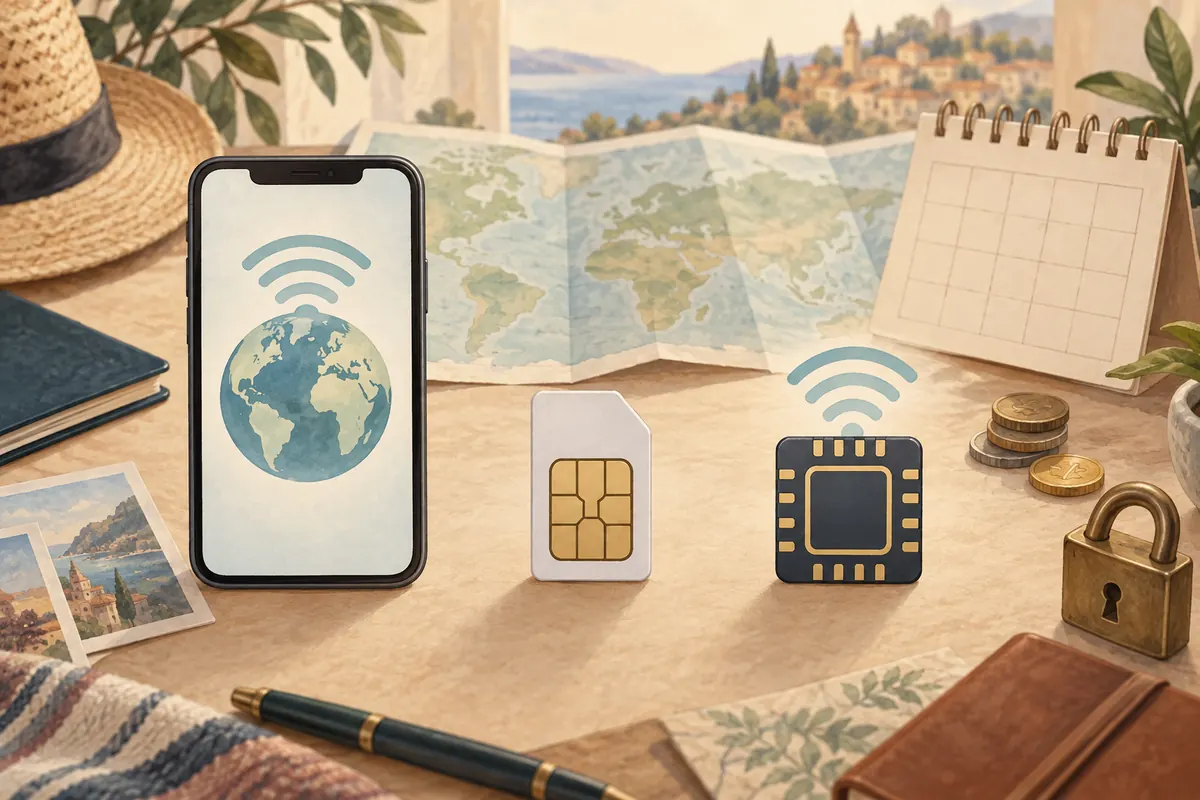
Before leaving, look up your carrier’s international rates and travel add-ons for every country on your itinerary. Calls, texts, and data may be billed differently, and a daily pass can have a different trigger or renewal rule from pay-as-you-go service. Read the supported destinations, daily allowance, high-speed cap, speed after the cap, billing day, and whether the pass renews automatically. “Unlimited” is not enough detail: find out what happens after any stated allowance and whether tethering is included. Save the terms and your purchase confirmation so you have a record if the invoice differs from what you expected.
Estimate your likely use. Navigation, messaging, translation, ride-hailing, and photo uploads consume data in different ways; video calls and laptop tethering may use far more than occasional map checks. A rough daily range and trip length are enough to compare a fixed-price pass with a prepaid allowance. Include call costs if you need to contact local businesses, and remember that data-only plans may not provide a local voice number.
Compare a roaming pass, local SIM, and eSIM by total cost
A home-carrier pass keeps your usual number available and can be convenient for a short trip. Multiply its daily price by the number of active days, then check whether arrival or the first network connection starts billing. A local SIM or travel eSIM may cost less for a longer stay, but the advertised price might exclude calls, taxes, top-ups, or another country on your route. Compare the same duration and data amount.
For an eSIM, confirm that your phone supports it and is not locked in a way that prevents another provider’s profile from working. Check the country list, activation instructions, validity period, hotspot policy, and refund rules. Some plans start validity when installed; others begin when the device first connects at the destination. “Install” and “activate” may be different steps. If your trip crosses a border, verify each country rather than relying on a regional label. Keep the purchase QR code or setup details somewhere accessible without depending on the connection you are trying to establish.
Convenience also matters. A roaming pass can preserve access to your usual number for verification texts. A local SIM may provide a local number, while a data eSIM can leave your original SIM installed for calls and texts. Decide which line will carry mobile data and disable roaming on the line you do not intend to use. Know how to switch back if the travel profile fails.
EU “Roam Like at Home” has a defined territory
The European Commission says the regime applies in the 27 EU countries and also lists Iceland, Liechtenstein, Norway, Ukraine, and Moldova. In covered destinations, calls, SMS, and data are charged on the same basis as at home, subject to fair-use conditions and the operator’s plan. The United Kingdom is outside the regime after leaving the EU; some operators have kept similar benefits voluntarily, so check your carrier before travelling. A trip described as “Europe” does not prove that every border crossing is covered.
The Commission warns that connections to non-terrestrial networks on aircraft or boats are outside the regime and usually carry high surcharges. Such networks may be satellite services provided onboard. Turn off mobile data or roaming during an air or sea crossing unless you have confirmed the price and intend to use it. Near a land border, a phone may connect to a neighboring country’s network, so review the country list and connection alerts. The Commission describes the EU framework; it does not set the price of your specific operator’s plan. European Commission roaming guidance
Expert perspective: treat the connection and the device as separate risks
EFF’s digital-security guide notes that device loss or seizure can expose stored data and explains full-disk encryption and passphrases. It does not compare roaming prices; it adds a separate travel check: changing SIMs changes connectivity, not the data on the phone. Before departure, check available encryption and screen-lock settings, carry only needed files, and know how to recover important accounts if the device is lost. Protection depends on the device and threat context; no setting guarantees safety.
Test the setup and watch usage after arrival
At your destination, check which carrier the phone joined before using data. If a travel eSIM does not connect, follow the provider’s supported-network instructions instead of repeatedly activating profiles or resetting the phone. Turn on usage alerts and a data limit where available. Automatic photo backups, app updates, cloud drives, and video autoplay can use data while the phone is idle; restrict them if your allowance is small. Save the provider’s support details offline in case activation needs help.
Before returning home, check whether the roaming add-on renews and when to disable or remove the travel profile. Keep cancellation confirmation. A quick review of covered countries, total price, activation moment, allowance, calling and hotspot terms, and the line selected for data usually prevents more surprises than choosing by headline price alone.
Sources
- European Commission, Roaming: connected anywhere in the EU at no extra charge — Covered destinations, the UK’s status, and the exclusion and surcharge warning for non-terrestrial networks. Page title and body verified; no publication date displayed; retrieved 2026-10-03.
- Electronic Frontier Foundation, Keeping Your Data Safe | Surveillance Self-Defense — Specialist digital-security guidance on device data and risks from loss, theft, or access by others. Page title and body verified; last reviewed 2024-07-22; retrieved 2026-10-03.