Indigenous Language Archives: Community Authority Before Wider Access
How CARE and UNESCO’s language-preservation context can inform digital archives, while distinguishing governance principles from legal permission.
Publication & corrections: infostoa · Editorial standards
Individual author and specialist reviewer information is not provided for this article.
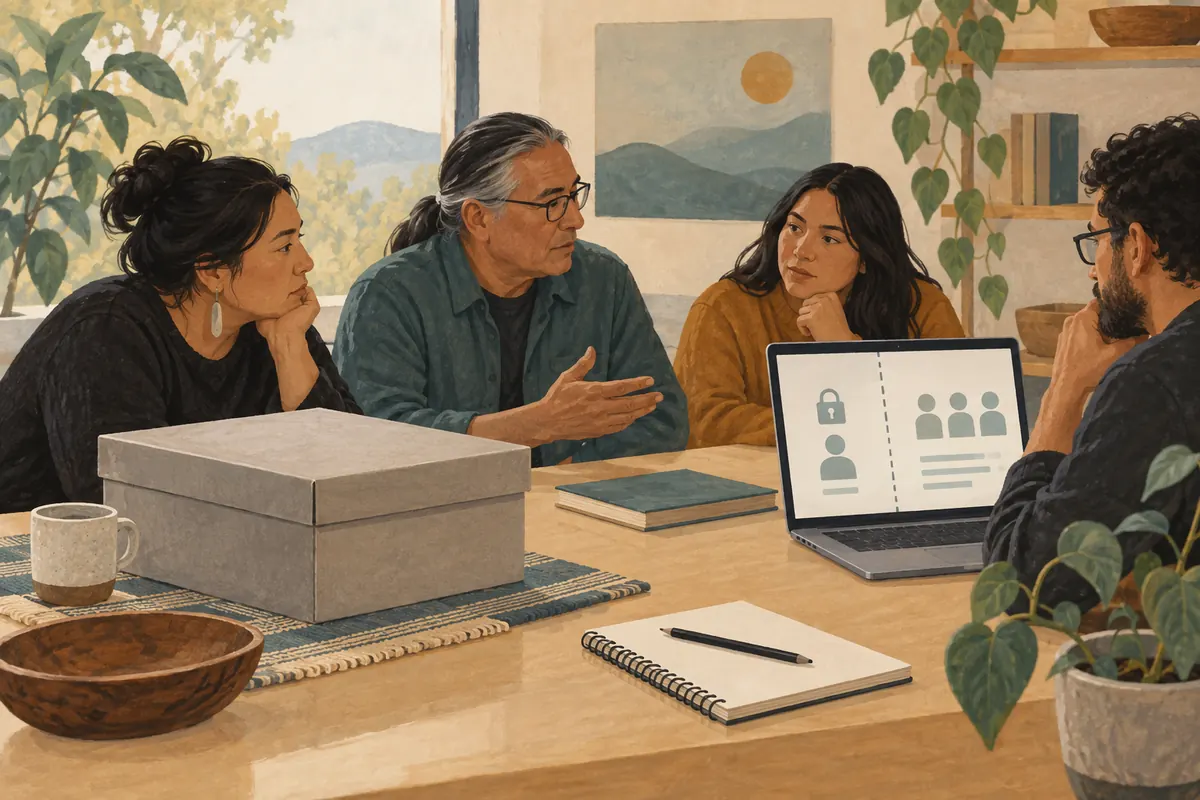
Keeping language records for the long term and making them available for anyone to reuse are different decisions. UNESCO frames 2022–2032 as the International Decade of Indigenous Languages and calls for language preservation, revitalization, and promotion. A 2020 Data Science Journal paper on the CARE Principles places people, purpose, and community authority at the center of data governance. A digital archive therefore needs to explain not only how files are preserved, but also who may make decisions about their use and under what conditions.
Separate preservation from permission to publish
Digitizing recordings, dictionaries, documents, and photographs makes copying and search easier. That technical capability does not itself establish consent to publish or permission for reuse. A collection may include material suitable for broad access alongside knowledge whose access depends on community, relationship, or context. An archive should not assume that all Indigenous communities follow one policy; it should identify the conditions set for the material and the people connected to it.
Preservation staff can distinguish keeping an original file, limiting access, granting a particular use, and describing the record. Treating one permission as permission for every later step can make an internal preservation agreement appear to cover web publication or machine-learning reuse. Recording the purpose of retention separately from the actions a user may take helps prevent that expansion of meaning.
What CARE adds to data-centered practice
CARE stands for Collective Benefit, Authority to Control, Responsibility, and Ethics. The authors do not frame CARE as a replacement for FAIR, which describes data characteristics such as being findable, accessible, interoperable, and reusable. Rather, CARE complements data-oriented stewardship by asking who benefits, who decides, and what responsibilities and ethical relationships govern the data.
That distinction matters in repository design. Better search and download tools do not necessarily show the record’s context, the benefits a community seeks, or how authority is exercised. Conversely, a restriction without a clear decision-maker or process may leave users unable to understand what is allowed. CARE is best read as a governance framework for considering people and purpose, not as a product setting or universal legal clause.
Record scope and context at the level of the material
The paper discusses applying CARE to repositories and collections. It says Indigenous Peoples must determine data-governance protocols and be actively involved in stewardship decisions for Indigenous data held by other entities. In practice, an archive can connect each record’s origin and collection context with the party responsible for preservation, current use conditions, and the authority that established them. This is an implementation example derived from the principles, not a mandatory form prescribed by the paper.
Access conditions can differ within a collection. For a request, clarify its purpose and check recorded conditions. If those conditions do not resolve the request, the archive should use an agreed process with the relevant community rather than automatically treating the material as either unrestricted or categorically unavailable.
An expert perspective: do not turn governance into legal guarantees
CARE is a normative framework for community-centered and responsible data governance. It does not by itself prove that an institution has obtained every legally required consent or that every later reuse is authorized. The article is not legal advice for a particular archive and cannot grant permission on behalf of a community. Rights and obligations depend on the records, the people and agreements involved, and applicable law.
An archive should make it understandable what it preserves, who decides access, and how it handles records whose descriptions or conditions are incomplete. For a request, staff can establish the intended purpose and scope, follow existing conditions, and avoid promising uses that exceed the permission on record. Clear explanations also help avoid treating a community as if it had only one voice or one set of conditions for every record.
Design the repository around relationships as well as technology
When building an archive or migrating a collection, consider storage formats and backups alongside decision-making authority and record context. Check whether a community protocol already governs the material, then align descriptions and access conditions with that decision. These fields are examples, not a universal checklist.
Digital continuity is more than keeping files intact. It also involves whether the record’s purpose and context remain understandable, whether restrictions travel with the data, and whether the relevant community has authority in stewardship decisions. CARE asks archives to bring these questions into data practices that may already follow FAIR. Specific access and reuse conditions must still be determined from the rights and agreements that apply to the material.
Sources: UNESCO, Indigenous Languages Decade (2022-2032), Carroll et al., The CARE Principles for Indigenous Data Governance