Mechanisms of Thyroid Hormone Excess and Autoimmunity in Graves Disease
Explains how Graves-related stimulating antibodies can raise thyroid hormone, how symptoms and tests are interpreted, and why other causes and clinical context matter.
Publication & corrections: infostoa · Editorial standards
Individual author and specialist reviewer information is not provided for this article.
Thyroid hormone and its feedback signals
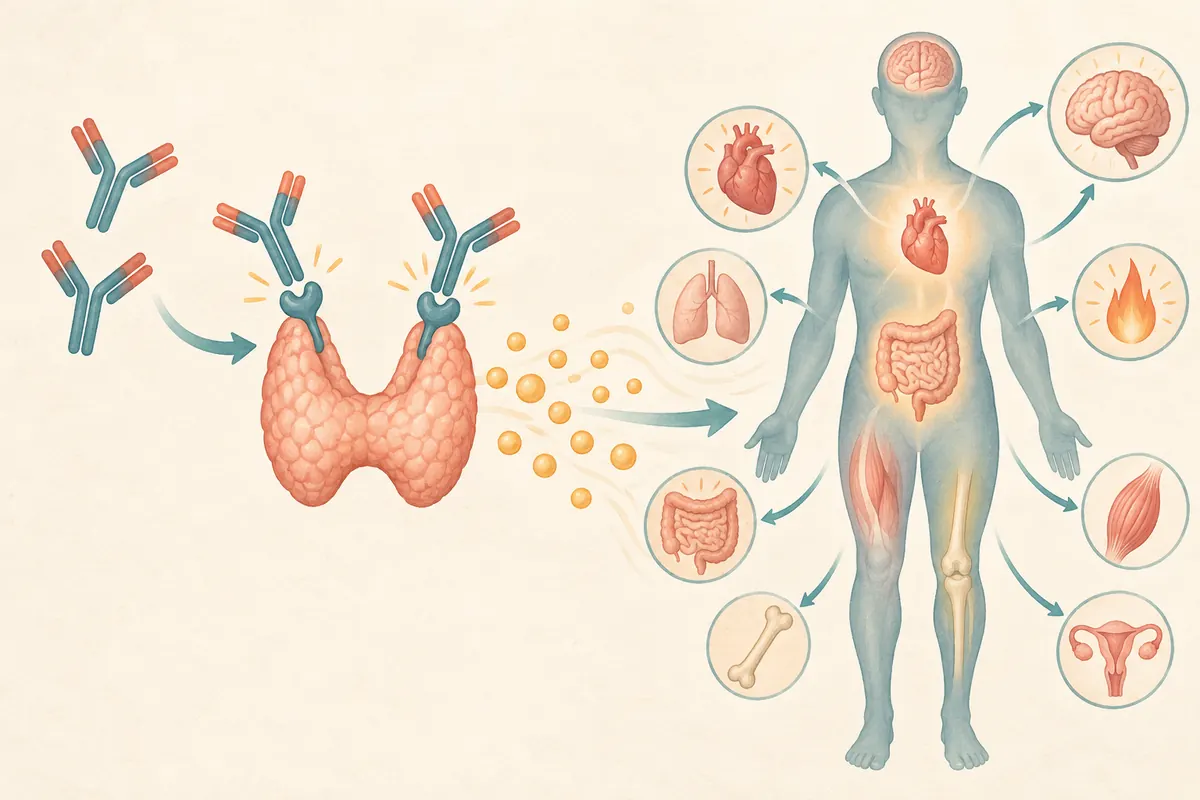
The thyroid releases thyroxine (T4) and triiodothyronine (T3) into the blood. These hormones affect energy use and the function of many tissues. Pituitary thyroid-stimulating hormone (TSH) signals the thyroid to produce hormone; as circulating thyroid hormone rises, feedback normally reduces TSH. Disease can alter parts of this system, but one laboratory value alone does not identify the cause.
Hyperthyroidism and thyrotoxicosis describe different things
Hyperthyroidism refers to the thyroid gland producing more hormone than the body needs. Thyrotoxicosis describes excess thyroid hormone in the circulation and tissues; it can also occur when thyroiditis releases previously made hormone. Separating the excess-hormone state from the mechanism that produced it matters because causes and evaluation differ. NIDDK and the American Thyroid Association (ATA) describe several causes, including Graves disease, overactive nodules, thyroiditis, and iodine- or medication-related factors.
How stimulating antibodies act in Graves disease
Graves disease is an autoimmune cause of hyperthyroidism. Antibodies that stimulate the TSH receptor can signal thyroid cells to make more hormone. Sources use terms such as TSH-receptor antibodies (TRAb) and thyroid-stimulating immunoglobulin (TSI), but names and assay reporting are not interchangeable in every context. The mechanism explains how thyroid stimulation can continue despite normal pituitary feedback. Graves disease is a common cause, but it does not account for every case of excess thyroid hormone.
Symptoms and blood tests need clinical context
Excess hormone can affect heart rate, heat tolerance, bowel activity, sleep, and muscle strength. Possible symptoms include palpitations, tremor, feeling unusually warm, sleep difficulty, or weight change, but they vary and overlap with other conditions. NIDDK and ATA describe evaluating suspected hyperthyroidism with examination and tests such as TSH, T4, and T3, with antibody or imaging tests used when relevant to the cause. A typical pattern can guide evaluation; a symptom or single result cannot diagnose the condition by itself.
Laboratory results are interpreted as a pattern, with attention to which tests were measured and when. The ATA describes a common pattern of low TSH with elevated T4 or T3, while milder or early changes and other health contexts may not look identical. A person can also have low TSH while T4 and T3 remain within their reference ranges; that situation is assessed differently from clearly elevated thyroid hormone. Antibody tests answer a related but separate question: they can support an autoimmune cause, rather than replacing measurement of hormone levels. Reference ranges, medicines, timing, and the clinical picture all matter, so a printed result should not be used alone to name the disease.
Different causes lead to different testing questions
The table summarizes the preceding explanations. Each row is a question for clinical evaluation, not a procedure for selecting your own tests or treatment.
| Possible cause | Route to hormone excess | Question for the visit |
|---|---|---|
| Graves disease | Receptor-stimulating antibodies can increase production | Do antibody results support this cause alongside other findings? |
| Overactive nodules | Nodular tissue produces hormone independently | What do examination/imaging show about nodular function and findings? |
| Thyroiditis | Stored hormone may enter the bloodstream | Is this increased synthesis or release of stored hormone, and how is it changing? |
| Iodine/medicine-related | Intake or medicine exposure may contribute | Have product names and start/change dates been considered? |
Bring a record alongside the result sheet
Record test names, dates, values and laboratory reference ranges, the exact antibody-test name, medicines/supplements, symptom onset and changes. A fictional entry could read: ‘told TSH was low; T4/T3 and antibody results not yet checked.’ This is not a Graves diagnosis. It separates ‘has hormone excess been established?’ from ‘what caused it?’
Management depends on the cause, results, symptoms, pregnancy and other health conditions. Do not change medicines yourself based on the result sheet. ATA's separate Graves patient page explains stimulating antibodies, but the antibody name alone does not establish identical assays. This article does not interpret personal results or set an individual treatment plan.