How a Gravitational-Wave Standard Siren Measures Cosmic Expansion
See how GW170817 links a waveform distance to its host galaxy’s motion, and why peculiar velocity, inclination, and the dated analysis matter.
Publication & corrections: infostoa · Editorial standards
Individual author and specialist reviewer information is not provided for this article.
What a standard siren measures
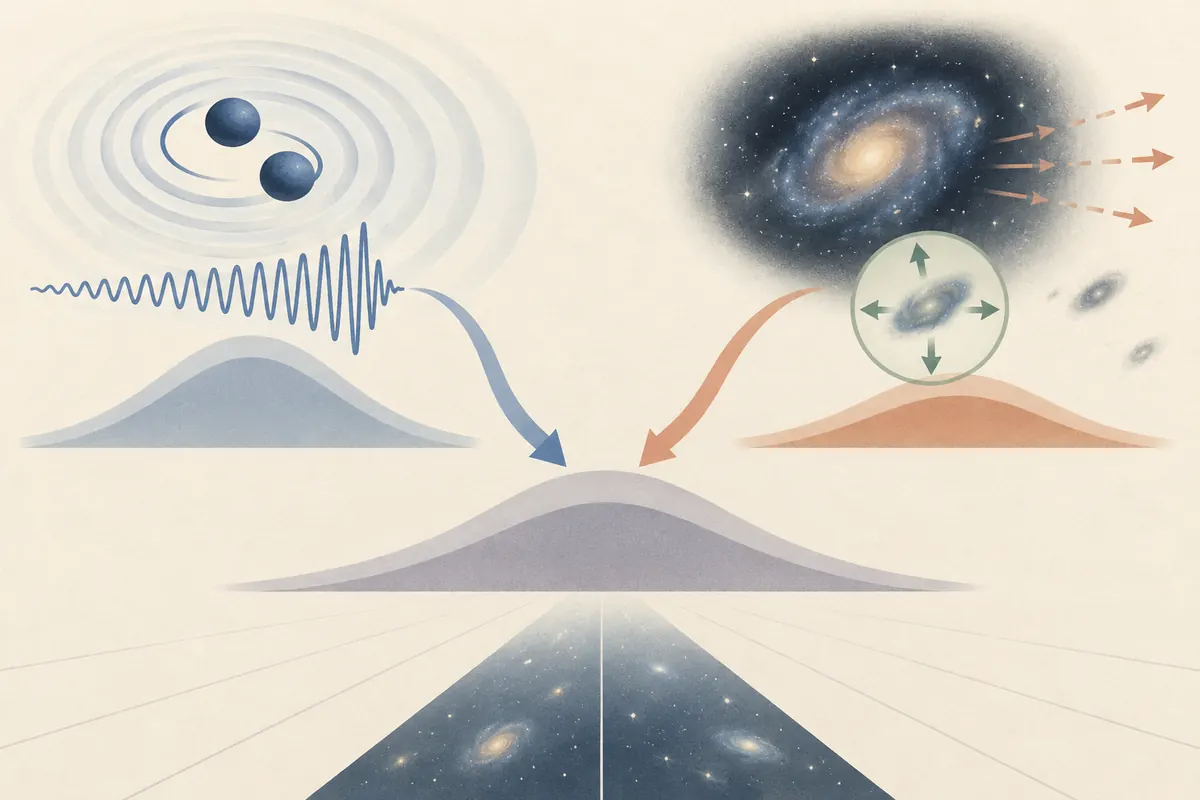
A gravitational-wave standard siren combines two observations of a compact-binary event: the waveform provides information about luminosity distance, while light from the host galaxy supplies redshift or recession information. Together they can constrain cosmic expansion. The name echoes a standard candle, but the distance is inferred from the evolving signal of the binary rather than from a calibrated stellar brightness. This offers an observational route independent of the traditional electromagnetic distance ladder.
The two measurements play different roles. Gravitational waves constrain how far away the source is; electromagnetic observations can identify the host galaxy and characterize its motion. Linking both to the same event is what makes an estimate of the Hubble constant possible.
How GW170817 supplied the link
In August 2017, Advanced LIGO and Advanced Virgo detected gravitational waves from the binary-neutron-star merger GW170817. Telescopes observed the event across the electromagnetic spectrum, enabling identification of its host galaxy, NGC 4993. LIGO’s science summary reports a waveform-based distance of about 44 megaparsecs (Mpc), under the assumption that the gravitational-wave sky position exactly coincided with the optical counterpart.
That distance estimate carried roughly 15% uncertainty. Detector noise contributes, and the binary’s orbital inclination is not known precisely. A more distant binary viewed nearly face-on can produce a gravitational-wave amplitude similar to that of a closer binary viewed more edge-on. Distance and inclination are therefore correlated in the inference; the waveform does not simply output an exact distance.
Expert perspective: correcting the host’s peculiar motion
A host galaxy’s measured radial velocity is not all due to cosmic expansion. Galaxies also move locally under the gravitational influence of neighboring galaxies and clusters. For nearby NGC 4993, that peculiar velocity can be a significant part of the observed motion and cannot safely be ignored.
The LIGO summary says the analysis identified NGC 4993’s galaxy group and used a much larger survey of galaxy peculiar velocities to correct for the group’s motion. It estimated a Hubble-flow velocity just above 3,000 km/s and allowed a deliberately broad 150 km/s uncertainty for the correction. This is a source- and environment-specific inference, not a universal velocity adjustment to insert into every standard-siren calculation.
Combining the observations still leaves uncertainty
At a conceptual level, a recession velocity divided by distance gives the scale of the Hubble constant. In an actual analysis, uncertainty in host motion, gravitational-wave distance, inclination, and source-host association is propagated into a probability distribution. One event therefore yields a range under stated assumptions, not a single exact answer.
LIGO’s GW170817 summary identifies the roughly 15% distance uncertainty as the dominant influence on its Hubble estimate at the time. Correlation between distance and inclination also shapes the resulting distribution. Reducing one small component of the velocity error alone would not necessarily make the overall result precise.
Read the 2019 analysis as a dated result
The LIGO and Virgo collaboration paper on arXiv (1908.06060) was submitted in 2019, revised to version 5 on November 8, 2021, and published in *The Astrophysical Journal* in 2021. Its abstract combines detections from the first and second observing runs. It includes the GW170817 counterpart-based result and adds binary-black-hole events with galaxy catalogs. Under a flat-in-log prior, the paper reports a joint H₀ of 68.7 km/s/Mpc with a 68.3% highest-density interval of +17.0/-7.8. It describes this interval as about 4% narrower than the GW170817-only result.
Those numbers belong to that dataset, analysis, and prior. LIGO’s educational summary likewise labels GW170817 as the first standard-siren measurement and anticipated better precision from future observations. The 2019/2021 estimate must not be presented as the best current value or a settled consensus in 2026. A current comparison requires newer observations and analyses.
Questions to ask when reading a result
Check which event and detector runs were included, whether an electromagnetic counterpart and host galaxy were identified, and how the analysis handled distance–inclination correlation. For a nearby host, look for the peculiar-velocity correction and its uncertainty. Then note the prior, interval definition, and publication or revision date. Those details prevent results produced under different conditions from being treated as interchangeable measurements.