Schema Stitching vs. Apollo Federation: Choosing a GraphQL Gateway Design
Compare stitching and Apollo Federation within their documented product and version boundaries, then test ownership, request delegation, and failure behavior.
Publication & corrections: infostoa · Editorial standards
Individual author and specialist reviewer information is not provided for this article.
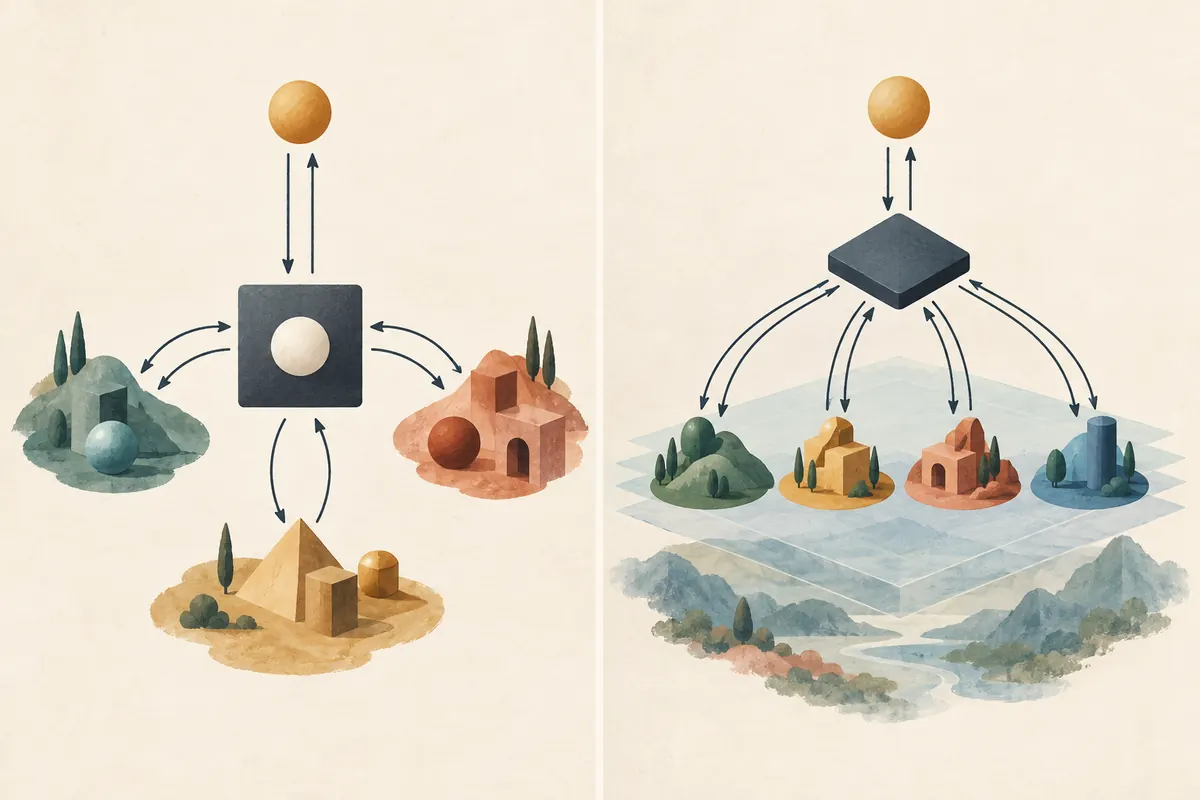
When several teams operate separate GraphQL APIs, clients do not have to combine every endpoint and response themselves. A gateway can present one graph and connect data behind it. Two commonly compared approaches are schema stitching and Apollo Federation. Both aim to expose multiple APIs through a unified graph, but their names alone do not establish which is faster or easier to run. Compare the actual tools, schema ownership, request planning, and deployment responsibilities.
Start with the boundary of each approach
The Guild’s current @graphql-tools/stitch documentation says it creates one gateway proxy schema from multiple GraphQL services and delegates parts of a request to the relevant subschemas. It describes schema extensions, programmatic type merging, and directive-based type merging as approaches. The design choice depends on how you connect existing schemas and handle naming or type conflicts.
Apollo’s current Federation documentation describes an Apollo product architecture that declaratively combines APIs into a federated GraphQL API. Clients send requests to a router, which coordinates the underlying APIs. Apollo calls the unified graph a supergraph and its constituent APIs subgraphs. These terms and directives belong to Apollo Federation’s design; GraphQL as a specification does not require every server to adopt them.
Who owns changes and composition?
With stitching, gateway code may take the central role in loading and connecting subschemas. Teams need to decide whether to add relationships through schema extensions, connect shared entities through type merging, and where to test delegation rules. If boundaries and data ownership are unclear, integration logic can accumulate in the gateway or a remote schema change can surface late in deployment. A tool does not resolve those organizational questions automatically.
With Federation, teams contribute subgraphs to a supergraph, while composition rules and the router represent those boundaries. Apollo describes a model in which teams develop APIs independently while clients use one entry point. That does not guarantee team autonomy by itself. The organization still needs to define field ownership for shared entities, compatibility checks, responsibility for composition failures, and router operations.
Test the decision before comparing feature lists
Name the current problem. The test plan differs depending on whether the priority is connecting several remote schemas quickly or managing each team’s proposed changes against a shared graph. Choose representative queries, including one that spans two services, and record delegation or routing, partial failures, error propagation, latency, authentication boundaries, and schema-change workflow. Check current releases and compatible server implementations for the tools under consideration.
Use the same data and query in each trial. Separate cache, network, and downstream service time. Fan-out to multiple services can affect cost and failure behavior, but the result depends on deployment and query shape. A feature list in documentation cannot predict production performance. Evaluate composition time, developer workflow, observability, and incident response together.
Turn operations into questions you can record
Before choosing, agree on who changes each team’s schema, who resolves composition failures, and what response clients receive when a downstream service fails. Run the same test queries and failure scenarios through both implementations, and compare the path from change proposal to deployment. Adoption cost includes gateway operations as well as team training, monitoring, and upgrades. Document both the complexity a unified graph removes and the operational boundaries it creates.
Expert perspective: pin the documentation version and operational owner
The Guild documentation says stitching became fairly comparable to Federation as of GraphQL Tools v7. That is a version-qualified statement in that library’s documentation, not a guarantee that every implementation is equivalent. Apollo’s documentation describes Apollo’s router, supergraph, and subgraph model. In practice, base a decision on reproducible tests that specify the library versions, composition rules, ownership boundaries, and failure behavior—not on the approach names alone.