Git Packfiles: Object Storage, Delta Compression, and Indexes
Git packfiles bundle objects and can store similar versions as deltas to reduce repeated data. This guide explains how pack indexes locate objects, how deltas are reconstructed, and why a transfer thin pack differs from a complete on-disk pack.
Publication & corrections: infostoa · Editorial standards
Individual author and specialist reviewer information is not provided for this article.
Git can initially store objects such as commits, trees, and blobs as individual files. As a repository grows, related objects can be grouped into packfiles. Objects in a pack are compressed, and similar versions may be represented as deltas against a base object to avoid repeating much of the same content. Reading an object then involves the pack index and, for a delta, a reconstruction path; a packfile is more than a concatenated archive.
1. Why Git groups objects into packs
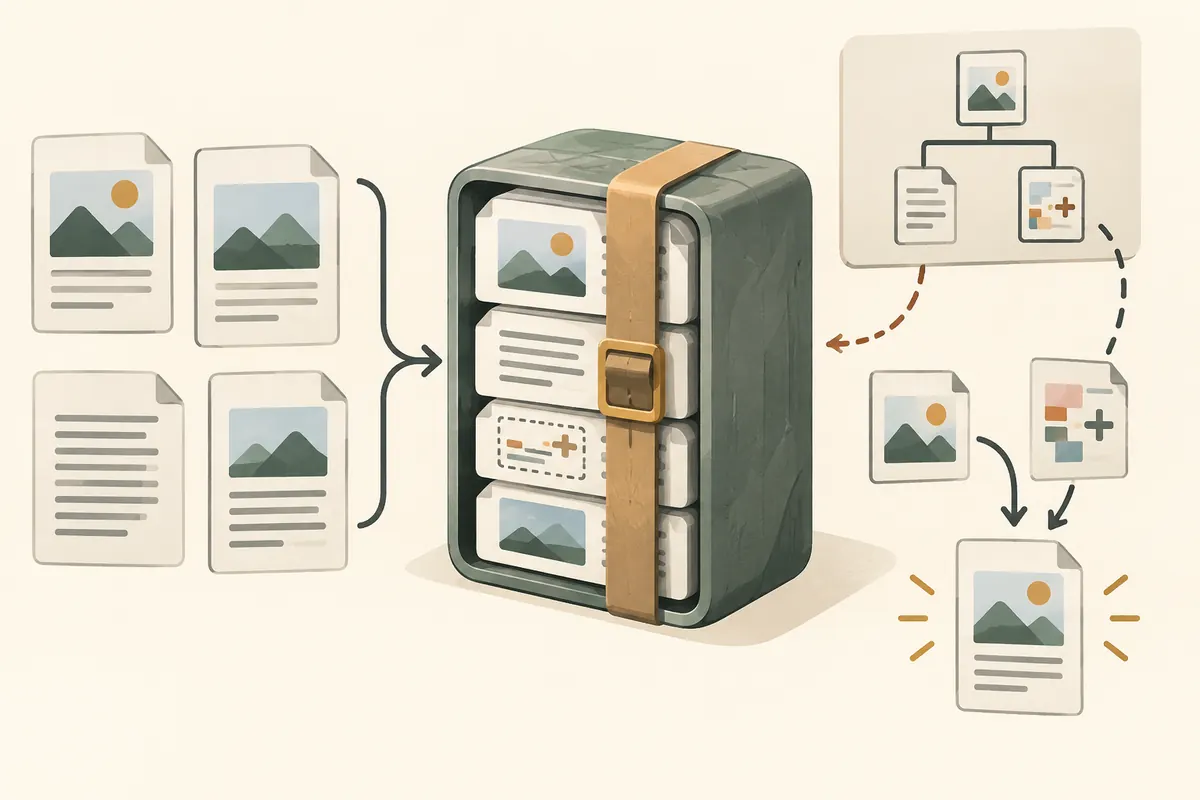
Git's object model keeps content in identifiable objects. Loose objects are commonly stored as separate files, so a project with many small files or a long history can accumulate numerous files and repeated content. A packfile stores many objects together in a compressed representation, helping reduce storage use and file-management overhead. When packing occurs depends on the commands used and repository maintenance policy.
A pack contains a header, an object count, and entries that describe object type, size, and compressed data. Not every entry refers to another object. Some objects are stored in a form that can be reconstructed directly; where useful, Git can instead encode an object as a delta against a base. Understanding the format helps explain both disk use and the work needed to reconstruct an object.
2. What a delta saves—and what it takes to read
If two versions of a file are mostly alike, Git can store instructions for reconstructing one object from a base rather than repeat all of its content. Pack deltas include operations that copy a byte range from the base or insert new bytes carried by the delta. An OFS_DELTA identifies a base by its offset in the same pack; a REF_DELTA identifies it by object name.
Deltas can reduce repeated data, but reading one requires finding a base object and applying the delta instructions. A chain of deltas may require applying several steps from an earlier base. The actual cost depends on pack layout, access patterns, and cache state, so delta storage does not make every read faster. Git's packing and repacking decisions balance storage with access and reconstruction costs.
3. Pack indexes and thin packs are different concerns
A pack index maps object identifiers to offsets in a pack so Git can locate an object without scanning the whole pack from the beginning. The official format documentation specifies the companion index structure as well as the pack. This is why inspection and integrity checks consider the pack and its index together.
A thin pack is a transfer representation that can omit a base object expected to already exist at the receiving side, reducing the amount sent. It should not be confused with a complete pack stored in a repository. Because a thin pack may refer to an external base, the receiver needs a process to supply the missing object and make the resulting pack self-contained. Transfer handling can repair that representation; the on-disk pack must be valid for its stored object set.
4. Expert perspective: diagnosing storage and maintenance
The Git book's packfiles chapter demonstrates how Git can use deltas between related versions to save space. A single very large pack is not automatically best for every repository. Object access frequency, repository size, transfer patterns, and the CPU cost of repacking all matter. Prefer Git's integrity and maintenance commands to editing pack or index files directly, and observe the actual storage and command performance.
When a repository is unexpectedly large, first identify which objects consume space and examine the balance between loose objects and existing packs. Repacking or cleanup should account for the objects and references collaborators rely on. Understanding packfiles corrects the idea that Git always stores every version as a full copy, but delta compression alone cannot guarantee a particular storage reduction or performance improvement.