How oxygen and nitric oxide help control firefly flashes
The chemistry that produces firefly light is distinct from the timing of each flash. Primary experiments test oxygen access and nitric-oxide signaling, while a specialist review explains why emission color remains a separate, debated question.
Publication & corrections: infostoa · Editorial standards
Individual author and specialist reviewer information is not provided for this article.
Firefly light is made by a chemical reaction, but the reason an adult firefly emits brief flashes must be considered separately from the light-producing chemistry. Researchers have tested when oxygen reaches the lantern’s light-producing cells and which signals may regulate that process.
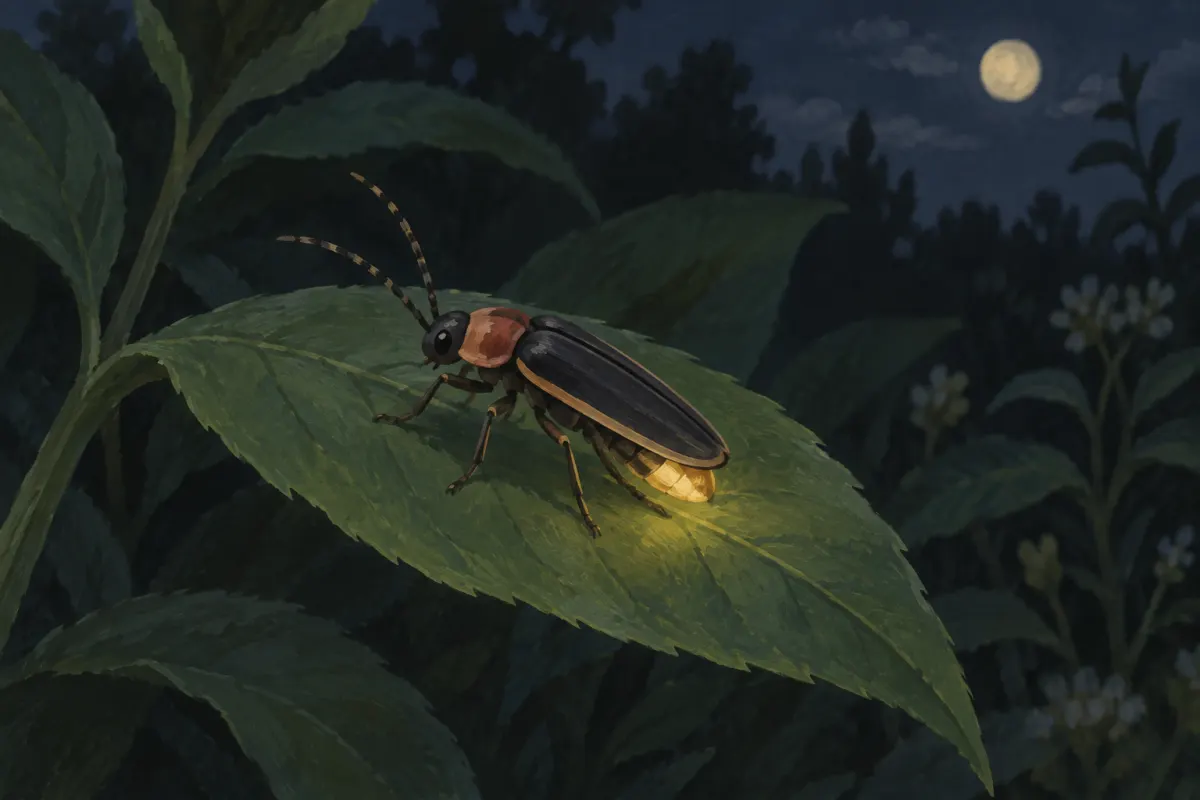
1. Light production and flash timing are different questions
In the lantern, luciferin reacts with oxygen in light-producing cells called photocytes, with the enzyme luciferase helping the reaction proceed. Excited oxyluciferin releases a photon as it returns to a lower-energy state. This chemistry explains how light can be produced; by itself it does not explain how an adult firefly gates that light into brief flashes.
2. A primary experiment changed oxygen access
Timmins and colleagues tested whether oxygen access to adult firefly photocytes controls flashing. Under normobaric hyperoxia—higher oxygen without raising ambient pressure—animals that were normally dark began to glow continuously. The authors concluded that flash control involves gating oxygen to photocytes and proposed that changing fluid levels in the tracheoles supplying those cells could create a variable barrier to oxygen diffusion. The result supports oxygen access as part of adult flash control; it does not establish that one detailed structure works identically in every species or condition.
This was an intervention that tested whether extra oxygen could release repression, not a direct recording of tracheolar fluid during a natural flash. The authors present a variable fluid barrier as a likely explanation; the abstract does not establish it as a fully observed anatomical switch.
3. Nitric oxide is a candidate signaling link
In a separate primary study, Trimmer and colleagues reported that nitric oxide stimulated firefly light production when oxygen was present. Compounds that scavenge nitric oxide blocked bioluminescence induced by the neurotransmitter octopamine. The researchers also found strong nitric-oxide-synthase expression in lantern cells positioned between nerve endings and photocytes. Together, these findings support nitric oxide as a regulator connecting neural activity with light-producing cells. Blocking nitric oxide provides evidence that this pathway participates in the octopamine response. These experiments do not establish nitric oxide as the only signaling route, or show that it alone determines the rhythm, ending and complete neural sequence of every natural flash.
4. Oxygen supply and neural signaling can work in the same system
The two experiments address different parts of the process. The oxygen study tests whether oxygen availability can limit light production at photocytes; the nitric-oxide study tests whether a signaling molecule in the lantern is involved in activating emission. Oxygen is required for the chemistry, while nitric oxide may participate in regulating oxygen use or photocyte activity. Treating the findings as a choice between “oxygen” and “neural signals” would go beyond what either experiment measured.
5. What the specialist review says about emission color
A Chemical Reviews specialist synthesis examines the chemistry of oxyluciferin emission in fireflies and other bioluminescent beetles. Interactions around luciferase, solvent polarity, and electronic effects can influence emitted color. The reviewers find that multiple coexisting oxyluciferin forms provide the explanation most consistent with the accumulated evidence, while noting that fundamental details of the reaction remain debated. This work on color spectra addresses a different question from experiments on how adult fireflies time their flashes.