Does “Fermented” Mean Live Cultures or Probiotic Benefits?
Fermentation, live microbes at the time of eating, and a proven probiotic effect are different claims. Learn what labels and human studies can—and cannot—show.
Publication & corrections: infostoa · Editorial standards
Individual author and specialist reviewer information is not provided for this article.
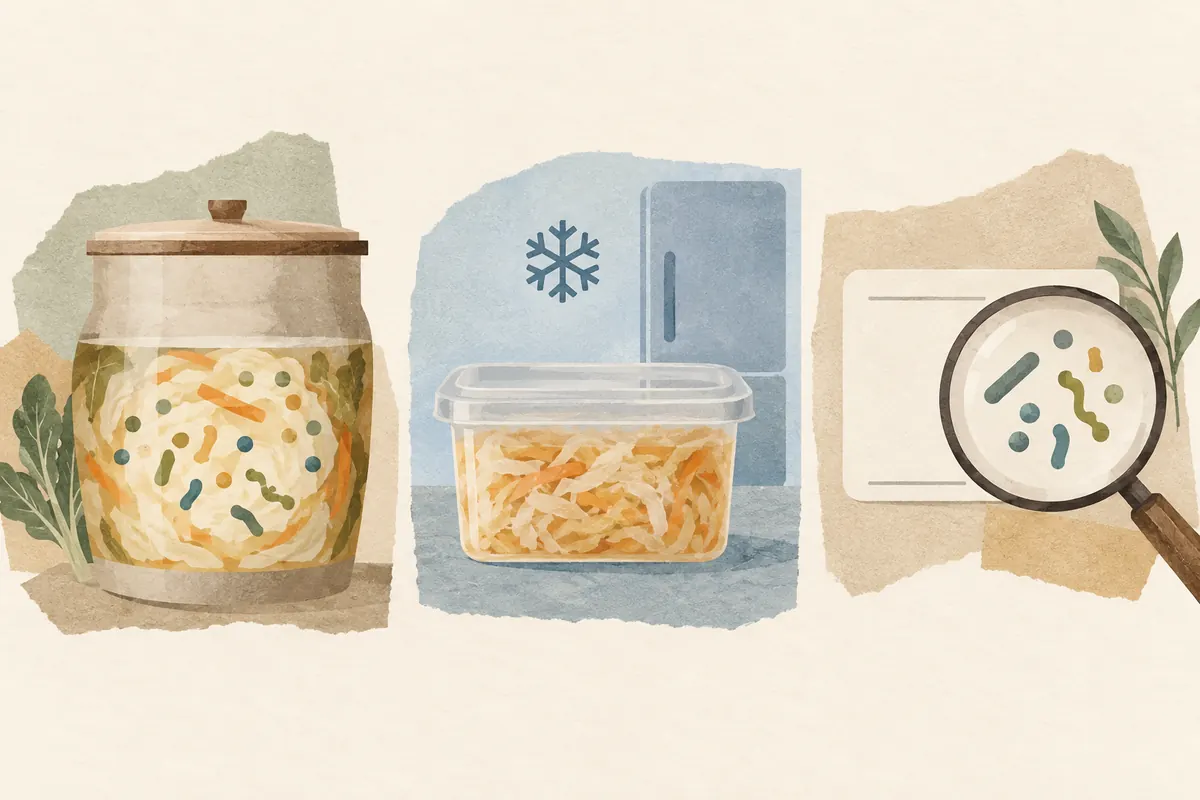
A label that says “fermented” does not automatically guarantee that live microbes remain when you eat the food—or that it delivers a particular health benefit. Fermentation is a production process in which microbes transform food components. Whether organisms remain alive depends on later steps such as heating or filtration, and on storage through the use-by date. A probiotic benefit requires evidence for a particular strain and intended use. Check these as separate claims.
“Fermented” describes a process, not a laboratory result
A peer-reviewed review defines fermented foods and beverages as products made through controlled microbial growth and the enzymatic conversion of food components. Some products rely on microbes naturally present in the ingredients or environment; others use starter cultures. Kimchi, miso, bread, and yogurt differ in ingredients and production, so their final microbes and metabolites are not interchangeable. The word “fermented” alone does not identify a strain, count its cells, or show that they survive until consumption.
Heat treatment, filtration, and baking can reduce or eliminate live microbes. Even if organisms were alive after production, storage temperature and time can change their numbers before the food is eaten. Look for refrigeration and storage instructions, whether the product was heat-treated, and whether any strain or count claim applies at manufacture or through the stated shelf life. If the label is silent, do not assume a guaranteed live count.
Live microbes are not the same as proven probiotics
Finding live organisms in a food is not equivalent to showing that they provide a defined health benefit. Evidence for a probiotic claim depends on the identified strain, dose, intended population, measured outcome, and reproducibility. A result for one strain cannot automatically be transferred to another strain or to every food in a category. Fermentation-derived metabolites and changes in food components are also studied, but those possible effects should not be relabeled as benefits caused by live microbes.
Phrases such as “contains lactic acid bacteria” may not tell you the strain, the viable count at the time of eating, or whether a clinical benefit has been tested. If a number appears, check whether it is measured at manufacture or guaranteed through the best-before date, and how it was measured. Broad claims about preventing or treating disease do not follow from the general fact that a product is fermented.
Read human studies within their tested scope
A randomized dietary intervention by Stanford researchers compared a high-fermented-food diet with a high-fiber diet in healthy adults. The 17-week study observed increased gut-microbiome diversity and lower inflammatory markers in the fermented-food group. It tested a dietary pattern containing multiple foods; it did not test one commercial product, one isolated strain, or treatment of a specific disease. Its participant groups were also limited in size, so the result should not be assumed to occur in every person.
The review likewise concludes that clinical evidence for gastrointestinal benefits is limited for many fermented foods. An effect seen in laboratory experiments does not establish the same effect from an ordinary serving in people. When reading a study, identify what was consumed, the comparison group, duration, participants, measured outcomes, and the authors’ stated limitations.
What to check when buying and eating
Start with ingredients, production information, heat treatment or filtration, and storage instructions. If live cultures matter to you, look for named strains, a viable count, and the date through which the claim is guaranteed. You can ask the manufacturer for missing details, but avoid filling gaps with assumed benefits. Follow the stated temperature and use-by date after opening; discard a product if its packaging or smell suggests spoilage.
Check other product-specific information—such as sodium, added sugars, allergens, and alcohol—separately from its microbes. People with a weakened immune system, pregnancy, a medical condition, or a prescribed diet may need individualized advice about particular products. This article explains labels and study interpretation; it is not personal nutrition or treatment advice.