Preserving Family Photographs: Handling, Storage, and Expert Help
Identify photographic materials, handle prints safely, choose suitable enclosures, avoid risky home treatments, and prepare for a conservator consultation.
Publication & corrections: infostoa · Editorial standards
Individual author and specialist reviewer information is not provided for this article.
A family photograph that curls or changes color does not automatically need to be flattened or cleaned. Photographs use different supports, binders, image materials, and processes, so safe handling and storage depend on what the object is. Record its condition first, handle it by its edge or housing, and consult a conservator who works with photographic materials before applying an adhesive or cleaner.
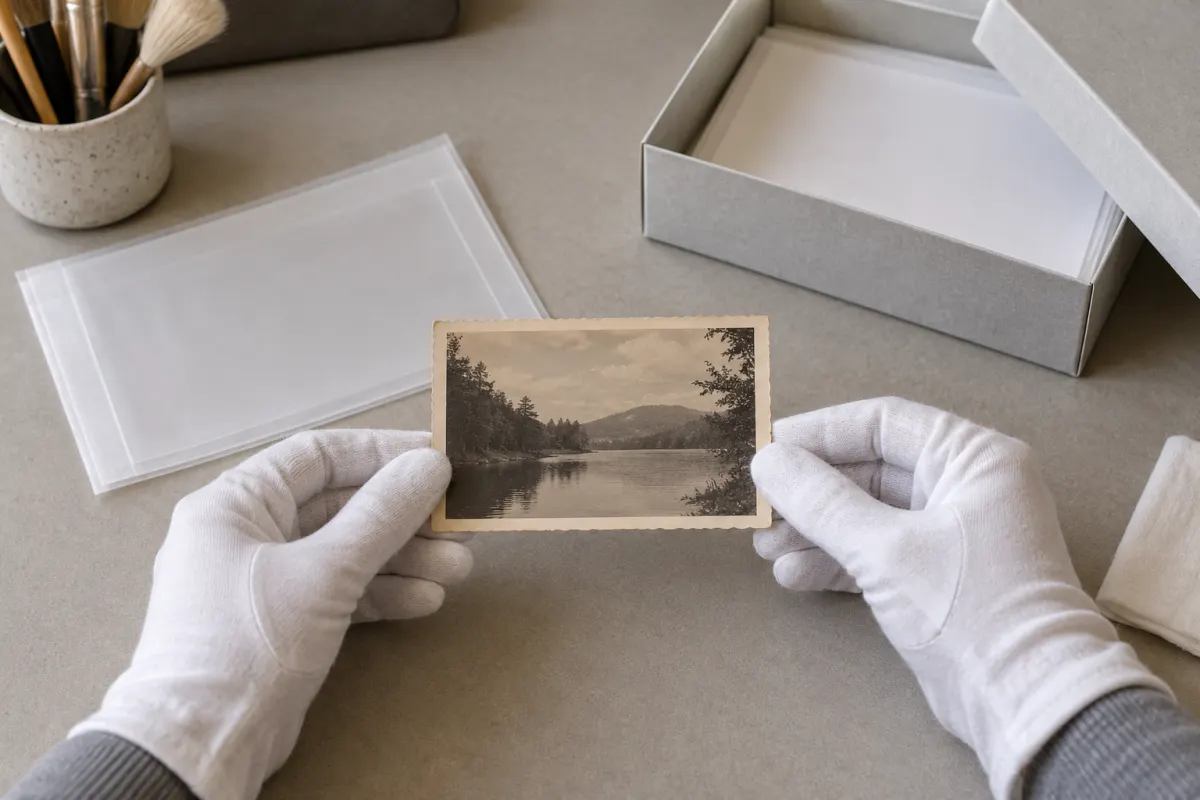
1. Identify the material and observe its condition
A photograph is not always a paper print. The Library of Congress (LOC) explains that identifying the support, binder, image material, coating, and production process is necessary to choose appropriate handling and storage. Paper prints, film negatives, and photographs on metal or glass have different surfaces and structures. Do not rub, flatten, or separate an object when you do not know its materials, especially if color has shifted, silver mirroring is visible, an emulsion is lifting, or two photographs are stuck together.
Inspect a photograph where it is rather than forcing it out of a frame or album. Note tears, stains, creases, loose layers, and points of attachment. Prepare a clean, dry work surface without food or drink.
2. Handle by the edges and keep marks and adhesives off the image
LOC advises handling photographs with clean hands or clean nitrile gloves and, when possible, holding them by the edges or their housing. Gloves may be useful for metal, glass, or plastic-based negatives, but they can reduce dexterity and become dirty. Whatever you use, avoid touching the image area, bending the print, or lifting it by one corner. A weak or large photograph can be moved on a support board to reduce flexing.
Do not use paper clips, rubber bands, tape, sticky notes, or glue to organize photographs. Adhesives can leave residues on the surface or image layer; clips can press or stain it. If a note is needed, write in pencil on a protective folder or sleeve instead of the photograph. If a print is stuck to an old album page, do not pull it free. Support the album and ask a conservator whether separation can be done safely.
3. Choose photo-safe enclosures and a stable storage place
LOC recommends protective primary enclosures, such as folders or sleeves, to reduce dust, light, and handling. Do not rely only on a “photo-safe” label: check that the material meets ISO 18902 and has passed the Photographic Activity Test (PAT). Unsuitable enclosures can contribute to fading, yellowing, silver mirroring, and embrittlement. If an album has self-adhesive pages, acidic paper, or a suspect plastic, do not force photographs off the page; ask a conservator about a safe alternative.
LOC recommends a relatively dry, cool, and stable place. Relative humidity is especially important for most photographic prints, with daily fluctuations ideally below five percent. For color photographs and film negatives, LOC recommends storage at 40°F (about 4°C) or below; this material-specific recommendation does not give a home packaging or temperature-transition procedure for an individual photograph. Ask a photographic conservator whether and how it applies. Avoid attics, basements, vents, fireplaces, radiators, exterior walls, and leak or condensation risks; limit light and pollutants.
4. Do not attempt home treatment for stains, mold, or stuck layers
Even a soft brush can scratch or otherwise damage a photographic surface. LOC mentions a hand-operated air bulb—not canned air—for loose dust, but this is not a general instruction to clean every photograph. Mold, water staining, lifting emulsion, adhesive residue, and a print attached to glass require different assessments depending on materials and condition. Do not apply water, alcohol, household cleaner, erasers, tape, or craft glue, and do not pull stuck photographs apart.
Record the affected area, its relation to an album or frame, storage location, and known leak or heat exposure. The LOC page reviewed here gives no specific handling or treatment steps for mold or moisture damage. Do not improvise separation, sealing, or packing; ask a conservator experienced with photographic materials to assess it. If several prints are affected, do not set priorities from appearance alone.
5. Expert perspective: prepare useful information for a conservator
The American Institute for Conservation (AIC) describes conservation as examination, documentation, treatment, and preventive care supported by research and education. Conservators receive extensive training, specialize in materials, and follow professional ethics. When the process or damage to an old photograph is uncertain, ask a conservator who works with photographic materials to assess it. This does not mean every photograph needs treatment, and it does not guarantee a particular result.
For a consultation, prepare images of both sides, size, any known date, people or place, attachment to an album or frame, storage conditions, and known water, heat, or adhesive exposure. The LOC and AIC pages reviewed here do not specify packing for shipment. If a conservator or repository requests transfer of the original, ask them for object-specific handling directions before arranging it. This article is not a diagnosis or shipping protocol.