Why Earth’s magnetic reversals are not a countdown
Magnetic minerals preserve evidence that Earth’s polarity has reversed, but reversals do not follow a regular clock. Here is what the geological record shows, and why a weakening field alone cannot date the next event.
Publication & corrections: infostoa · Editorial standards
Individual author and specialist reviewer information is not provided for this article.
A reversal is not a compass flipping overnight
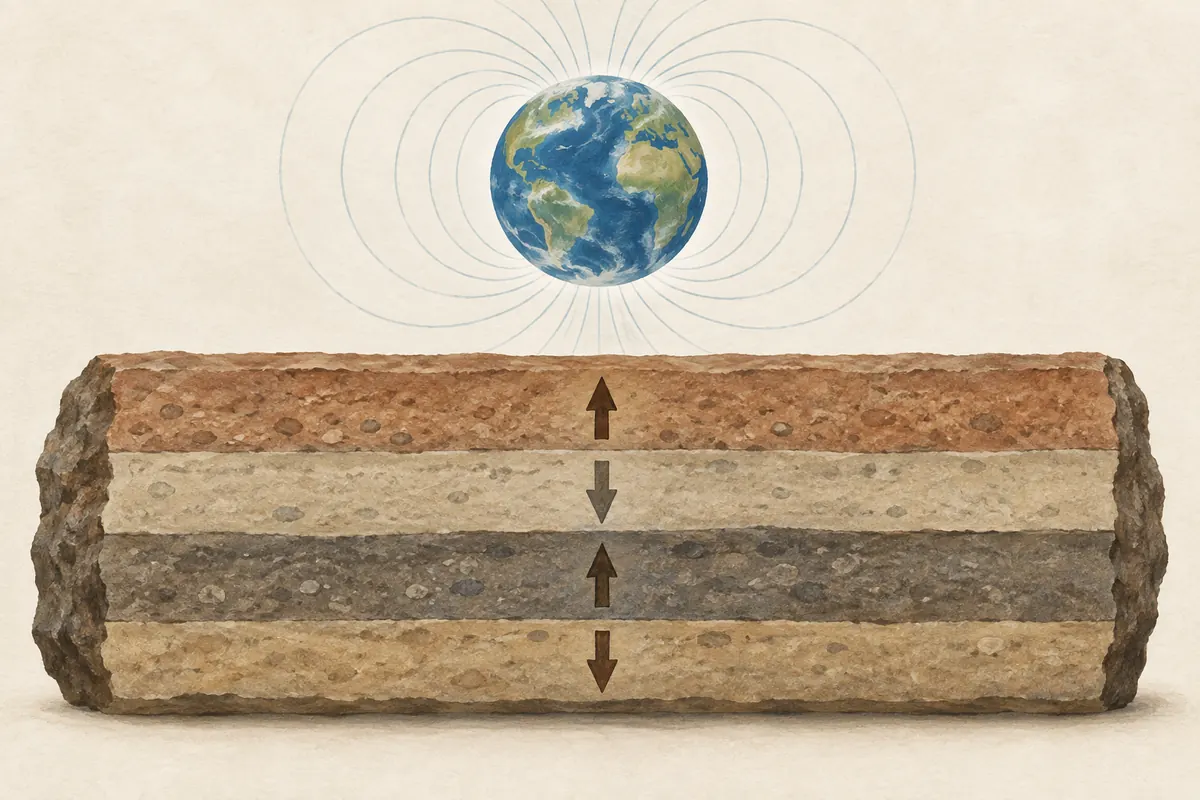
Earth’s magnetic field is not a rigid bar magnet. It is generated mainly by electrically conducting liquid metal moving through the outer core, with Earth’s rotation helping organize that flow. Over geological time, the dominant dipole component can change polarity. A geomagnetic reversal would not make every compass needle switch direction at one instant, nor would it mean that all magnetic field disappears. The transition can take thousands of years. During it, the dipole may weaken while the field’s direction and strength vary differently from place to place.
Scientists can study this history because some rocks retain a record of the field that existed when they formed. As lava cools, magnetic minerals align with the local field and then preserve that orientation. New ocean crust records magnetic direction too; seafloor spreading carries the record away from the ridge in bands. These archives let researchers reconstruct past polarity changes rather than infer them from today’s compass readings alone. They provide strong evidence that reversals occurred, but they do not function as a calendar for the next one.
Geological evidence records events, not a dependable interval
NOAA’s National Centers for Environmental Information (NCEI) describes paleomagnetic evidence showing that Earth’s field has strengthened, weakened, and changed polarity many times. Magnetic stripes on the seafloor, considered alongside dated lava sequences, help establish the order of normal and reversed intervals. The conclusion is historical: polarity reversals have happened repeatedly. The record does not show a metronome whose average interval can be used to announce that another reversal is “due.”
The time between reversals is irregular. A polarity can persist for a long interval, while other parts of the record contain more frequent changes. Preservation and dating also vary. Some rocks have been altered after formation, and a geological record cannot resolve every brief fluctuation equally well. Researchers combine evidence from many locations to build a chronology, but reconstructed event ages carry uncertainties. An average calculated across an irregular record is a description of that sample, not a physical schedule that binds the future.
Expert perspective: a weakening field is not a reversal forecast
The expert distinction is between observing change and diagnosing a future event. NCEI notes that the measured decline in the dipole field does not establish that a reversal has begun; the current decline could change course. Modern instruments provide detailed measurements over a comparatively short historical span, while reversals unfold on much longer geological timescales. Extending a short trend into a countdown hides the uncertainty and assumes the trend will continue in a particular way.
Even if a reversal were underway, completion could take thousands of years. That does not mean the field would remain equally strong at every location throughout the transition. Scientists combine ground and satellite measurements with the much longer paleomagnetic record to update models of the field. The evidence supports the conclusion that Earth’s magnetic field changes over time. It does not support naming a year when the next reversal will happen. A claim that current weakening proves an imminent reversal goes beyond what these observations establish.
What the magnetosphere does—and what that does not settle
Earth’s magnetic field shapes the magnetosphere, an extended region that interacts with charged particles streaming from the Sun. NASA explains that the magnetosphere deflects much of the solar wind and changes shape in response to solar conditions. This should not be simplified into a guarantee that a strong field removes every space-weather hazard. Atmospheric protection, solar activity, particle energy, and the geometry of the magnetic field all matter. During a reversal, a weaker dipole would not necessarily mean no field at all; the global configuration could become more complex, with multiple magnetic regions.
The scientific value of reversal research is therefore not a doomsday date. Paleomagnetic records help researchers understand flow in the outer core and long-term changes in the Earth system. Present-day field measurements also matter for navigation and monitoring the space environment. Those uses answer different questions on different timescales. A measured change warrants continued observation, but by itself it cannot establish a particular ecological or human impact scenario. The careful summary is that past reversals are well supported by evidence, while the timing and detailed course of the next one remain difficult to predict.
Sources
NOAA NCEI: Geomagnetism Frequently Asked Questions NASA Science: Earth’s Magnetosphere