How to Read Evidence Ratings in Early Reading Guidance
An IES guide for grades K–3 assigns different evidence ratings to language, sound–letter links, decoding, and connected-text reading. The ratings describe support for each recommendation; they are not a simple ranking of effect size or permission to omit a practice.
Publication & corrections: infostoa · Editorial standards
Individual author and specialist reviewer information is not provided for this article.
When a reading guide labels one recommendation “strong evidence” and another “minimal evidence,” does it mean one skill matters and the other can be skipped? The Institute of Education Sciences’ guide for foundational reading in kindergarten through grade 3 gives four recommendations different evidence ratings. Those labels describe the evidence supporting each recommendation; they are not a simple ranking of effect size or a signal that a classroom may ignore a lower-rated area.
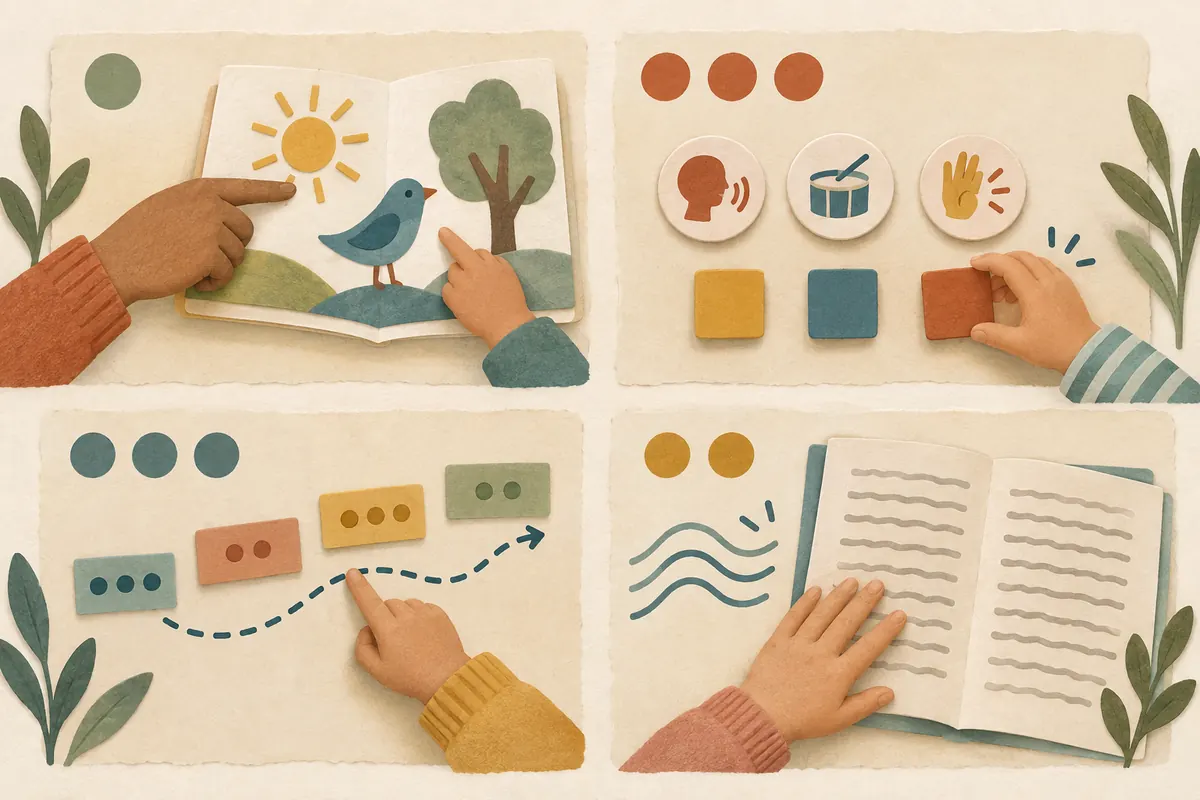
Ratings describe evidence behind a recommendation
The What Works Clearinghouse guide was released in 2016 and revised in December 2019. It gives ratings to four recommendations for foundational reading in grades K–3. Academic language and vocabulary receive a minimal-evidence rating. Linking speech sounds with letters and teaching decoding, word parts, writing, and word recognition receive strong-evidence ratings. Daily connected-text reading for accuracy, fluency, and comprehension receives a moderate-evidence rating.
These labels should not be read as direct measurements that compare the size of learning gains across recommendations. “Strong” does not mean every student will benefit more from that practice, and “minimal” does not mean there is no evidence or no possible value. The page reports evidence ratings for recommendations; educators should also read the detailed recommendation, intended grade range, and explanation of the supporting research.
The recommendations address different learning tasks
The first recommendation concerns academic-language skills, including vocabulary and inferential or narrative language. The second addresses hearing segments of speech and linking them to letters. The third covers decoding words, analyzing word parts, writing, and recognizing words. The fourth calls for daily connected-text reading to support accuracy, fluency, and comprehension.
Keeping the tasks distinct prevents a single score from standing in for the entire process. Correctly reading a list of words can provide practice in decoding, but it does not by itself show whether a student understands a sentence. Listening to a passage and explaining it does not necessarily provide practice connecting letters and sounds. First identify the skill an activity is intended to teach, then look for evidence that the learner is engaging in that task.
Do not turn the ratings into a “best method” ladder
Choosing only the strongly rated recommendations and dropping the others goes beyond what the guide says. Each recommendation addresses a different area, and the guide includes academic language and vocabulary even though that recommendation is rated minimal evidence. A moderate rating for connected-text reading is not an instruction to deprioritize reading practice or comprehension.
Evidence ratings also cannot choose a commercial program automatically. Educators need to consider whether the research population, instructional conditions, and recommendation match their curriculum and a particular learner’s needs. The guide is written for U.S. kindergarten through grade 3; its recommendations should not be assumed to transfer unchanged to other languages, writing systems, or education settings.
Read expert commentary separately from the rating table
In a 2019 post, literacy educator Timothy Shanahan argues that “science of reading” should not be reduced to phonics alone or to one commercial program. His article is an expert interpretation, not the same kind of source as the WWC evidence table. Use the WWC guide for the recommendation wording and ratings; use Shanahan’s discussion as context for why reading instruction spans more than one component.
One expert essay cannot prescribe a method for every learner or classroom. An official guide also cannot diagnose which skill is creating difficulty for an individual student. Keeping research ratings, expert interpretation, and classroom observation distinct helps educators avoid making a broader claim than any one source supports.
Use the guide to review learning opportunities
A teacher can map where current instruction includes vocabulary and oral-language work, sound–letter connections, decoding unfamiliar words, and daily connected-text reading. Then ask what a student actually practices during each activity and whether that practice fits the recommendation and grade range. The purpose is to find missed learning opportunities, not to fill in a checklist for its own sake.
Records are more useful when they describe what the student did rather than only naming an activity. Did the student apply letter–sound knowledge to a new word, read a connected sentence accurately, and explain what the passage or a new word meant? Keeping those observations separate avoids treating one score as a complete measure of reading. If concerns continue, use the school’s specialist-support process instead of assuming that one teaching approach fits every learner.