Digital Cultural Heritage: Preserve Community Protocols with the Files
Connect community-defined access and reuse conditions to metadata, derivatives, and transfers without treating labels as access controls.
Publication & corrections: infostoa · Editorial standards
Individual author and specialist reviewer information is not provided for this article.
A digital heritage collection can outlive its original platform, but the rules for viewing and reusing its files may not travel with it. A photograph, recording, oral history, or ceremonial item can be copied into a new repository, search index, exhibition, research dataset, or model pipeline. If the governing community’s conditions disappear during that transfer, technical preservation can succeed while the relationship and responsibilities around the material are lost. This article focuses on metadata and protocols for Indigenous and community-linked heritage; a label is not, by itself, a legal permission or a technical access-control system.
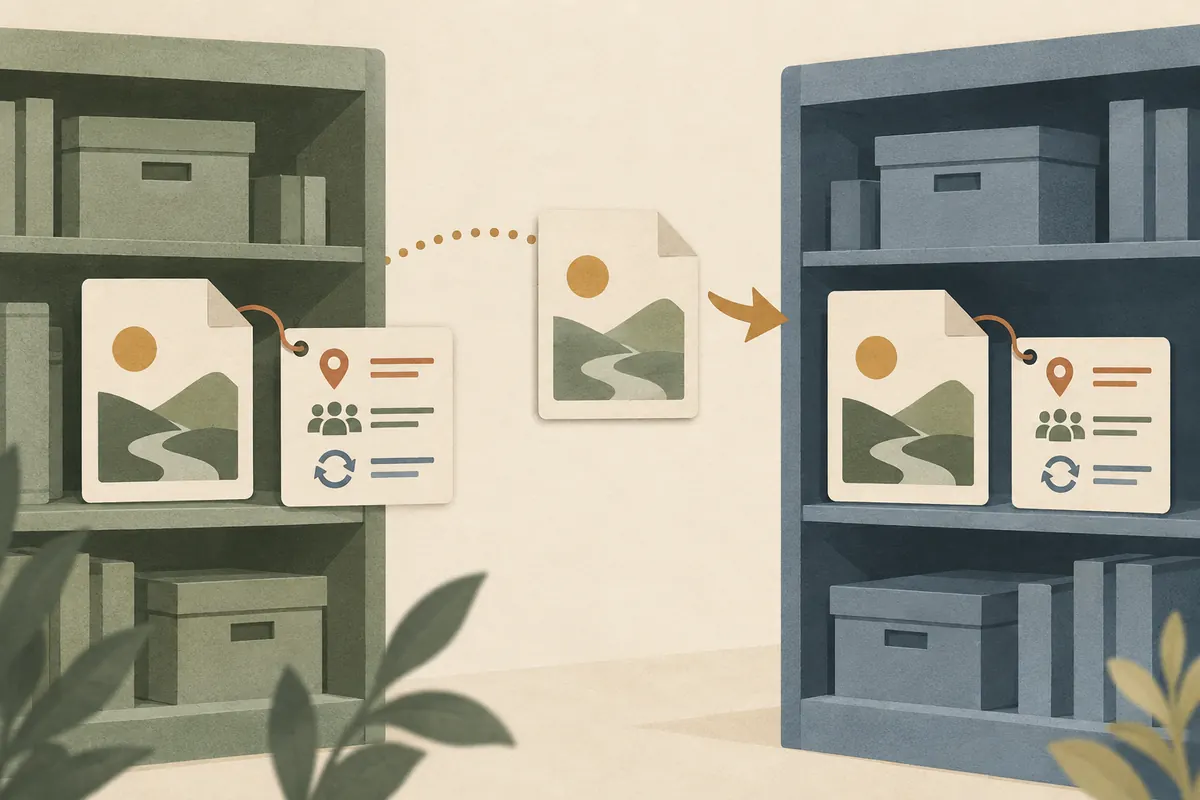
File description and community protocol are different layers
Descriptive metadata—title, creator, date, format, identifier, and rights statement—helps people find and manage a file. It does not answer every question about who may see it, how it may circulate, or which future uses are acceptable. A single public/private flag can flatten conditions that vary by season, gender, ceremony, place, or relationship. The record should preserve the distinction between what a file is and the community-specific responsibilities attached to engaging with it.
Local Contexts’ Traditional Knowledge (TK) Labels were developed with Indigenous communities and local organizations to express protocols for cultural materials circulating digitally beyond community contexts. Its system distinguishes Provenance, Protocol, and Permission labels. These can identify a primary cultural authority or other interests, communicate access protocols, and indicate activities generally approved by the community while directing other uses to engage with cultural authorities. The labels provide context and guidance; they do not automatically encrypt a file, prevent copying, or create legal rights on their own.
Who sets and updates the conditions
Carroll and colleagues’ peer-reviewed CARE Principles paper presents Collective Benefit, Authority to Control, Responsibility, and Ethics as a people- and purpose-oriented complement to data-centric openness principles. It argues that Indigenous Peoples should determine governance protocols and participate actively in stewardship decisions, including when another institution holds the data. Custody of a collection therefore does not, by itself, settle who may set its terms of access or reuse.
A workable process names the community-recognized authority, the people who need to be consulted, the accessible language and time for that process, and how disagreements or changes in authority will be handled. Rather than a lone “consent: yes” field, a record can link the approving authority, scope, affected items, permitted purposes, conditions, decision date, and a route for review, renewal, or withdrawal. These fields should record only what the community has agreed may be documented. Do not expose sensitive locations, identities, or restricted ceremonial detail merely to make a catalogue appear complete.
Carry conditions into copies and derivatives
A protocol attached only to the original catalogue record can disappear when a thumbnail, transcript, caption, export, machine-learning dataset, or third-party cache is created. Before transfer, check which labels or usage statements can accompany the derivative, whether a stable link to the community-approved context remains, and whether a search result could reveal a restricted title or description. Where a platform cannot retain the protocol, the repository needs a separate handoff and stewardship process rather than silently treating the item as unrestricted.
Conditions can change as relationships and community decisions change. Metadata should therefore identify when it was reviewed and how an authorized party can request correction. The plan can name who takes responsibility if the repository closes or a legal duty conflicts with an access restriction. None of these fields can resolve the conflict alone; they make it visible early enough to consult the right people.
Expert perspective: CARE asks about relationships before openness
The CARE paper in Data Science Journal explains why findability, accessibility, interoperability, and reuse alone do not address power, collective benefit, and the consequences of secondary use. CARE asks who benefits, who controls decisions, who is responsible for respectful relationships, and how people and communities can assess harms and future uses over the data lifecycle. The paper also notes that practical tools and policies are still needed to implement CARE in repositories, co-produced knowledge, and existing databases.
A label is not proof that an institution has met CARE, and one community’s preferred wording should not be generalized to another. Begin with the authority and protocols identified by the relevant community, represent them in terms that community approves, and test whether downstream systems preserve the meaning. Copyright, privacy, contract terms, and community protocols can overlap without being identical, so review each separately. The aim is accountable stewardship, not a claim that metadata alone can control every later use.