How Scientists Measured DART’s Change to an Asteroid’s Orbit
DART shortened Dimorphos’s orbital period by about 32 minutes. See how brightness measurements revealed the change, how debris recoil matters, and what the experiment does and does not establish.
Publication & corrections: infostoa · Editorial standards
Individual author and specialist reviewer information is not provided for this article.
What counted as a successful impact?
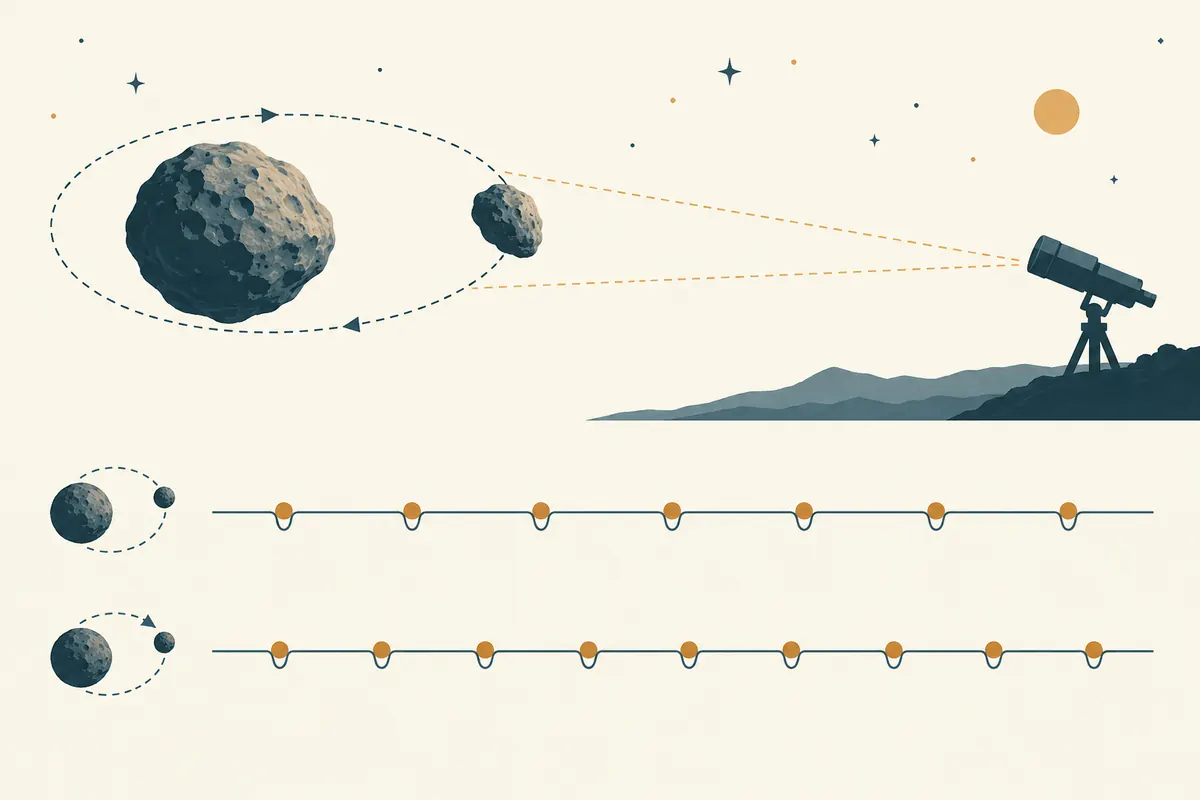
On October 11, 2022, NASA’s DART investigation team announced an initial estimate that Dimorphos’s orbit around Didymos had shortened by about 32 ± 2 minutes. Thomas and colleagues later reported a refined change of 33.0 ± 1.0 minutes (3σ) in their Nature paper published March 1, 2023. These are measurements from different analysis stages, and both describe Dimorphos’s orbital period in its binary system—not an asteroid redirected away from Earth. NASA’s 2022 announcement Thomas et al., 2023 paper
How can astronomers measure an orbit they cannot resolve?
From Earth, Dimorphos appears as a tiny point, so simply comparing its position in individual images is not the useful measurement. Instead, astronomers observe how the brightness of the Didymos system changes over time. As Dimorphos passes in front of or behind Didymos, the system dims in a recurring pattern. The timing of those events lets researchers estimate the orbital period. If the events recur earlier after an impact, the smaller body is completing an orbit sooner. The Nature study combined ground-based photometric observations from multiple observatories to determine the change. Its title is “Orbital period change of Dimorphos due to the DART kinetic impact,” and it was published on March 1, 2023. Thomas et al., Nature
This approach can detect a timing shift without resolving a small asteroid into a detailed image. It also depends on observing cadence, weather, telescope location, and how well a model fits the repeating light curve. A reported value should therefore be read with its observation period and uncertainty. Both values describe this binary system’s period change; neither supplies a universal deflection amount for other asteroids.
Spacecraft push and debris recoil
The spacecraft transferred momentum to its target, but the effect need not equal the spacecraft’s momentum alone. Material blasted off the surface carries momentum away. The resulting recoil can give the asteroid an additional push in the opposite direction, somewhat like a jet of escaping gas. NASA says ejecta substantially enhanced DART’s push, while also noting that the target’s surface and strength were still being studied.
The Nature paper reports an observed orbital-period change. Interpreting the efficiency of momentum transfer requires combining that measurement with estimates of the target’s mass and physical properties. The period shift is an observational result; explanations involving internal structure and the amount or behavior of ejecta depend on further measurements and models. One impact on one small moon cannot establish the same response for bodies with different sizes, compositions, or surfaces.
Expert perspective: a technology demonstration is not a complete defense system
These are estimates of the same binary orbital-period change from the 2022 impact, analyzed at different stages. The refined estimate is not a second impact separate from NASA’s early report. When citing a value, identify the analysis date and its uncertainty. They should not be added together or restated as a change in an Earth-centered trajectory.
NASA’s investigation team drew a useful boundary around the result. It confirmed a real orbital change that exceeded the mission’s minimum success benchmark, while explaining that the momentum-transfer efficiency still depends on ejecta and on properties such as the target’s mass and surface strength. That distinction does not diminish the demonstration. It identifies what the experiment directly measured and what scientists still need to infer.
DART tested one controlled impact in a known binary system. Responding to a real hazard would also require finding the object early, calculating its orbit well, having time to design and launch a mission, and understanding its physical properties. The measured timing shift demonstrates that kinetic impact can alter an orbit, but it does not guarantee that every threat could be stopped or that the same technique would work equally well for every object. NASA also stated that neither Didymos nor Dimorphos posed a hazard to Earth before or after the test. A successful experiment and an actual Earth-impact risk assessment answer different questions.