Cultural Heritage Impact Assessment: Whose Values Count?
Assess a project’s effects on heritage values by tracing attributes, participation, alternatives, mitigation, and residual impacts before a decision.
Publication & corrections: infostoa · Editorial standards
Individual author and specialist reviewer information is not provided for this article.
What an impact assessment asks
A cultural heritage impact assessment (HIA) examines how a proposed development or infrastructure project could change the significance of a particular place before approval and design choices become difficult to reverse. It is more than an inventory of old structures inside a construction boundary. Relevant attributes may be physical, such as buildings or archaeological remains, and intangible, such as practices, knowledge, relationships, and social arrangements through which a place carries meaning. In a World Heritage context, the assessment should identify effects on Outstanding Universal Value (OUV), the attributes that convey it, and other conservation or cultural values rather than treating them as one interchangeable score.
That scope differs from ranking heritage places by exposure to climate hazards. HIA asks what this proposed action—its location, scale, construction method, and operation—may do to identified values, and what alternatives exist. Record what may be affected, who describes its significance, the supporting evidence, and remaining uncertainty.
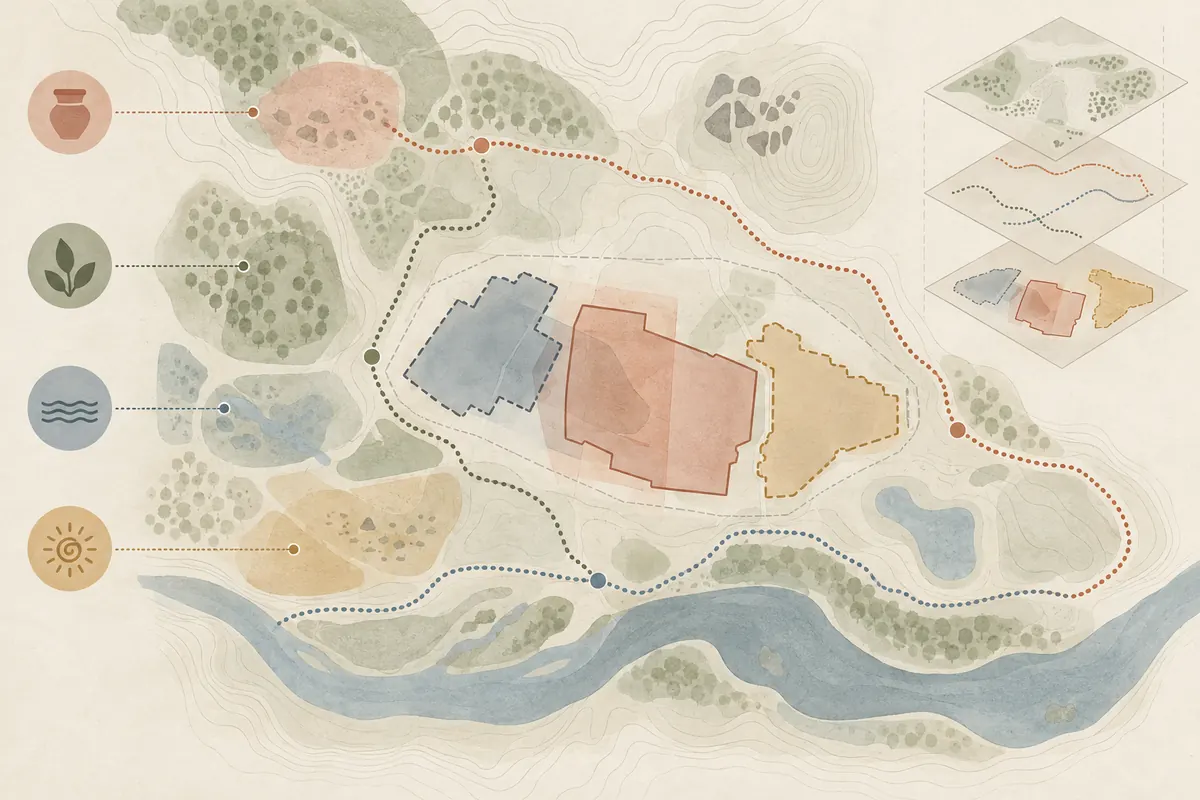
Who describes the place’s values
Heritage specialists can interpret evidence in architecture, archaeology, history, landscape, and other relevant fields, but professional expertise alone cannot represent every meaning attached to a place. The co-authored guidance calls for inclusive and equitable participation by rights-holders, Indigenous peoples, local communities, and stakeholders, with their concerns meaningfully considered. Asking residents for comments once is not equivalent to enabling participation in the assessment of effects, alternatives, and mitigation.
A participation plan identifies affected people, accessible languages and formats, timing, and how differences within a community will be recorded. It should not assume that traditional knowledge or sensitive place information can be published without agreement. The guidance treats values broadly: OUV can exist alongside local and national designations, Indigenous and community values, and the tangible or intangible attributes that convey them. Different accounts need not be averaged into a single number or collapsed into a consensus statement; their source and context can remain visible.
Compare alternatives before commitments harden
The UNESCO, ICCROM, ICOMOS, and IUCN guidance recommends starting assessment at the earliest stage of consideration, before commitments or irreversible activity constrain choices. It calls for evaluating reasonable alternatives, including the option not to proceed. Compare relocation, a smaller footprint, construction methods, or access changes by asking which attributes each option affects or protects.
Alternatives are not simply a cost-and-schedule table. They should show consequences for the place’s values and attributes and for communities’ continuing relationships and uses. If evidence is incomplete, state the limitation and identify further study, consultation, or design pause as a condition for the next decision. The team needs expertise suited to both the place and the proposed action, while specialist input does not replace participation by affected people.
Mitigation, cumulative effects, and what remains
When an effect cannot be avoided, assess design changes and operating conditions that could reduce it, then state clearly what cannot be conserved. The guidance asks assessors to consider the broader context and cumulative effects, and treats assessment as iterative: new consultation or mitigation can require reassessment. Tie mitigation to an accountable party, timing, and a verification method. A written measure should not be assumed to reverse every loss of significance.
Decision materials should distinguish residual effects after avoidance and mitigation from effects that have not yet been assessed, and should name monitoring conditions. The purpose is to inform the authorized decision-maker, not to make the project automatically acceptable or unacceptable. Recommendations should connect evidence, alternatives, uncertainty, and community views. New information may require reviewing conditions and management measures.
Expert perspective: significance is expressed through attributes and relationships
Australia ICOMOS describes the Burra Charter and its Practice Notes as best-practice guidance for managing cultural heritage places in Australia. It lists “Understanding and assessing cultural significance” as a dedicated note. This professional perspective reinforces why assessment should look beyond an isolated building to context, relationships, and uses that carry significance. The Australian practice material does not replace the co-authored international guidance’s participation principles or establish the legal approval test for a project elsewhere.
Trace each value from evidence and contributor to the attributes or practices that express it, then to the proposed change. This makes disagreements visible and supports comparison without reducing unlike meanings to one metric. Statutory procedures and submission requirements still depend on jurisdiction and designation.