Cross-Currency Basis Swaps: Why CIP Gaps Affect Dollar Funding
Understand cross-currency versus FX swaps, how to read the basis, and why hedging demand and intermediary constraints can affect synthetic dollar funding costs.
Publication & corrections: infostoa · Editorial standards
Individual author and specialist reviewer information is not provided for this article.
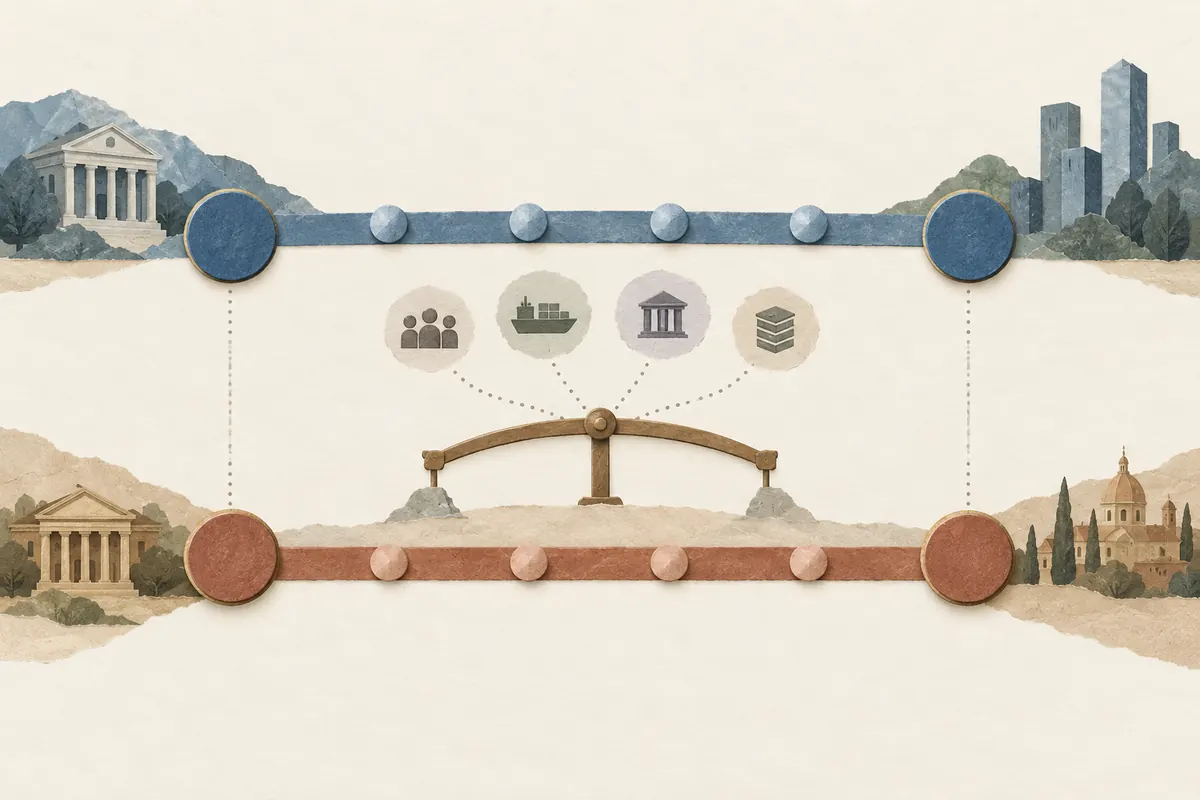
A cross-currency basis swap exchanges principal and interest cash flows in two currencies. The basis is an adjustment from the relationship implied by reference-rate differentials and forward exchange pricing. Covered interest parity (CIP) is the no-arbitrage relationship under which returns in two currencies should align once exchange-rate risk is hedged. In real markets, hedging demand, funding supply, transaction costs, and intermediary balance-sheet constraints can leave a gap.
A swap exchanges currency cash flows
In a cross-currency swap, parties may exchange principal amounts in different currencies at the start and maturity and exchange interest payments during the contract. A cross-currency basis swap generally exchanges floating-rate cash flows, with a basis spread added to or subtracted from one reference-rate leg. The contract specifies which notionals and cash flows are exchanged, the re-exchange terms, and settlement dates.
An FX swap exchanges two currencies at the spot rate and reverses the exchange at an agreed forward rate. It is not the same instrument as a longer-term cross-currency swap. The markets are linked through CIP, but their maturities, cash flows, and conventions differ. Treating FX forward points as the same quantity as a basis spread can mislead.
What CIP and the basis describe
CIP says that the interest-rate difference between two cash markets should be reflected in the relationship between spot and forward exchange rates. In simplified terms, directly borrowing one currency should cost the same as borrowing another currency and converting it through an FX swap into synthetic funding. When traded prices depart from this relationship, the difference is called the cross-currency basis. The sign depends on the currency pair, quotation convention, and which interest leg carries the spread.
BIS and ECB historical analyses discuss periods when swapped dollar funding in specific markets such as EUR/USD cost more than the reference-rate differential alone implied. That evidence should not be generalized to every currency pair today, nor turned into a universal rule that a negative sign always means higher costs for a dollar borrower. Check the contract’s quotation direction and payment legs, and identify the pair, maturity, reference rates, and trade date.
Hedging demand and arbitrage limits shape prices
An investor holding foreign assets or a company issuing debt in another currency may use swaps to reduce exchange-rate exposure. If demand to borrow a currency such as the dollar exceeds supply, relative prices can adjust and the basis can widen. Banks and other intermediaries may trade against the imbalance, but that arbitrage is not costless or risk-free. Credit, liquidity, collateral, capital, and balance-sheet costs can constrain the amount of risk they can take.
The BIS analysis describes hedging demand as one force that can open the basis and balance-sheet and risk-management constraints as factors that can limit its closing. ECB Occasional Paper No. 228’s historical EUR/USD analysis was by Thomas Brophy and six co-authors. The paper says its views are the authors’ and do not necessarily represent the ECB; it examines policy divergence, cross-border flows, and reporting-date funding constraints. These are explanations for particular samples and periods. To explain the current basis or a policy effect, analysts must examine recent transaction data and other possible drivers.
Compare actual funding costs on consistent terms
A comparison between direct borrowing and synthetic funding should use the same date, maturity, credit exposure, and settlement assumptions. Check the reference rates, the direction in which the basis is quoted, principal exchanges, collateral and margin, counterparty limits, bid-ask costs, and fees. Historical studies may assume LIBOR, EURIBOR, or regulatory conditions that have since changed. Current contracts may use replacement reference rates and newer documentation, so old formulas and observations should not be copied forward without adjustment.
Central-bank swap lines and emergency dollar facilities are also distinct from private-market cross-currency swaps. They operate under policy terms for eligible institutions and dates; they are not automatic backstops available directly to every market participant. Analysts should state the date and instrument definition and should not treat the basis alone as an investment return or a standalone forecast of exchange rates. This article explains market structure and does not recommend a trade or hedge.