Cooled and Reheated Rice: What One Resistant-Starch Trial Measured
A close reading of one randomized crossover study in 15 healthy adults: a specific IR-64 white-rice preparation, resistant-starch content, and a single-meal glucose-response measure. The result does not establish a general rice method or diabetes treatment.
Publication & corrections: infostoa · Editorial standards
Individual author and specialist reviewer information is not provided for this article.
The finding is a single-meal result under specific conditions
A 2015 study reported more resistant starch and a lower post-meal glucose incremental area under the curve (IAUC) after participants ate white rice that had been chilled at 4°C for 24 hours and reheated, compared with freshly cooked rice. The human experiment was a randomized, single-blind crossover study in 15 healthy adults. Its result belongs to one rice variety, a defined preparation, a small group, and one test meal. It does not show that cooling rice lowers glucose for everyone or that the method treats diabetes. This article reads the measured scope of that one trial. It does not present general starch chemistry, a recipe for rice preparation, or food-storage advice.
The laboratory comparison and the human test used different conditions
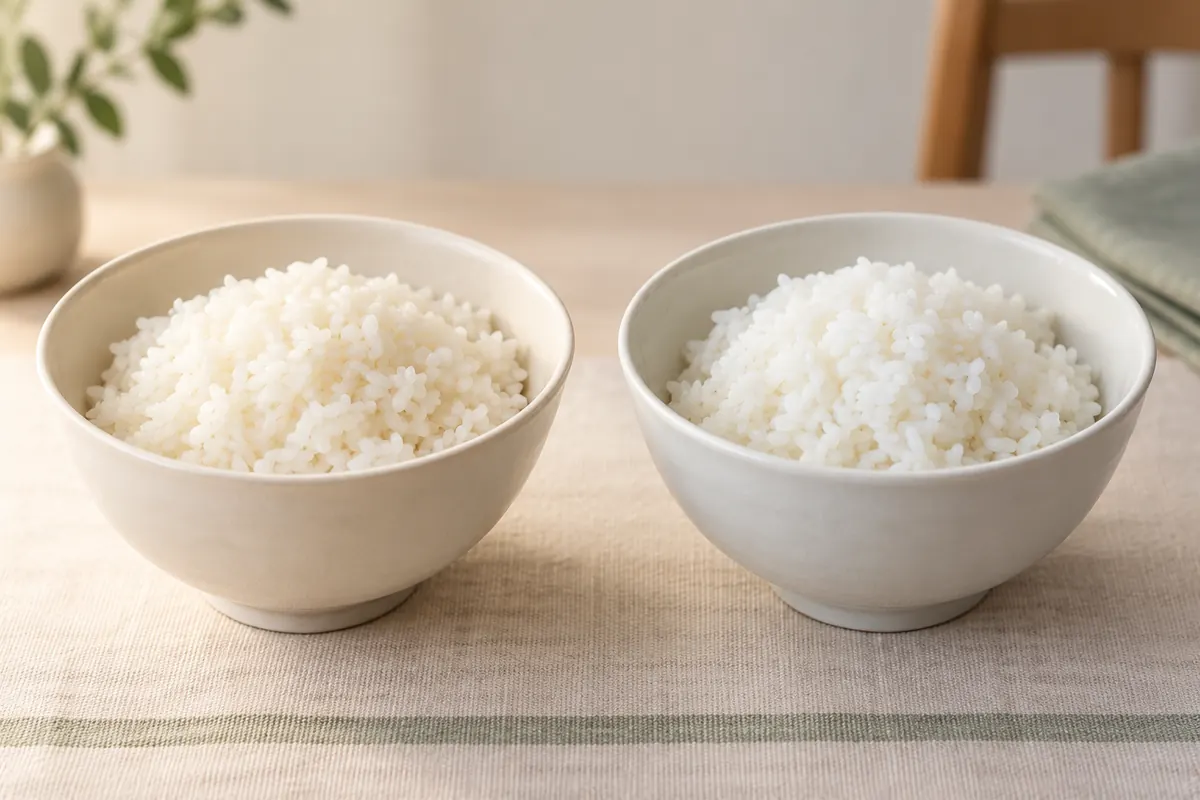
The researchers analyzed resistant starch in Indonesian-grown IR-64 white rice prepared in three ways: freshly cooked control rice; test rice I held for 10 hours at about 27°C; and test rice II cooled at 4°C for 24 hours and then reheated in a rice cooker. Reported resistant-starch contents were 0.64, 1.30, and 1.65 grams per 100 grams, respectively. Because test rice II had the higher content, it was selected for the human study. The room-temperature rice was not fed to participants. In the clinical comparison, each volunteer ate freshly cooked rice at one breakfast and the 4°C-cooled, reheated rice at another. Each meal contained 125 grams of rice, a 60-gram standard omelette, and 240 milliliters of water. Keeping those stages separate matters: the paper measured composition in three preparations but post-meal glucose response in only two.
The measured glucose differences varied by time point
Blood glucose was measured at the first bite and at 15, 30, 45, 60, 90, and 120 minutes; the authors calculated a two-hour incremental area under the curve (IAUC). Glucose and IAUC analyses included 14 participants, after one person’s data were excluded following unusual vigorous activity before a session. IAUC was 125±50.1 mmol·min/L after the cooled-and-reheated rice and 152±48.3 after fresh rice (p=0.047). The pattern was not lower at every measurement: the 15-minute reading was higher after test rice, there was no statistically significant difference at 30, 90, or 120 minutes, and readings at 45 and 60 minutes were lower. The accurate claim is a difference in one meal’s two-hour IAUC and at selected time points, not a consistently lower glucose curve.
Expert perspective: do not turn a small trial into a dietary prescription
Harvard T.H. Chan School of Public Health’s Nutrition Source classifies resistant starch as a fermentable fiber and notes it in foods such as cooked-and-cooled pasta and potatoes. That overview helps explain the term; it does not independently replicate this rice trial or establish an effect for all rice. The experiment enrolled healthy adults aged 20 to 40, studied one rice variety and one defined breakfast, and observed an acute response. It did not test people with diabetes, long-term glucose control, or clinical outcomes. The sample was small, one participant’s glucose data were excluded, and the authors noted that participants could distinguish the rice by texture. The result cannot be assumed to hold across varieties, cookers, cooling periods, reheating methods, repeated meals, or individual health conditions. A higher resistant-starch measurement is not itself proof of a meaningful health benefit. The trial also was not a food-safety study, so it cannot establish safe storage practices. Those are separate questions and outside this article’s evidence scope.