Community Museum Collecting: Start with Place and Relationships
A practical framework for weighing place-based meaning, community participation, rights, and long-term stewardship before adding an object to a local collection.
Publication & corrections: infostoa · Editorial standards
Individual author and specialist reviewer information is not provided for this article.
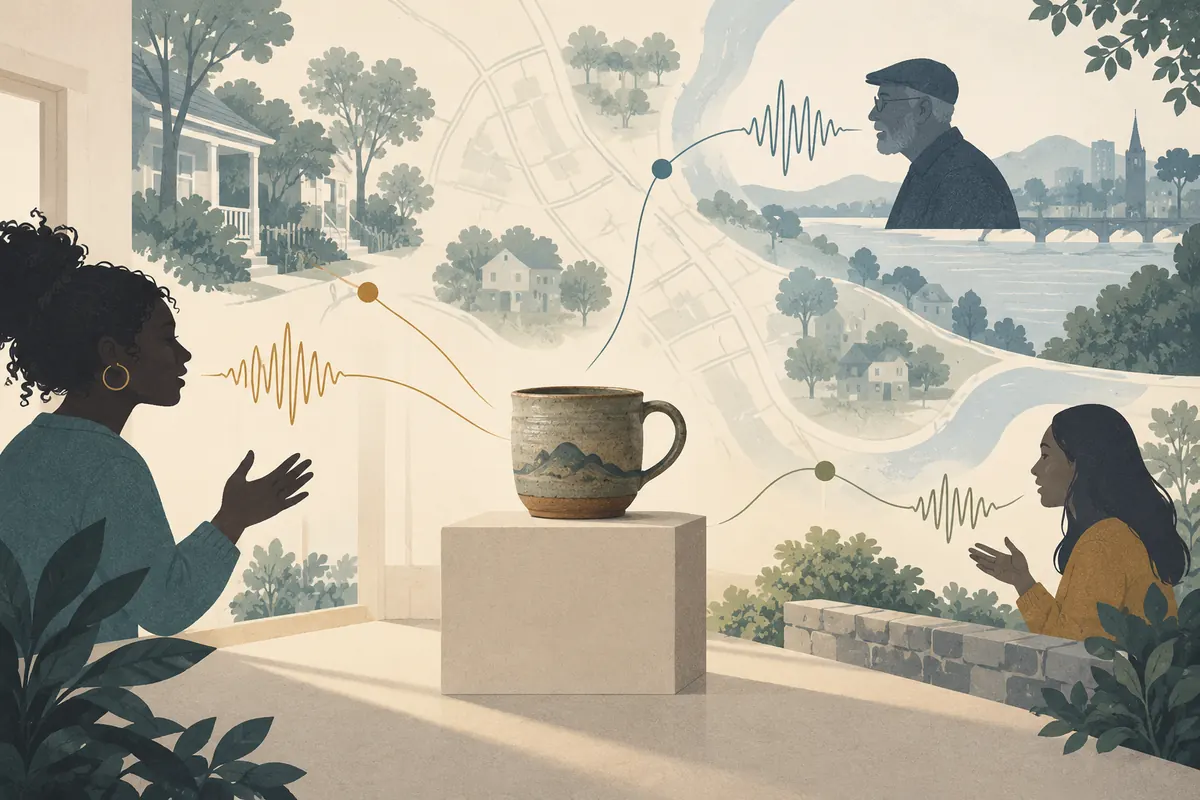
Collecting in a local museum is not simply accumulating old objects. It is a choice about what to care for and with whom to interpret its meaning. An object may connect changes to a place with work, migration, craft, or memory, yet accepting everything can exceed the museum’s storage and documentation capacity. The International Council of Museums (ICOM) definition adopted in 2022 describes research, collecting, conservation, interpretation, and exhibition of tangible and intangible heritage alongside accessibility, inclusion, ethical practice, and community participation. The Museums Association’s collections recommendations call for strategic collecting with communities and listening for meanings a curator working alone could overlook.
Ask about place and relationships before the object
When someone offers an object, begin with its connections as well as its age or rarity. Who made or used it? In which place and period did it matter? Who can describe the story? Similar objects may carry different memories for different communities. Even when an object is unavailable, oral accounts, photo captions, maps, or event records may help document a place’s significance.
This approach does not mean that every story must become museum property. An interview, temporary exhibition, community-managed record, or reinterpretation of an existing collection may be more appropriate. Deciding what to collect and deciding what story to document are separate judgments. A museum may record a story with permission without accepting an object; accepting an object does not automatically grant permission to publish the donor’s account online or in an exhibition.
Make collecting criteria concrete with communities
ICOM connects community participation with ethical and professional museum work. The Museums Association recommends listening to audiences, users, and non-visitors and collecting strategically in partnership with communities. A local museum can translate these ideas into specific questions: whose experience is already well documented across places, activities, generations, and occupations, and what is missing?
Useful questions include how a proposed object relates to existing stories, whether the people connected to it want to take part in collecting and interpretation, whether ownership and donation terms are clear, and whether the museum can support conservation and access over time. Do not assume that one person represents an entire community; different groups may hold different views. Participation alone does not guarantee consensus or representativeness.
Weigh public value against long-term responsibility
New material can support research, education, or interpretation. It also creates obligations: safe storage, condition checks, cataloguing, rights and privacy management, and a plan for access. Digital stories and images need more than file storage. The museum should clarify who can view them, whether names, locations, or sensitive accounts can be made public, and which media and time periods a permission covers.
A small institution may have limited storage and specialist staff. Before acquisition, it can check existing holdings and other institutions’ collections, then consider shared collecting, a long-term loan, or a documentation partnership. The Museums Association also recommends collaboration between museums. Information sharing does not itself transfer ownership or publication rights; terms and responsibilities still need to be recorded.
Expert perspective: connect strategic collecting with use and access
The Museums Association explains that collecting should not be done merely to increase the number of objects; it should connect to plans for use and access. This is a professional recommendation, not a rule that dictates which object any particular museum must accept. A real decision depends on local history, community priorities, the museum’s collecting policy, legal rights, and conservation capacity. Partnership can be designed as a conversation about the purpose, conditions, and access boundaries of collecting and documentation, rather than a process aimed at persuading someone to donate.
Record the decision and be ready to explain it again
A brief record of why the museum accepted, deferred, or declined an offer helps the next staff member understand the criteria and lets the museum explain its reasoning to the donor. It can note the place and relationships considered, historical context, legal ownership and publication rights, conservation capacity, the scope of community input, and what remains uncertain. For a deferred offer, state what would trigger reconsideration. For a declined offer, consider whether another form of documentation or another institution may be a better fit.
Criteria should be published and reviewed in light of the museum’s mission and local context. A public policy does not mean that everyone will agree, and new collecting does not automatically repair past omissions. Considering objects, places, relationships, and stewardship together can make the reasons and limits of a decision more transparent.