Coffee Extraction Variables: Grind, Time, and Water
Research comparing brewers and an expert extraction-kinetics study explain how grind, ratio, water, contact time, and flow interact—and why no single recipe fits every brewer.
Publication & corrections: infostoa · Editorial standards
Individual author and specialist reviewer information is not provided for this article.
To tune coffee, consider more than grind size. Record the coffee-to-water ratio, particle distribution, water, contact time, brewer, and flow. Start from the same coffee and device, then change one condition at a time so that results are easier to reproduce.
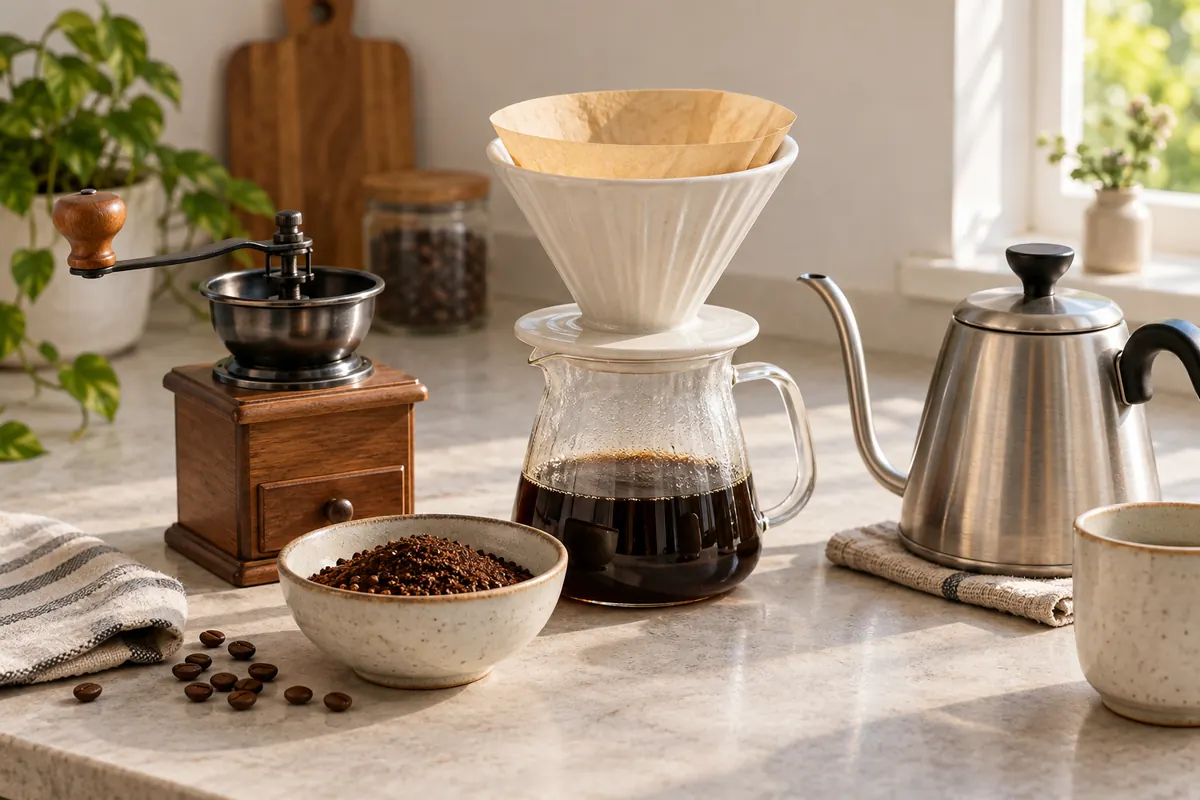
Extraction variables interact
Hot water dissolves soluble material from ground coffee. A finer grind exposes more surface and shortens the distance from a particle’s interior to its surface, which can change extraction speed. But uneven particle sizes or water flowing through only part of the bed can reduce uniformity. Finer does not automatically mean better: the filter, brewer, flow, and coffee also matter.
Brew ratio is a starting point for recording a recipe. Beverage strength describes dissolved coffee relative to the finished beverage volume; extraction yield describes the share of dry grounds that moved into the water. The measures are related but different. Even at the same ratio, grind, temperature, contact time, and flow can change concentration and sensory character.
A study comparing extraction methods
Santanatoglia and colleagues prepared the same medium-roast Kenyan Arabica with Pure Brew, V60, AeroPress, and French Press. They used method-specific grind sizes and compared volatile compounds and sensory traits across repeated samples. The four methods showed different profiles. The result indicates that filters, water paths, immersion, and pressure can affect a cup even when the coffee is held constant.
The experiment covered one coffee and defined equipment and conditions. It does not rank methods for all beans or provide a universal recipe. The authors say further targeted work is needed to connect chemical markers with sensory perception. Pour-over flow and drainage differ from immersion time and filtration; begin with instructions for the brewer in hand rather than transferring another device’s grind setting or timing.
Expert research: surface dissolution and internal diffusion
Moroney and colleagues explain that exposed surface solubles can dissolve relatively quickly, while material inside a grain’s pore network takes longer to move toward the surface. These different time scales help explain why grind and contact time may not act identically throughout a brew.
Their paper lists ratio, grind size and distribution, time, water temperature, agitation, water quality, and extraction uniformity as variables. Its simplified mathematical model is specialized to a dilute, well-mixed suspension of coffee grains in a fixed water volume. It is not a complete model of every pour-over bed, pressure brewer, or coffee. Use it to understand relationships, not to claim one setting is always optimal.
Test one condition at a time
Record the coffee and roast, grinder, dose, water, brewer and filter, temperature, and finish time for a baseline. If flow seems unusually fast or slow, change grind one step and keep the rest stable. Repeat a changed result before assigning a cause; pouring, bed shape, and measurement variation also matter.
If grind changes do not help, inspect particle distribution, water flow, filter blockage, and whether contact time fits the brewer. Keep immersion and separation times consistent for immersion methods. These are checks, not claims that a fault must exist. Record aroma, acidity, bitterness, body, and aftertaste in comparable terms, then adjust toward personal preference. When coffee or equipment changes, treat old notes as a starting point.
For comparisons on different days, also note how long the coffee has been stored and whether it was ground immediately before brewing. The method-comparison study controlled its material and preparation to compare brewers; a home trial adds variation in measurement, pouring, and grinder settings. Without recording those details, it is easy to mistake ordinary preparation variation for the effect of a recipe change.
A home grinder may not produce a particle distribution that can be described by one precise number. In that case, record the grinder and its setting, dose, and method, and repeat the same procedure. Water mineral composition can also affect extraction and sensory perception, but the two studies cited here do not justify recommending one bottled water or one mineral profile for every coffee. If you compare water, keep the other settings stable and interpret the result for that coffee and your own preference. This keeps the practical conclusion within what the research supports.