Climate Risk for Cultural Heritage: Record Values Alongside Indicators
Learn to document hazards, exposure, vulnerability, and tangible and intangible heritage values together, while treating scores as aids rather than universal priorities.
Publication & corrections: infostoa · Editorial standards
Individual author and specialist reviewer information is not provided for this article.
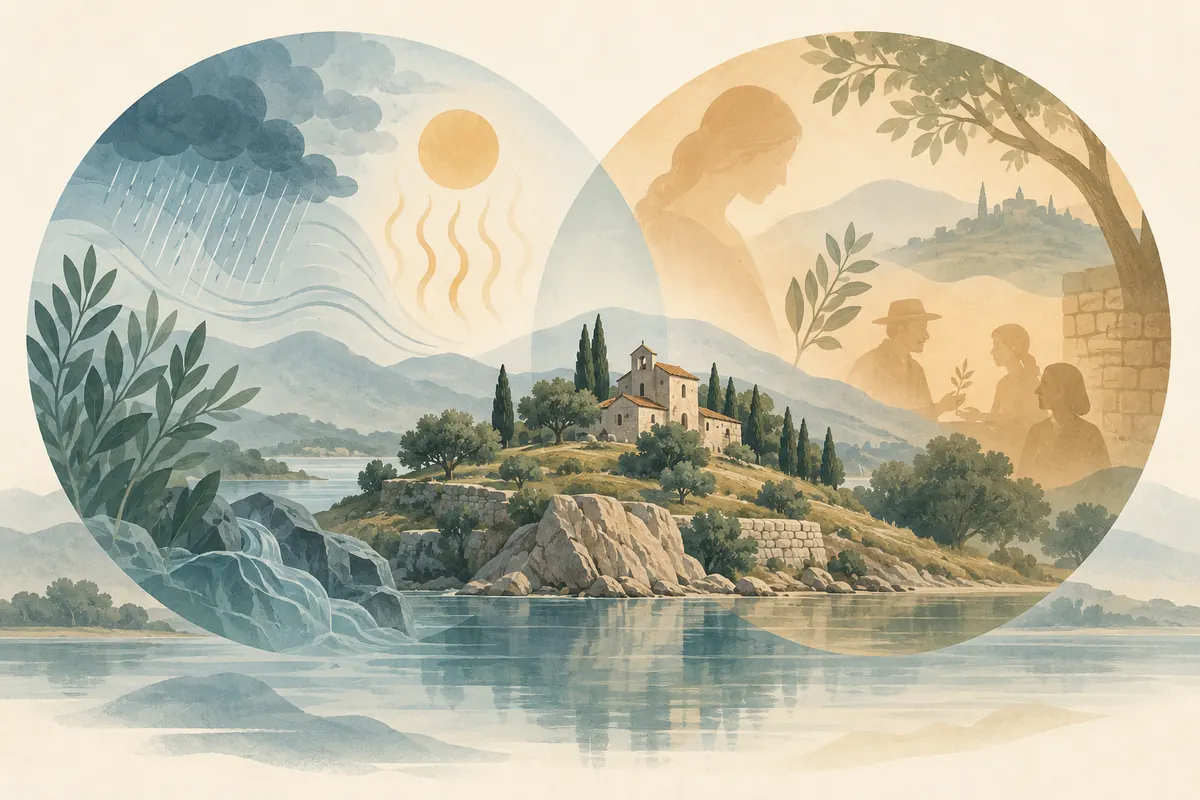
A climate-risk assessment for cultural heritage cannot be reduced to the measurements that are easiest to count, such as flood depth or the number of cracks. The same heatwave or cloudburst can affect a place differently depending on its materials, ecological setting, seasonal practices, livelihoods, and community memory. UNESCO’s culture-and-climate overview explains that culture and local knowledge can support climate adaptation and resilience, while climate risks threaten tangible heritage. The IPCC also notes that cultural significance may not be captured by quantitative indicators alone. Together, these sources support considering physical evidence alongside a place’s meaning; the UNESCO overview does not set site-specific legal duties.
Separate hazards, exposure, and vulnerability
Climate risk is not a single property that can be read directly from a map. Record the hazard being considered, the heritage feature or activity exposed to it, and the conditions that may increase damage or make recovery harder. Coastal salt and erosion, repeated heavy rain, and prolonged heat can change materials and landscapes through different pathways. Also note impact extent and duration, reversibility, and evidence uncertainty.
These sources do not establish a single legal duty or assessment procedure for every heritage place. Check local law, designation, site evidence, and responsible authorities separately.
Record what matters alongside what may be damaged
Explain a priority by identifying the value or attribute at stake. At a World Heritage property, this can include specific attributes that convey OUV and relevant aspects of authenticity or integrity. A place may also matter to local people through memory, ceremony, craft, routes, livelihoods, or relationships with a surrounding landscape. These local values are distinct from formally designated OUV but can inform management choices.
A comparison based only on damaged area or replacement cost can therefore miss questions about continued use, transmission, or identity. The reverse is also true: saying that a value matters does not by itself demonstrate a particular climate hazard or impact. Keep value records beside physical and climate evidence.
Use scores as aids to discussion, not as substitutes for judgment
When teams need to compare several places or features, they may build a table with criteria such as likelihood, extent, recovery time, and evidence confidence. Combining unlike values into one total can conceal which considerations received greater weight. Record the scoring method, evidence date, missing information, and who made the judgment. Explain that a lower score does not mean a place or practice is unimportant. Quantification can organize a discussion; it cannot measure community meaning on its behalf.
Expert perspective: let local knowledge and climate evidence test each other
The IPCC highlights exchange of cultural, historical, and technical information among stakeholders as relevant to adaptation decisions for cultural heritage. UNESCO describes culture and local knowledge as potential contributors to adaptation. In practice, teams can document the reach and limits of each kind of evidence rather than choosing between an expert score and community testimony. Seasonal patterns of use, memories of past damage, or local water paths missed by a monitoring station may add information that a climate projection or building survey does not contain. Participation alone does not guarantee consensus or representativeness; the record should also state who could not take part and where views differ.
Revisit priorities as evidence and conditions change
Climate hazards evolve, and vulnerability changes with conservation condition, site use, infrastructure, and local capacity. A plan can identify who will review the evidence and when, then explain how new damage or updated projections will trigger reconsideration of the affected attributes and priorities. When comparing possible responses, examine whether an action that reduces one hazard could harm another value or use, whether its effects are reversible, and what resources continued maintenance would require. These prompts are an editorial framework for local review, not a single scoring method required by UNESCO or the IPCC for every place.
Recording risk together with values can make a choice about “what comes first” easier to explain and revisit when evidence or perspectives change. It does not remove risk or guarantee that a particular intervention is correct. Local climate and materials specialists, site managers, rights holders, and community members need to check the evidence and their respective responsibilities.