Implementing a Climate Adaptation Choice for Living Heritage
After a heritage place is selected for action, compare feasible interventions and record operating conditions that support continuing practice.
Publication & corrections: infostoa · Editorial standards
Individual author and specialist reviewer information is not provided for this article.
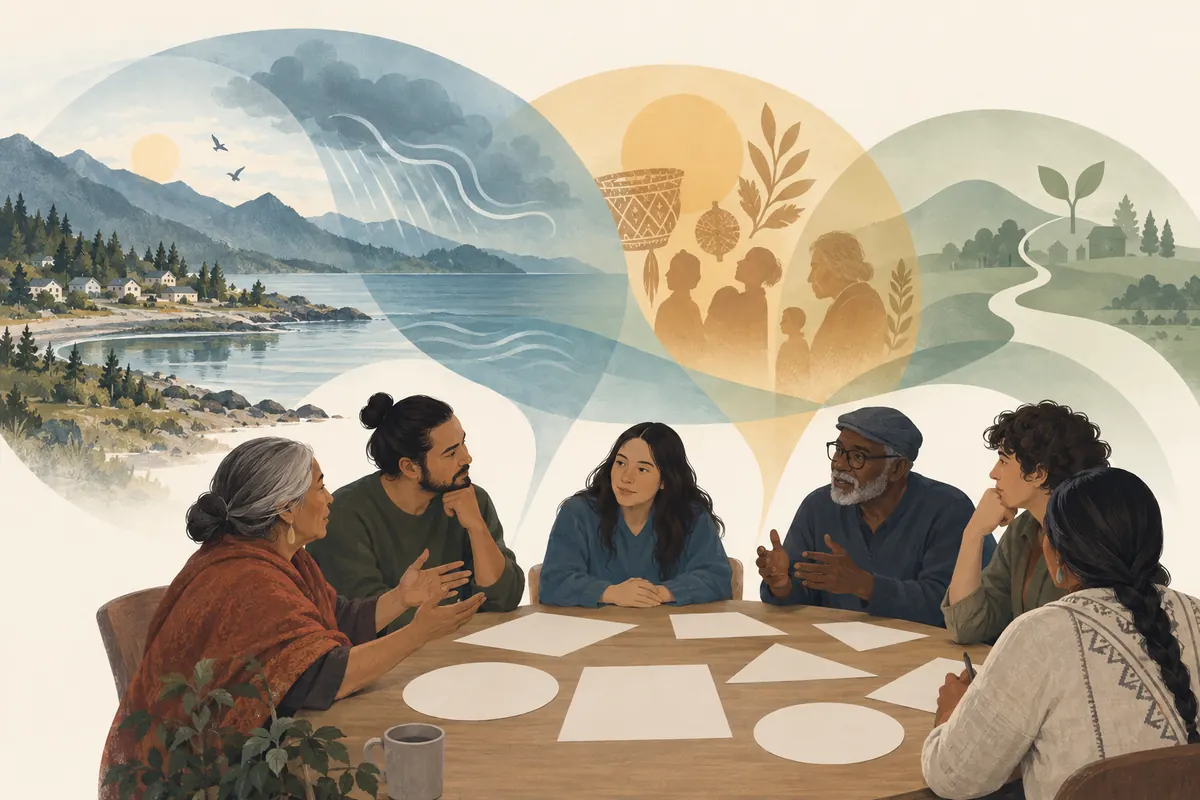
After a team has identified a climate risk and selected a heritage place for attention, it still has to choose an action that can be implemented. A measure that protects a building or site can also change access to the customs, skills, or gatherings that continue there. Section 6.3.3.6 of IPCC AR6 Working Group II Chapter 6 assesses impacts on tangible and intangible heritage and discusses built-heritage options ranging from monitoring, documentation, and maintenance to preservation or relocation. This guide is about the implementation decision for a place already selected for action. It does not rank heritage risks or decide which place should come first.
Define the decision after risk identification
Name the selected building, place, or practice, then specify which climate effect may disrupt which function. Flooding could close a work area, heat shift a seasonal gathering, or material shortages constrain a repair practice. Check each possibility against site evidence before presenting it as a local fact.
Separate an option’s potential effects on structures, access, practice materials and timing, and knowledge transmission. The IPCC says cultural significance cannot be determined solely through quantitative indicators and that effective decisions involve exchanging cultural, historical, and technical information. It does not prescribe one process for every community; one survey or score alone cannot justify an implementation choice.
Compare feasible actions and their side effects
Depending on a site, options may include monitoring and documentation, routine maintenance, preservation of core or shell elements, or elevating or relocating a structure. The IPCC categories summarize evidence and examples; they are not a universal prescription. A no-action or documentation-only option also deserves a record of costs, risks, and possible loss of knowledge. The assessment notes that financial constraints can shape long-term adaptation choices.
Record likely physical effects and implications for continuing practice. Relocation may reduce a hazard while changing ties between place and memory; reinforcement may affect use or compatible material supply. Maintenance may support continued use, but evidence must show whether it sufficiently reduces risk. List costs, operators, irreversible changes, and uncertainty separately; do not invent a composite score.
Set operating conditions with practitioners
UNESCO’s Convention for the Safeguarding of the Intangible Cultural Heritage concerns practices and associated spaces recognized and continually recreated by communities, and emphasizes community participation in safeguarding. For a particular project, a team can ask who carries on the practice, who needs access to the place and records, and whether any knowledge should not be disclosed or moved. The Convention alone does not establish a project-specific legal consent process, so applicable law and rights must be checked separately.
The implementation plan can state whether construction schedules conflict with seasonal activities, whether an alternate place or travel support is needed, and whether traditional materials and skills are available. Identify who pays and maintains the intervention and when practitioners and site managers will revisit its design. Attendance counts do not establish representation. Record who could not participate, unresolved disagreement, and evidence still needed before a decision is final.
Monitor the action and define when to revisit it
Approval does not end the assessment. Alongside physical damage and access restrictions, a team may monitor actual use, the seasons when an activity can take place, availability of materials and skills, and changes reported by practitioners. Suitable indicators depend on the site and practice. Where a change cannot be reduced to a number, combine participant accounts with observation records; do not generalize one case to all communities.
Set a review interval and an owner, then specify observable triggers—such as greater-than-expected damage, loss of access, or a shortage of materials—that will reopen the choice of action. This is an operational record for checking whether a selected intervention works as intended, not a scorecard for ranking climate risks. The IPCC also notes evidence gaps and the need for more research across contexts. A responsible plan records uncertainty and the information needed for the next review instead of guaranteeing success.
Expert perspective: record side effects of the selected action
The IPCC assessment describes how costs, cultural significance, stakeholder engagement, and institutional conditions can affect implementation. A practical review can therefore ask both “does this reduce the identified risk?” and “what practice, access, or relationship to place might it change?” This comparison does not calculate overall heritage priorities or guarantee that one intervention is correct. Local climate and materials specialists, responsible institutions, rights holders, and practitioners need to verify the evidence and their respective responsibilities.