Design Quiz Questions Around Goals, Feedback, and Next Steps
Focus on prompting retrieval of needed knowledge and deciding what to do with responses, rather than maximizing the number of questions.
Publication & corrections: infostoa · Editorial standards
Individual author and specialist reviewer information is not provided for this article.
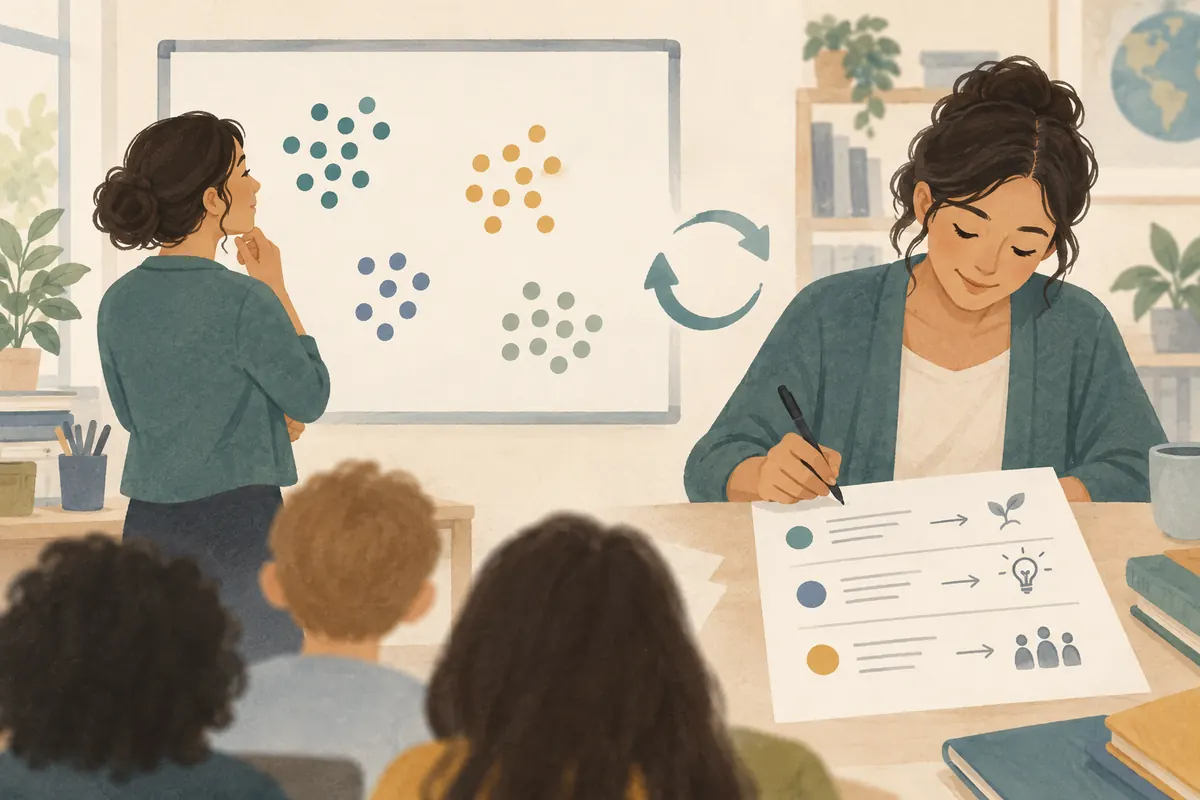
Use response patterns to choose the next lesson
If the same wrong answer appears across the class, reteach the idea to everyone with a different explanation or example. If a smaller group shares a misconception, give that group focused practice. If answers are dispersed, check individual reasoning and first test whether the item wording was ambiguous. Treat scores as hypotheses for the next lesson, not fixed measures of student ability.
Distinguish two quizzes with different evidence
The WWC summary describes pre-questions about not-yet-learned material (recommendation 5a) as having minimal evidence. Quizzing to re-expose learners to key content they have studied (5b) is rated strong evidence. They serve different purposes; do not treat results from pre-questions as proof of learning gains.
Record the path from feedback to a new check
If several learners reverse evaporation and condensation, revisit the direction of change with a diagram, then ask them to solve a new case. A compact record might read: Goal: distinguish state changes → error: reverses liquid-to-gas and the opposite → feedback: explain with particle diagram and arrows → next check: a different example item. At the next lesson, use a new question to check transfer instead of repeating the same item. This is an illustrative design, not an observed classroom result.
Review questions
How did you collect whole-class, subgroup, or individual reasoning? Did you check whether the item was ambiguous? Does your record connect the goal, error, feedback, and next check?
Sources: IES WWC: Organizing Instruction and Study to Improve Student Learning · Roediger et al. (2011), Test-Enhanced Learning in the Classroom