Chronic Venous Insufficiency: Valve Reflux, Swelling, and Evaluation
Understand how valve dysfunction and reflux can raise venous pressure, why symptoms alone cannot diagnose CVI, and how clinicians assess treatment options.
Publication & corrections: infostoa · Editorial standards
Individual author and specialist reviewer information is not provided for this article.
Chronic venous insufficiency (CVI) describes impaired return of blood from the legs toward the heart, often involving malfunctioning venous valves and reflux. Possible signs include ankle swelling, heaviness, skin discoloration, and ulcers that are difficult to heal. Those symptoms do not identify the cause by themselves. Clinicians begin with history and examination and may use duplex ultrasound to assess blood flow and vein structure. This overview explains the process; it cannot diagnose an individual.
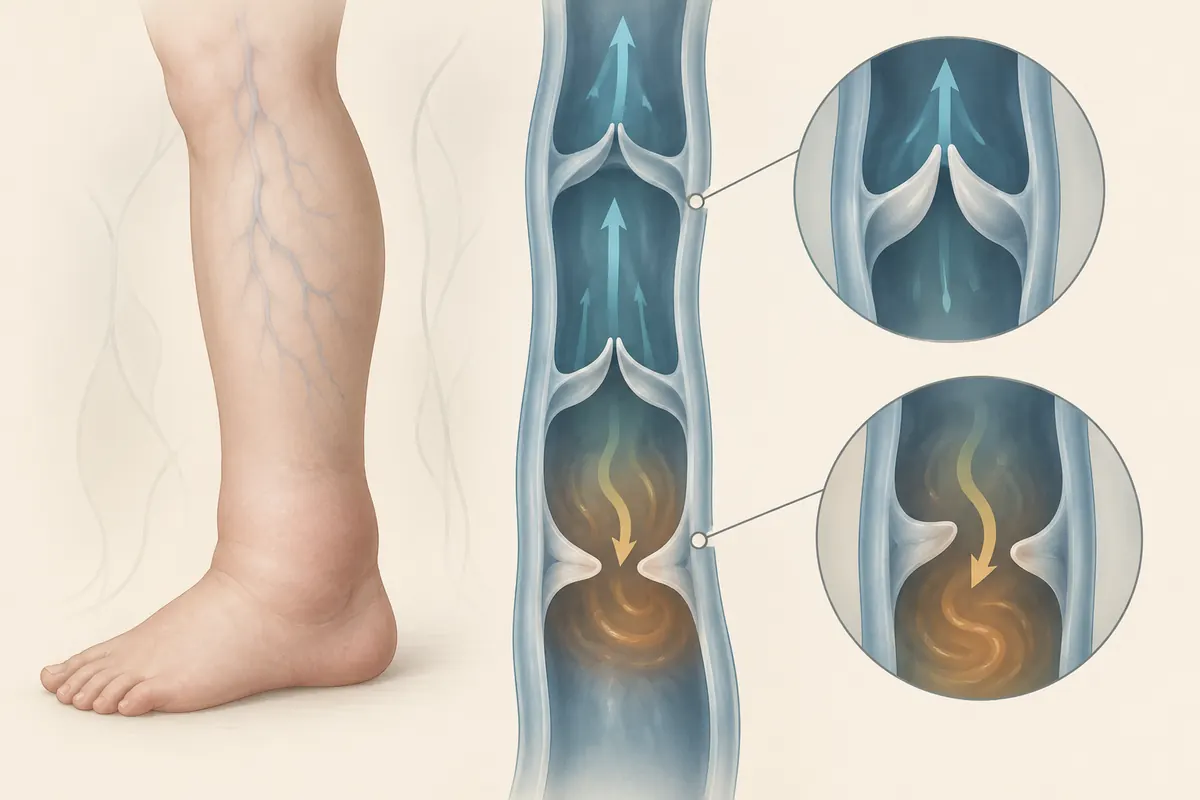
How valve failure and reflux raise venous pressure
Leg veins rely on one-way valves to help blood move upward against gravity. When valves or vein walls weaken or are damaged, blood can pool or flow backward, increasing pressure in the veins. The National Heart, Lung, and Blood Institute describes this sequence in varicose veins. Valve damage after a deep-vein thrombosis, aging, pregnancy, family history, and prolonged sitting or standing can contribute, but a risk factor alone does not establish CVI.
Varicose veins and chronic venous insufficiency are related terms, not perfect synonyms. Enlarged visible veins can be one sign, but appearance alone cannot show how well the full venous system is working. Conversely, swelling or skin changes can have causes unrelated to venous reflux. The mechanism helps explain possibilities; it is not a self-diagnosis checklist.
Symptoms vary and overlap with other conditions
CVI may involve swelling of the legs or ankles, tightness or heaviness in the calves, itching or pain, brown skin around the ankles, visible varicose veins, or hard-to-treat ulcers. Some people notice worse discomfort after prolonged standing or sitting and relief when resting with the legs elevated. That pattern can be useful history, but it does not confirm the diagnosis. Heart, kidney, arterial, medication-related, and skin conditions can also contribute to swelling or pain.
The Society for Vascular Surgery (SVS) advises people with symptoms to discuss them with a clinician and notes that evaluation by a vascular surgeon may be appropriate. Sudden worsening, bleeding, a wound, or an ulcer that will not heal deserves prompt medical attention. Do not assume that every leg symptom is venous or start tight compression without considering circulation and other individual factors.
What history, examination, and duplex ultrasound can show
A clinical assessment asks when symptoms began, how they change with standing, walking, or elevation, and whether there is a history of thrombosis, pregnancy, family venous disease, or prior treatment. Duplex ultrasound uses sound waves to evaluate blood flow and vein structure. It can help identify reflux or other abnormalities and is commonly used in assessment, but not every person needs the same tests. A clinician chooses tests based on the symptoms and examination.
SVS emphasizes comprehensive assessment for an accurate diagnosis and an appropriate plan. Ultrasound findings should be interpreted alongside symptoms, skin changes, and any ulcer—not in isolation. The amount of discomfort and the image findings may not map neatly onto each other. Asking how a result relates to a person’s function and treatment goals is more useful than treating one scan as a complete explanation.
An abnormal scan does not automatically mean a procedure is needed. As SVS emphasizes, a vascular specialist interprets symptoms, examination, and ultrasound together when developing an individualized plan.
Expert perspective: assess flow and tissue changes, not appearance alone
Read together, NHLBI’s explanation of reflux and SVS’s specialist guidance show why CVI is more than a cosmetic issue involving visible veins. A vascular clinician considers valve function, blood-flow direction, pressure-related symptoms, skin changes, ulceration, and the person’s history. Swelling alone is not enough to assign a cause, and an imaging result is not a treatment plan by itself. The practical next step is to document symptoms and obtain a clinical assessment that connects the findings with the person’s goals and risks.