Chocolate Tempering and Cocoa Butter Crystals: Form V and Bloom
Form V is associated with chocolate texture, but the polymorph alone does not guarantee gloss or bloom resistance. A controlled experiment and a 2025 expert perspective clarify what tempering research can show.
Publication & corrections: infostoa · Editorial standards
Individual author and specialist reviewer information is not provided for this article.
Chocolate’s gloss, snap, and melting behavior depend partly on the crystal structure formed by cocoa butter. Tempering melts and recrystallizes the fat under controlled conditions so that a useful crystal network develops. Form V is often described as the target, but identifying that polymorph alone does not guarantee gloss or resistance to fat bloom.
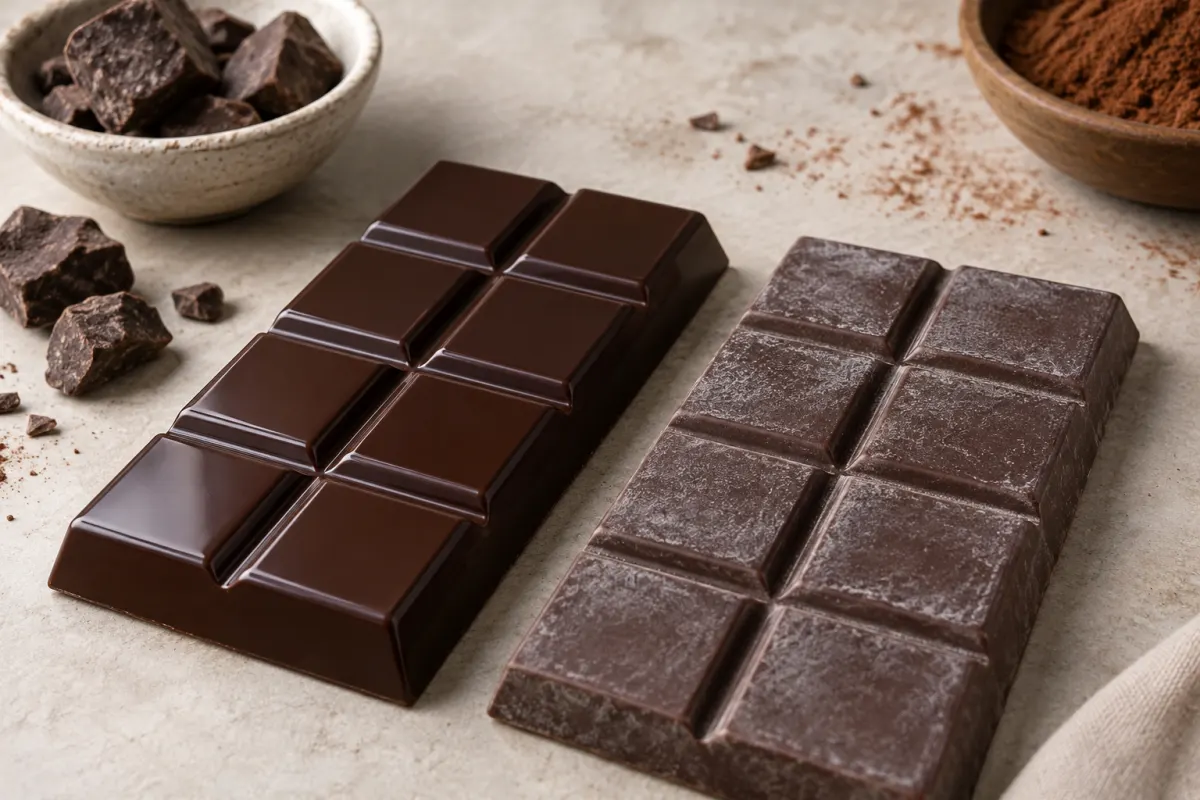
Cocoa butter can crystallize in different forms
The main cocoa-butter fats can pack into different arrangements depending on temperature and cooling history. Research traditionally distinguishes six polymorphic forms. Form V is valued for its melting behavior and its association with firmness, gloss, and a clean snap. A mixture that includes less stable or lower-melting forms can produce a softer texture and different material properties. Tempering aims to control melting, cooling, movement, and reheating so that unwanted crystals are reduced and a more desirable network forms.
A crystal form is not a single visual signal. Researchers use methods such as X-ray diffraction, differential scanning calorimetry, and microscopy to examine fat structure and melting behavior. A shiny or firm surface at home cannot identify a particular polymorph by itself.
What the additive experiment found
Chen and colleagues studied refined cocoa butter and commercial chocolate that had been melted and recrystallized. They added selected phospholipids at 0.1% by weight and examined crystallization and material properties. In the tested phosphatidylcholine and phosphatidylethanolamine conditions, rapid cooling without shear accelerated crystallization and produced signals associated with Form V, alongside gloss and mechanical properties comparable to commercial tempered chocolate. The work shows that small amounts of non-triglyceride components can influence nucleation and crystal growth under controlled conditions.
The experiment used measured additives, refined materials, and a specific cooling protocol. It was not a consumer recipe, a test of arbitrary kitchen additives, or a direct comparison of ordinary home tempering curves. The result does not establish which additives are suitable for any particular food product, nor does it justify copying the laboratory treatment at home.
Expert perspective: polymorph alone does not predict bloom
Stobbs and colleagues’ 2025 Perspective argues that Form V by itself does not guarantee high quality or resistance to fat bloom. Nucleation, structural homogeneity, and organization from the nanoscale to the microstructure also influence mechanical stability and susceptibility to bloom. Samples classified with the same polymorphic phase can still differ in their internal structure and their behavior during storage.
A Perspective offers expert interpretation and an analytical framework; it is not a formula that predicts bloom in every chocolate. Fat migration, crystal changes, and temperature fluctuations can contribute to visible defects. Fat bloom should also be distinguished from sugar bloom, which involves moisture dissolving sugar at the surface before it recrystallizes.
Reading a pale surface correctly
A light-colored film may be fat bloom or sugar bloom. Texture and storage history can provide clues, but a photograph alone may not establish the cause. Fat bloom is associated with fat movement and crystallization. Sugar bloom develops when surface moisture dissolves sugar and the sugar later recrystallizes. Both can be affected by storage and temperature conditions.
For a home comparison, record the chocolate type, melting history, cooling conditions, room temperature, and storage. Change one condition within the same batch so that a difference in appearance or snap can be interpreted. Keep the laboratory additive experiment separate from household handling, and avoid applying one temperature number to every chocolate formulation.
When comparing storage conditions, record the packaging, room-temperature changes, and whether condensation forms on the surface after chocolate comes out of refrigeration. Comparing those notes with a steadier-temperature condition can help track which changes coincide with appearance differences. The record supports comparison; it does not establish a shelf life or bloom resistance for every formulation.
Composition can also change the result. Milk fat, vegetable fats, particles such as sugar and cocoa solids, and emulsifiers including lecithin can all affect crystallization and the finished chocolate’s properties. Results from refined cocoa butter or one tested chocolate therefore cannot be applied unchanged to every commercial product. Compare the fat composition and nonfat ingredients of the study sample and the product in question.