How to Read Time and Temperature in Cacao Fermentation Studies
Separate a Colombian farm study from a defined-community experiment, and see why their fermentation endpoints do not become universal targets for other origins.
Publication & corrections: infostoa · Editorial standards
Individual author and specialist reviewer information is not provided for this article.
Chocolate flavor depends on more than cacao variety or roasting. During post-harvest fermentation, yeasts and bacteria metabolize sugars in the pulp and produce heat, acids, and other compounds. These changes can affect the seed and precursors that later contribute to flavor during drying and roasting. Yet one microbe cannot be named as the sole cause of a particular note, and one farm’s pattern is not a global standard.
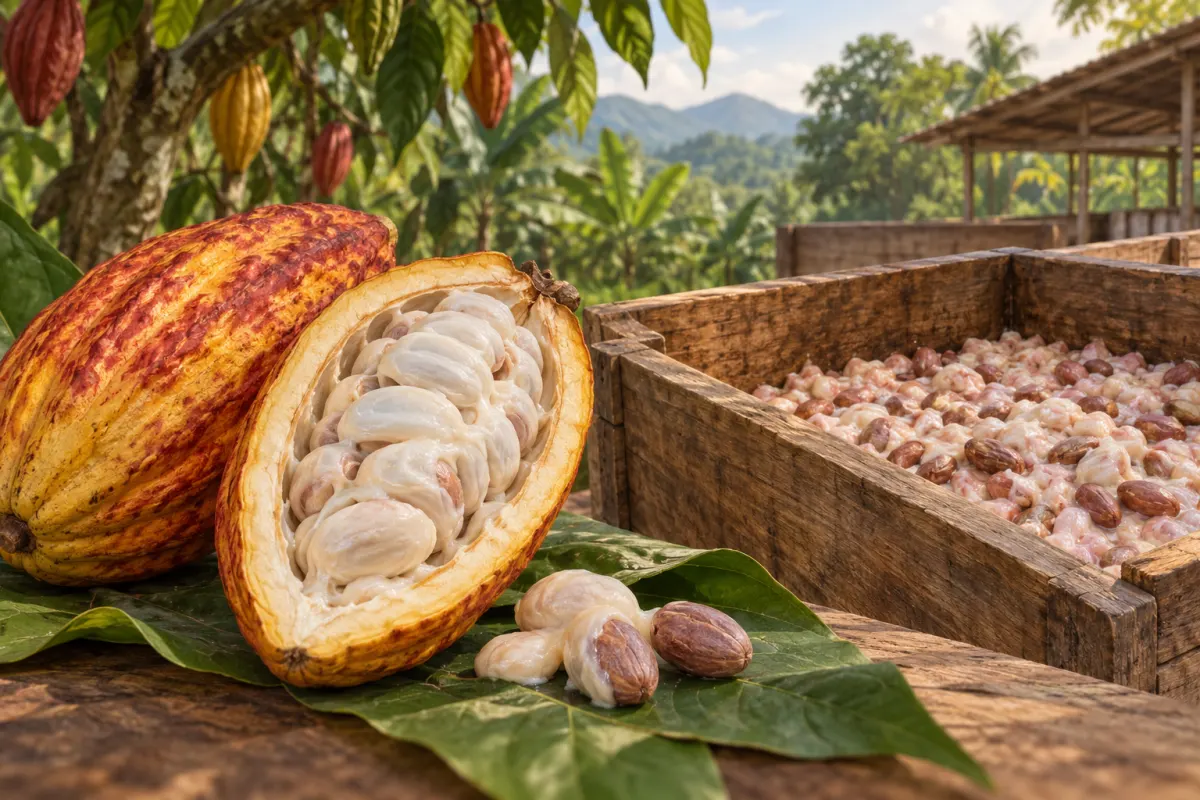
What changes during fermentation
Fresh cacao seeds sit in sugar-rich pulp. In spontaneous fermentation, a succession of yeasts, lactic acid bacteria, acetic acid bacteria, and other microbes develops over time. They consume sugars and organic acids, producing metabolites that include alcohols and acids. Their activity and physical and chemical changes in the pulp contribute to rising temperatures. Heat and acids affect the seed and can influence precursors associated with bitterness, astringency, and later aroma formation. Drying, roasting, genotype, and origin also shape the finished flavor; fermentation alone does not explain it.
What the Colombian farm study measured
Gopaulchan and colleagues studied fermentations at farms in Santander, Huila, and Antioquia, Colombia, across harvest periods. They tracked temperature and pH in pulp/testa and cotyledon, analyzed bacterial and fungal communities with metagenomic methods, and evaluated cocoa liquors made from fermented beans with a trained sensory panel. Fermentation trajectories and microbial communities differed among sampled farms. Some measurements were associated with fine-flavor attributes, including floral and caramel-like notes. These are observed associations, not proof that one organism directly creates a flavor.
The study covers three regions in one country and the particular farms, harvests, and processes sampled. A trained panel is not a survey of all consumers. Relationships among temperature, pH, microbes, and sensory scores do not rank every origin or establish which cacao is objectively superior. Different pH patterns in pulp and cotyledon also show why one acidity value cannot summarize fermentation.
What the defined-community experiment adds
After identifying candidates in field observations, the researchers tested a defined nine-member microbial consortium in controlled fermentations. Chemical and metabolic analyses and trained-panel assessment suggested that the consortium could reproduce selected fine-flavor attributes under those experimental conditions. This supports the feasibility of designing starter cultures; it does not establish a commercial recipe for every origin. Cacao genotype, season, vessel, turning schedule, scale, and temperature management can change results.
Expert review: microbial communities vary by place
Taylor and colleagues’ systematic review and meta-analysis compares microbes reported in spontaneous fermentations with geography and process parameters. The underlying studies differ in sampling, culture and identification methods, fermentation materials, and reporting detail. A frequently reported organism is therefore not guaranteed to occur everywhere, play the same role in every batch, or produce a particular sensory note. This expert synthesis helps separate detailed results from an individual study from a worldwide rule.
How to evaluate flavor claims
The cited Colombian farm study used 200–400 kg wooden boxes, turned the beans at 48 and 96 hours, and ended fermentation at 144 or 168 hours using temperature, pH, and cut-test results together. Those are observations from the study's farms and process, not universal targets. When comparing another report, check where temperature and pH were measured, variation within the container, turning schedule, and which indicators jointly determined the endpoint; elapsed time alone does not show that two batches reached the same stage.
When comparing studies, check origin and genotype, vessel and turning schedule, duration, where temperature and pH were measured, microbial methods, drying and roasting, and the sensory panel. Treat “this yeast makes a floral flavor” as a hypothesis until the experiment and measured outcome are clear. Producers can record repeatable processes and compare fermentation indicators with finished flavor, but warming beans at home does not safely reproduce farm fermentation. These studies explain flavor development; they are not household guidance for managing fermentation safety.