Bloom Filters: False Positives and RocksDB Design Choices
Why Bloom filters quickly reject absent keys while allowing false positives, and how RocksDB filter formats and bit budgets affect trade-offs.
Publication & corrections: infostoa · Editorial standards
Individual author and specialist reviewer information is not provided for this article.
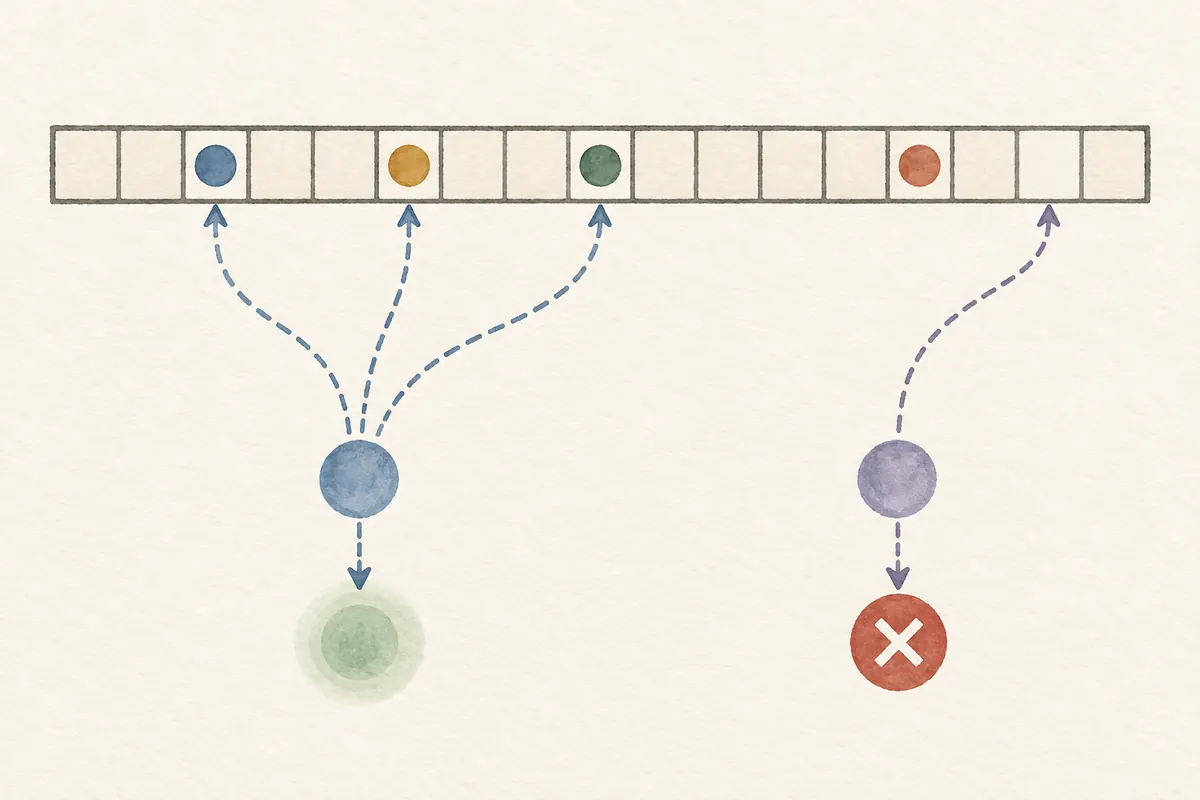
Bit arrays and probabilistic membership
In the textbook form, an m-bit array starts at zero and k hash-derived positions are set for each inserted item. On lookup, any checked bit still equal to zero lets a correctly maintained filter report that the item is absent. If all are one, the item is only possibly present and the underlying store must still be checked. The mathematical model assumes suitably distributed hashes; implementations may optimize how positions are derived, and it does not require a cryptographic hash.
False-positive probability and parameter trade-offs
If the chance that a bit remains zero after insertion is approximated by (1 − 1/m)^(kn), the probability that an absent item finds all k checked bits set is approximately (1 − e^(−kn/m))^k. This is an idealized basic-filter model with n items, m bits, and k checks. Treating k as continuous in that model gives k ≈ (m/n) ln 2; a real implementation must choose an integer and its own hash and memory layout. Do not transfer a RocksDB false-positive figure to a different implementation or key distribution without measurement.
How RocksDB formats change the space and lookup trade-off
RocksDB documentation describes multiple layouts, including block-based filters and full filters for an SST file. A full filter can use more space to keep a file’s key hashes available in a layout designed to reduce cache misses per lookup; older and newer formats differ in space and false-positive behavior. The documentation also notes that existing SST files use the format with which they were created, while options affect newly created files. Whole-key and prefix filters have different lookup scopes, so version and options matter.
A filter is an index aid, not the source of truth
RocksDB describes a negative result as a way to skip a key lookup within the relevant file or filter scope; a positive result still requires checking the stored data. The basic Bloom-filter model covers insertion, so it should not be read as support for arbitrary deletion or update. Prefix and whole-key settings also affect which queries use a filter. A filter does not replace stored records: measure the chosen format, key count, and bit budget against the workload that will use them.
An expert perspective on choosing and checking a filter
A key operational lesson from Bloom’s original paper is to decide where a tolerated error is acceptable and where a definitive check must remain. A filter answer of “possibly present” is not proof that the item exists. A false positive should be resolved by consulting the underlying store. A false negative can hide valid data, so insertion, lookup, and update paths must preserve the filter’s assumptions. Those consistency requirements belong in the application design before tuning a probability formula.
RocksDB’s project documentation describes how its formats trade memory use against lookup and cache behavior; it does not establish that one format is fastest in every environment. Results depend on how data is partitioned, whether the application queries whole keys or prefixes, and whether a negative filter result actually avoids a storage read. Check the version and options used to create the SST files instead of inferring performance from a configuration name.
A useful evaluation starts with an estimate of the key population and the cost of an unnecessary follow-up lookup. Then compare plausible bit budgets with representative positive and negative queries. Observe memory consumption, cache misses, and the number of underlying reads, and compare end-to-end latency before and after enabling the filter. The filter’s own hashing and memory accesses can cost more than the work it saves for some workloads.
Treat this as a workload experiment, not a universal optimization recipe. Keep the original key lookup in place, define whether false acceptance is acceptable, and test the exact RocksDB version and filter format that will run in production. The compact structure is useful because it can reject some absent keys cheaply; it cannot replace the source of truth or certify a positive result.
Sources and references: Bloom’s 1970 original paper (PDF, Princeton University archive), RocksDB Bloom Filter project documentation