Bennu’s Organic Molecules: What They Do—and Do Not—Show About Life
What returned Bennu samples reveal about early Solar System chemistry, why biological ingredients are not organisms, and what further evidence a claim of life would require.
Publication & corrections: infostoa · Editorial standards
Individual author and specialist reviewer information is not provided for this article.
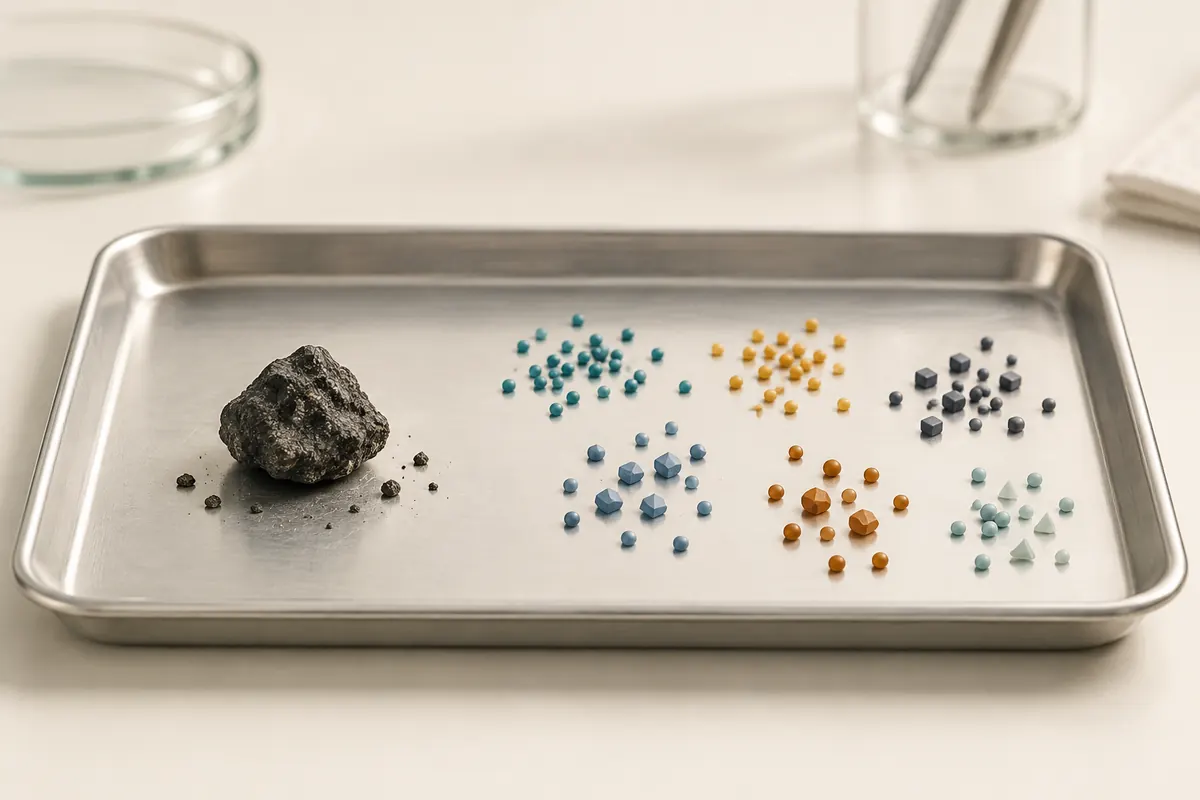
The detection of amino acids, nucleobases, and sugars in asteroid Bennu provides valuable chemical clues for research on life’s origins. But “a molecule used by life” and “evidence of life” are different claims. OSIRIS-REx returned samples containing particular molecules and chemical signatures; researchers did not report a living cell or direct evidence that life existed on Bennu.
What the samples reveal about early Solar System chemistry
A 2025 Nature Astronomy study reported ammonia and nitrogen-rich soluble organic matter in returned Bennu material, along with amino acids, amines, organic acids, aromatic compounds, and all five nucleobases found in DNA and RNA. The authors interpret nitrogen-isotope and molecular-abundance patterns as clues that some nitrogen-bearing compounds may have formed in a cold molecular cloud or the outer protoplanetary disk. Those are interpretations of sample chemistry and formation conditions, not observations of organisms.
The sample-return mission made it possible to examine material in laboratories rather than relying only on remote measurements. Laboratory instruments can distinguish compounds and compare their abundances in material collected from a known asteroid. Returning samples under controlled conditions also reduces the uncontrolled terrestrial exposure that complicates studies of meteorites recovered on Earth. Even so, handling, contamination control, analytical limits, and sample context matter when interpreting a result.
Organic molecules are not organisms
“Organic” describes a broad class of carbon-containing compounds; it does not mean that a compound was made by living things. Amino acids can be components of proteins and nucleobases can be components of nucleic acids, but molecules of these kinds can also arise through nonbiological chemistry. The reported inventory supports the conclusion that ingredients important to terrestrial biology were present in Bennu material. It does not show that those molecules formed cells, metabolism, or a self-replicating system.
That distinction is central to searching for life. Scientists ask not only which compounds are present but also how much is present, how compounds are distributed, what isotopes they contain, whether they occur in meaningful combinations, and whether biological or nonbiological processes better explain the pattern. Contamination and the limits of the measurement must also be considered. Calling one detected molecule a “trace of life” would claim more than the observation establishes.
What NASA’s 2025 sugar report adds
NASA’s December 2025 report says researchers detected ribose and glucose in Bennu samples. Ribose is part of RNA, while glucose is important in energy metabolism in life on Earth. NASA explicitly notes that the sugars themselves are not evidence of life. Alongside earlier reports of amino acids, nucleobases, and carboxylic acids, the findings add to evidence that ingredients of biological molecules were widespread in the Solar System.
Finding a component of RNA is not the same as finding RNA or a living system in Bennu. The presence of ingredients does not establish that they reached suitable concentrations, followed a particular reaction pathway, or formed a stable system for storing and copying information. The careful interpretation is that Bennu offers material for testing hypotheses about prebiotic chemistry—not that the asteroid contained life.
Expert perspective: separate detection, origin, and life claims
The Nature Astronomy paper measures the composition and isotopic features of returned material and uses them to discuss possible early Solar System chemistry. NASA’s public summary connects separate findings while stating that the sugars are not evidence of life. Read together, the evidence has several distinct steps: a compound is detected; researchers infer plausible chemical origins; and a separate argument would be needed to claim life. A result at one step does not automatically prove the next.
This distinction communicates uncertainty without dismissing the discovery. Bennu samples reveal chemistry difficult to reconstruct from remote observation, but molecular evidence and evidence of a biological process are not interchangeable. Stating both the finding and its boundary makes the result clearer.
Questions for the next studies
Further work can test which molecules occur with particular minerals or salts, how uniformly they are distributed across sample grains, and how isotopes and molecular structures constrain possible formation environments. Researchers can compare results from different locations and particles and continue to assess whether contamination could explain a signal. A sample from one asteroid cannot stand in for the entire early Solar System.
The reported molecules make hypotheses about extraterrestrial prebiotic chemistry more specific and testable. To infer that organisms existed, researchers would need additional evidence capable of distinguishing biological processes from nonbiological chemistry. The most accurate account keeps two statements separate: ingredients associated with life have been found, while life itself has not been reported in these samples.