Lithium batteries on flights: configuration, capacity and rule scope
Explains the passenger battery guidance in IATA DGR 67 Table 2.3.A alongside FAA and U.S. CFR carriage conditions. It distinguishes installed from spare batteries and relevant capacity and approval limits; actual carriage also depends on applicable national rules and the operating airline’s conditions.
Publication & corrections: infostoa · Editorial standards
Individual author and specialist reviewer information is not provided for this article.
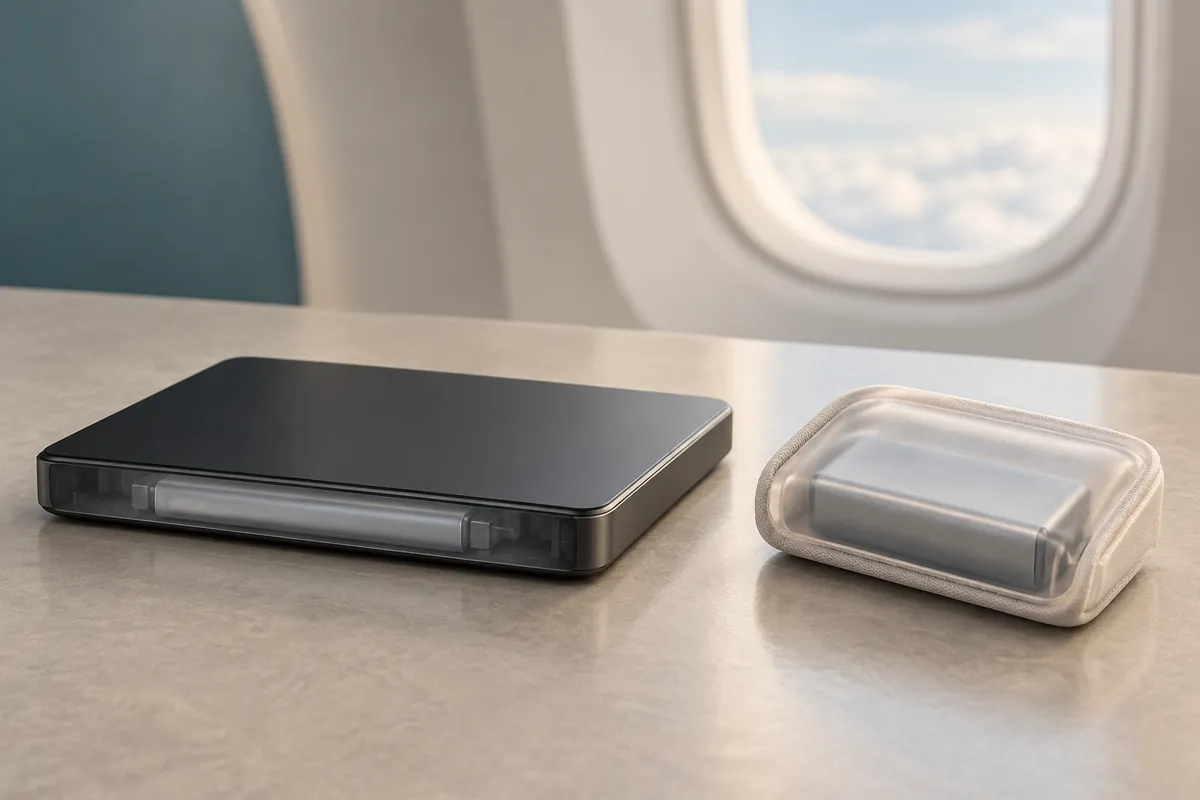
Conceptual illustration, not an observed packing or incident-response result.
Start with configuration, not a blanket battery rule
FAA guidance explains that lithium-ion batteries can overheat and undergo thermal runaway, including through damage, unsuitable packing or manufacturing defects. This risk does not make every battery configuration subject to one baggage rule. IATA’s specialist overview separates configuration from watt-hour rating or lithium content and links passenger and shipper resources. FAA risk explanation IATA configuration overview
Separate spare carriage from installed-device conditions
In U.S. FAA passenger guidance, spare lithium batteries and power banks belong in carry-on baggage. Remove them if that bag is gate-checked, and protect their terminals against short circuit. Installed devices are a different category: FAA recommends carry-on, while its checked-device guidance requires full shutdown and protection from activation and damage. Spare-battery guidance Installed-device guidance
Terminal protection is a concrete step to check while packing. FAA examples include keeping retail packaging, covering exposed terminals with insulating tape, or using a battery case, sleeve or protective pouch. U.S. rules require each spare lithium battery to be protected against short circuit. Keep a loose battery from contacting metal objects such as keys, and recheck its protection before checking a bag. These measures do not replace an airline’s separate quantity limits or packing conditions, so check the operating carrier’s current instructions too. FAA terminal-protection examples 49 CFR spare-battery conditions
The U.S. regulation includes a narrow exception to the full-off rule for devices containing only very small batteries; specialized heating devices, smoking devices and mobility aids have separate provisions. Thus “recommended in the cabin” and “never permitted in checked baggage” are not interchangeable. Check the actual category and conditions in 49 CFR 175.10 rather than using the spare rule for every installed battery. U.S. exceptions and conditions
Read chemistry and capacity together
For U.S. personal-use lithium batteries, the standard thresholds are 100Wh for lithium-ion and 2g lithium content for lithium-metal. Operator approval permits lithium-ion batteries above 100Wh and not above 160Wh, with no more than two such individually protected spares in carry-on. The above-2g to 8g lithium-metal exception concerns portable medical devices, not every consumer battery. Mobility-aid rules are separate. Regulatory capacity boundaries
The IATA 2026 Table 2.3.A similarly separates standard, larger and medical-device categories, but this January extract does not establish every later addendum or every state/operator variation. Keep the table’s date attached to it. Where a label gives volts and amp-hours, FAA explains Wh as their product; lithium-metal uses lithium content instead. An unclear rating should remain an unresolved item, rather than being treated as falling below a threshold by default. Dated IATA table Rating interpretation
ICAO Technical Instructions Doc 9284 Addendum No. 1, applicable from 27 March 2026, separates power banks from other spare batteries. Each person may carry no more than two power banks, regardless of capacity or other spares, and must not recharge the power bank itself onboard. In contrast, not using a power bank to recharge a portable electronic device onboard is a recommendation, not that same prohibition. Read these ICAO additions separately from the U.S. FAA/49 CFR conditions above and the January IATA extract. Do not attribute the two-power-bank cap to a separate FAA rule; check the applicable departure/transit-state rules and the operating carrier’s carriage and use restrictions. ICAO Addendum No. 1, Table 8-1 ICAO information sheet
For a hypothetical rating calculation, 3.7V and 20Ah (20,000mAh) give 3.7×20=74Wh. This interprets a label; it does not establish that every route accepts a 74Wh product. Do not confuse a charging-output voltage with the battery rating; check the manufacturer’s Wh marking first.
Report an abnormal device to crew immediately
IATA’s traveler guidance says to notify crew promptly about a hot or smoking device, not to attempt moving or cooling it yourself, and to avoid moving a seat when a device slips into it. FAA also calls for immediate notification when a battery or device overheats, expands, smokes or burns. These are passenger actions, not an operator fire-response checklist or a tested suppression procedure. Follow crew instructions. IATA incident guidance FAA notification guidance
Before departure, record configuration, chemistry, rating, whether operating-carrier approval is required, and the date of its instructions. If approval is unclear, ask that carrier with the product details and category. Do not decide carriage of damaged, recalled or specialized equipment from the general capacity threshold alone.
Sources
- FAA PackSafe - Lithium Batteries
- IATA - Batteries
- FAA PackSafe - Portable Electronic Devices Containing Batteries
- 49 CFR 175.10
- IATA Dangerous Goods Guidance for Passengers
- IATA DGR Table 2.3.A
- IATA Safe Travel with Lithium Batteries
- ICAO Doc 9284 Addendum No. 1, 27 March 2026
- ICAO additional power-bank restrictions