Planning an Aurora Trip: Latitude, Clouds, and Forecasts
Kp is only one clue. Plan around darkness, cloud cover, latitude, forecast horizon, and safe local access instead of treating an aurora forecast as a guarantee.
Publication & corrections: infostoa · Editorial standards
Individual author and specialist reviewer information is not provided for this article.
A high Kp forecast can be useful when planning an aurora trip, but the number cannot guarantee a sighting or tell you whether the sky above your hotel will be clear. Geomagnetic activity affects auroral visibility, while location relative to the auroral oval, darkness, clouds, and local light all matter separately. NOAA says auroras commonly form in ovals centered near the magnetic poles and are often visible under an oval roughly between 60 and 75 degrees latitude. The University of Alaska Fairbanks (UAF) Geophysical Institute identifies darkness and clouds as major obstacles to seeing them.
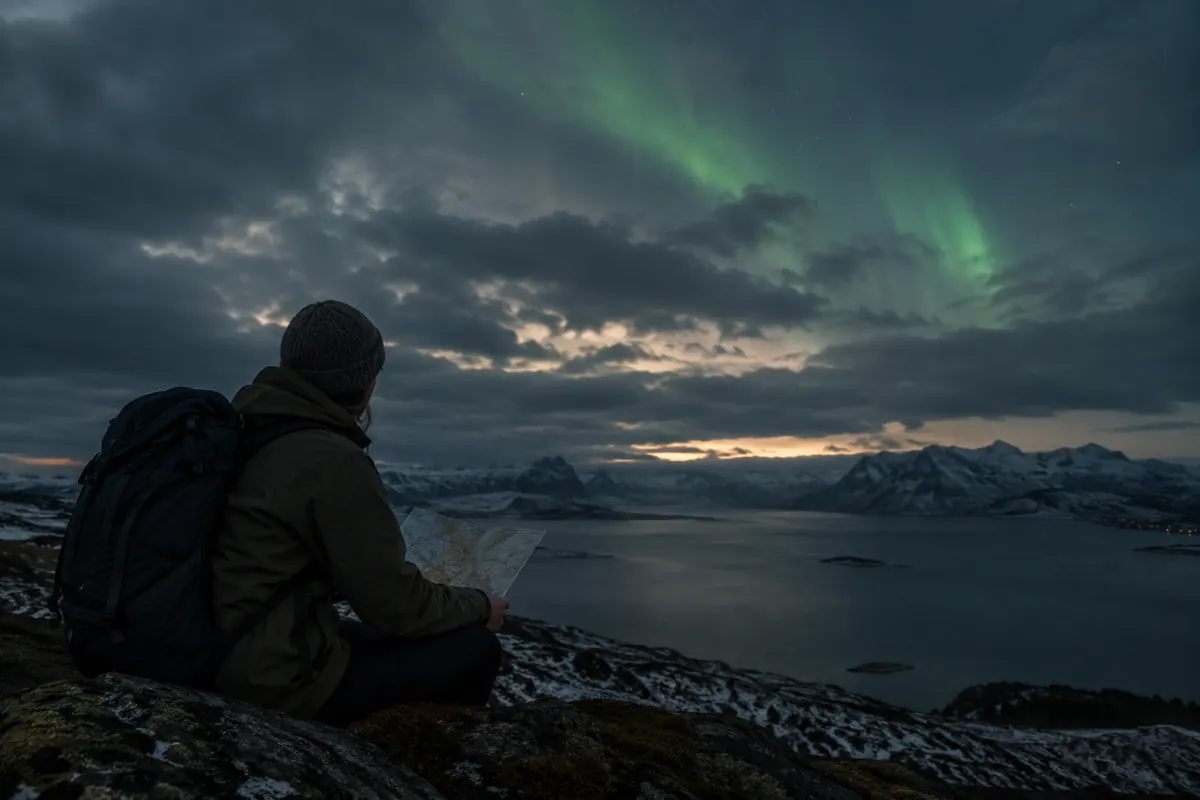
Kp does not forecast clear skies
Kp summarizes disturbances in Earth’s magnetic field. Higher values may indicate expansion toward lower latitudes, but not local clouds, darkness, or nearby lights. A strong activity forecast cannot make a cloudy or sunlit sky transparent. At more typical activity, aurora may still occur at high latitudes, but its position and brightness vary from night to night.
NOAA explains that energetic electrons collide with oxygen and nitrogen in the upper atmosphere and release light. Auroral ovals can expand during major storms, which explains why activity indices guide location planning but cannot promise a display at a specific place or hour.
Choose latitude and season before chasing a forecast
At average activity levels, high northern or southern latitudes offer a better chance of seeing aurora overhead. NOAA’s approximate latitude range is a useful starting point, not a city-by-city guarantee. Local terrain, light pollution, mobility, and where you can safely wait all affect the experience. UAF lists Fairbanks, northern Canada, Iceland, and northern Norway as high-latitude examples under average conditions. Treat these as geographic examples of the auroral oval, not as a promise about a date or location.
Season determines how much darkness is available. Winter nights can provide a longer observation window, while long summer daylight or twilight may make a display invisible even when aurora is active. Check local sunset and twilight times for your travel dates. Moonrise and moonlight matter too: a bright Moon does not switch aurora off, but it can brighten the sky and reduce contrast for a faint display.
Use long-range outlooks and short forecasts differently
UAF’s forecast page presents a 27-day outlook alongside a three-day forecast and says the three-day forecast is more accurate. Use the longer outlook as a broad planning signal, not a fixed itinerary. In the days before a viewing attempt, revisit the short-term forecast; on the day, check local cloud, precipitation, wind, road conditions, and available sky cameras. Forecasts change as new observations arrive, so a value seen when you booked is not a confirmed condition for the night you travel.
Plan safe waiting areas ahead of time and set limits for fatigue, ice, and poor visibility. A dark place near lodging and an indoor alternative can reduce risky last-minute driving.
Clouds and local light decide what reaches your eyes
Auroral activity is space weather; clouds are local weather. Do not assume one forecast map combines both. Check the aurora forecast and the cloud forecast for the actual viewing location separately. UAF notes that sunlight and clouds are among the biggest obstacles to visibility. Once you know the approximate hour and place, consult hourly cloud and precipitation forecasts and local cameras, and consider how far you can get from urban lighting.
Darkness alone is not enough if terrain blocks the view or the site sits under a cloud deck. Compare candidate locations by travel time, road access, toilets or shelter, mobile coverage, and local rules as well as sky darkness. Winter driving in northern regions can involve darkness, snow, and ice; the effort to improve viewing odds should never take priority over safe travel.
Budget for a night with no display
Several nights create more opportunities than staking the entire trip on one event, but extra time and cost still do not guarantee aurora. Space weather and clouds are outside a traveler’s control. Plan daytime activities and indoor alternatives as real parts of the trip rather than as consolation prizes. Before booking, check cancellation terms, winter equipment and insurance for a rental car, and the refund policy for a nighttime tour. That preparation can limit disruption when conditions change.
A forecast expert separates geomagnetic activity from local weather. NOAA explains the solar and geomagnetic conditions associated with aurora, while UAF provides a regional activity outlook; clouds and road safety still need separate checks. Color on a map does not guarantee a visible display.