Auroras: Light Shaped by Earth’s Magnetic Field
How solar particles, Earth’s magnetic field, and the upper atmosphere produce auroras, and what color and visibility can—and cannot—tell us.
Publication & corrections: infostoa · Editorial standards
Individual author and specialist reviewer information is not provided for this article.
An aurora is light produced as energetic particles from the Sun interact with Earth’s magnetic field and upper atmosphere.
1. An aurora is light from the upper atmosphere
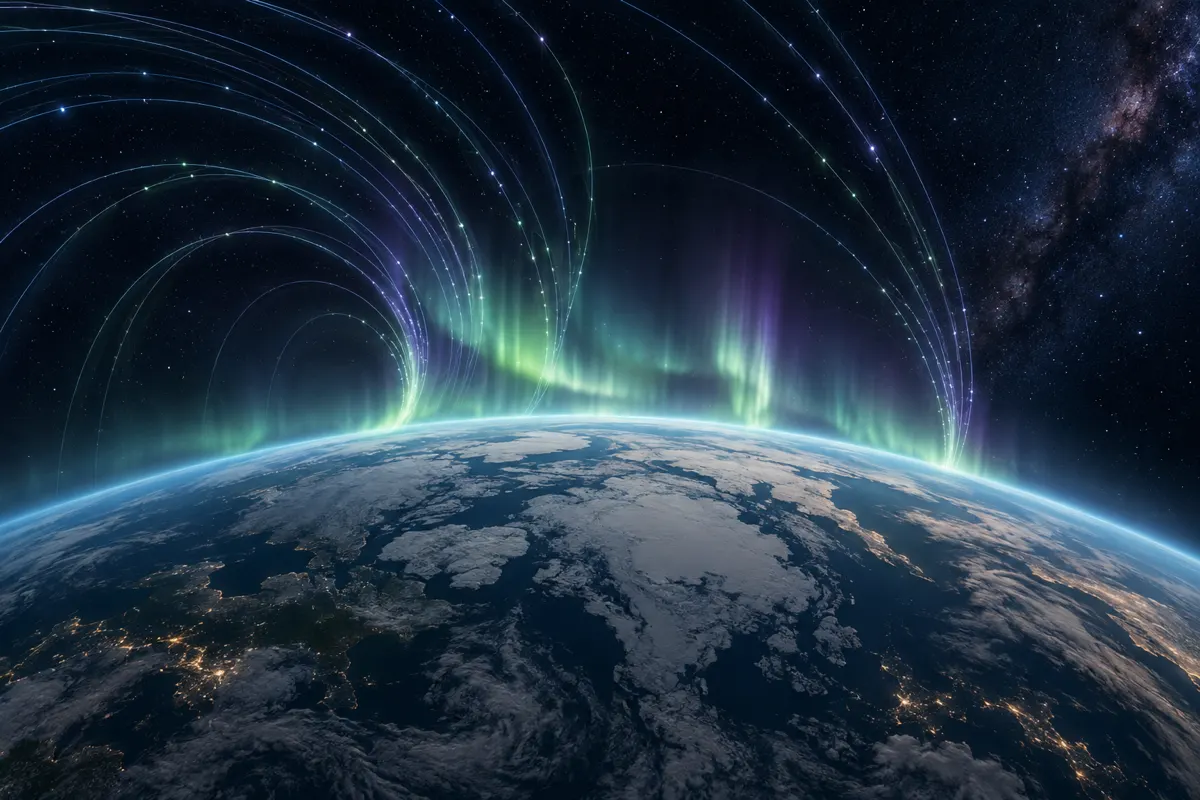
Auroras are luminous displays seen most often in the sky around Earth’s polar regions. NOAA and NASA explain that energetic particles from the Sun interact with Earth’s magnetic field and upper atmosphere. It is therefore incomplete to picture the phenomenon as solar particles simply striking the ground. The magnetosphere and atmosphere shape where particles travel and where collisions can produce visible light.
2. Electrons energized on the nightside make the atmosphere glow
NOAA explains that electrons can be accelerated in the magnetosphere’s downwind tail on the night side and at lower altitudes along auroral field lines. The energized electrons follow Earth’s magnetic field toward polar regions and collide with oxygen and nitrogen atoms and molecules in the upper atmosphere. The collisions raise the gases to higher energy states; when they return to lower states, they release light. NOAA places typical auroral emission roughly 80 to 500 kilometers above the surface. The usual oval distribution around the magnetic poles reflects the routes along which particles enter the atmosphere.
An aurora is not necessarily a single smooth arc. NOAA describes many forms as tall rays that resemble folds in a curtain. An arc can expand across the sky, move rapidly, and become bright during the peak of an auroral substorm. Later, diffuse cloud-like patches may blink on and off before fading. These changing forms show why an aurora is a time-varying atmospheric emission, not a stationary scene captured by one photograph.
NASA describes magnetic reconnection when the solar wind’s magnetic polarity is opposite to Earth’s: magnetic field lines from the Sun and Earth join. The solar wind stretches the connected lines toward the magnetotail; when they break, energy is released back along Earth’s field lines. This helps explain how energy enters the magnetosphere and contributes to auroral electron acceleration.
This does not mean every interaction between the solar wind and Earth’s magnetic field produces an aurora of the same scale.
3. Color varies with atmospheric gas and interaction altitude
NASA explains that green, the most common auroral color, is produced when electrons excite oxygen around 100 kilometers above Earth. NOAA gives a broader approximate range of 80 to 500 kilometers for auroral emission. These statements describe different things: one identifies a typical altitude for green light, while the other covers a wider range in which auroras occur. Color depends on the gases and their excited states at different heights, so a hue by itself cannot measure exact altitude or particle energy.
4. NOAA guidance: the oval and viewing conditions
NOAA explains that Earth’s magnetic field guides electrons into two auroral ovals centered approximately on the magnetic poles. During major geomagnetic storms, the ovals can expand away from the poles, making auroras possible at lower latitudes than usual. NOAA’s common viewing region of roughly 60 to 75 degrees and its broad viewing-frequency estimate describe regional patterns, not a guarantee for a particular place or night. Local darkness and cloud cover also affect unaided viewing; during the midnight sun, an aurora can be present but hard to see against a bright sky.
NOAA notes that during major storms auroras can reach lower latitudes, including much of the United States. Such events illustrate expansion of the oval; they do not establish in advance where a specific display will be visible.
To compare observations, record location and time along with darkness and cloud conditions. A photograph’s exposure can capture faint light more clearly than unaided vision, so noting exposure helps explain differences between a camera record and what an observer saw.
NASA reports that auroras also occur on other planets and moons with atmospheres, including Saturn and Jupiter. They usually form where a planet’s magnetic field lines meet its atmosphere, but the process can differ among worlds; Earth’s explanation should not be assumed to apply unchanged elsewhere.
Turn an observation into a question
If you observe an aurora or compare published photographs in a lesson, record the conditions before drawing a conclusion: location and local time, viewing direction, cloud and sky brightness, color/shape/motion seen by eye, and camera exposure if there is a photo. Then choose one question: “Did the camera show something different from unaided vision?”, “How did an arc or curtain change over time?”, or “What do records from another place at the same time show?” NOAA notes the need for dark, clear skies; NASA describes researchers combining all-sky cameras with instruments such as magnetometers and radars.
Keep observation separate from interpretation. “A faint green patch appeared in the photograph” is an observation; “a geomagnetic storm caused this color” needs more evidence. A long exposure can look different from what the eye saw, and one image’s color or brightness cannot establish particle energy, exact altitude, or storm strength. An aurora map or outlook is a reference to compare with location, time, darkness, and clouds, not a promise that a display will be visible at a particular place. This activity practices interpreting observations; it is not a method for predicting an appearance.