Before Playing Old Records and Tapes: A Safer Preservation Workflow
Before replaying a cultural collection’s records or tapes, check the medium, its condition, and its storage history. This guide combines Library of Congress handling advice with IASA’s specialist guidance on preserving digitized audio.
Publication & corrections: infostoa · Editorial standards
Individual author and specialist reviewer information is not provided for this article.
Start with condition and history, not playback
An old record or tape is more than a container for sound. Aging materials, dust or mold, wear from earlier playback, and poor storage can lead to signal loss or physical damage. A carrier that still plays is not necessarily safe to play repeatedly. Begin by matching the item to its catalogue record, then inspect the case, label, playing surface, edges, and the way tape is wound on its reel. Record visible cracks, lifting, deformation, or possible mold with a date and, where appropriate, a photograph. If the condition is uncertain, stop before playback and ask a preservation professional to assess it. This inspection is both a listening preparation step and the first act of preserving a potentially unique cultural record for future users.
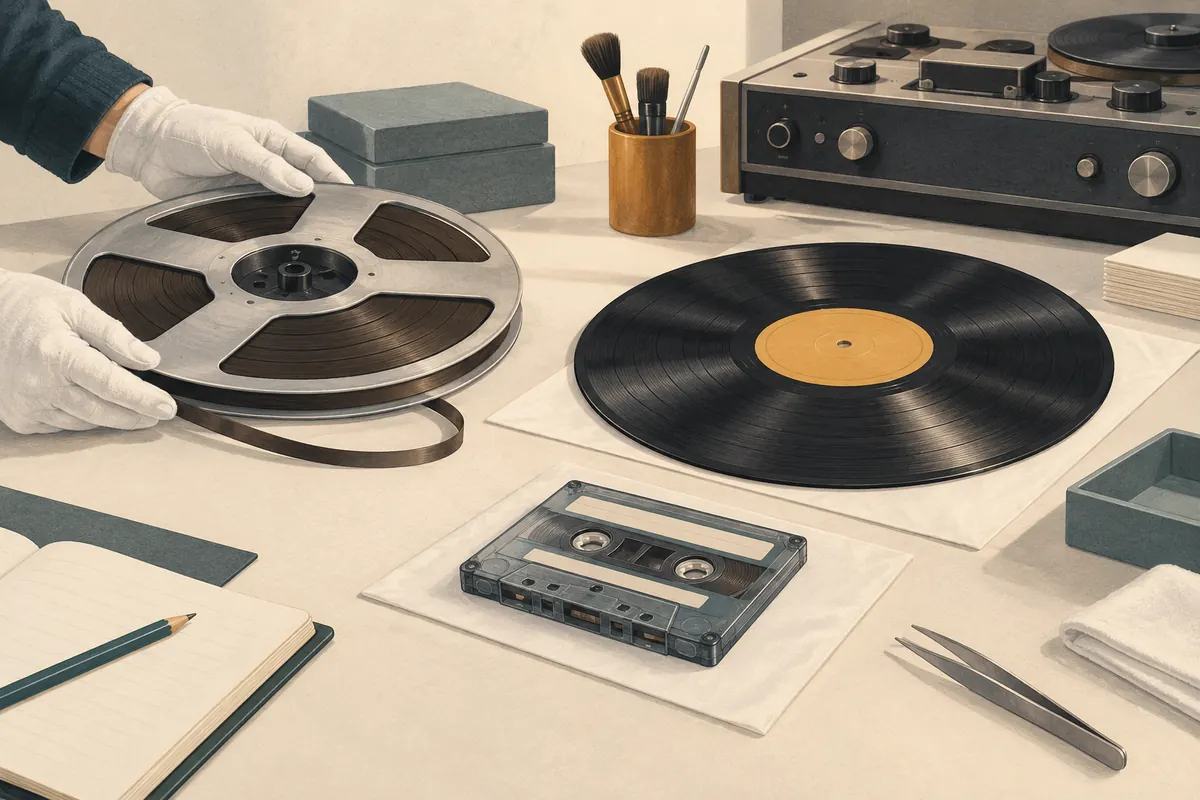
Each format has a different safe grip
The Library of Congress advises handling audiovisual materials in a clean environment, avoiding contact with playing surfaces, and keeping playback equipment clean. Hold grooved discs by their edges and label areas; handle optical discs by the edge and center hole. Hold open-reel tape by the reel flanges and center hub, without squeezing the wound tape. Hold cassettes by their outer shell and keep fingers away from the spools. Wash and thoroughly dry hands, and keep food and drink away from the work surface. These instructions reduce avoidable handling risks, but they are not a license to clean or repair a damaged item yourself. If a surface is contaminated or a carrier appears fragile, define a stop point and refer it to a conservator rather than improvising with household materials.
Expert perspective: storage and playback form one chain
The Library of Congress preservation guidance recommends storing audiovisual formats upright, checking that shelves and dividers can support their concentrated weight, and allowing items from cool storage to acclimate before handling or playback. In practice, no single temperature, enclosure, or handling trick solves every risk. Moving an item between storage and a reading room can create abrupt environmental changes, while a weakened carrier may be damaged even by otherwise functioning equipment. Staff should therefore document the storage location, the move, acclimation, playback equipment, and the person responsible. When a carrier is fragile or the institution lacks compatible equipment, fewer playback attempts and a referral to a specialist may be the safer choice. This does not make access unimportant; it weighs the value of listening now against the remaining life of the original.
Digitization does not end when a file appears
Digitization may be necessary to preserve content from a deteriorating carrier, but transferring a playback signal into a file does not by itself complete preservation. The International Association of Sound and Audiovisual Archives (IASA) publishes specialist guidance on producing and preserving digital audio objects. An institution should connect the original item’s identifier and condition to the playback and conversion equipment, work date, file format, and relevant technical information. Staff should review the resulting audio for missing sections, distortion, or speed problems. A preservation master and a convenient access copy have different purposes and should be identified accordingly. The exact format and storage policy depend on the institution’s collection and capacity; one setting cannot be assumed to suit every tape and disc. IASA’s guidance is useful as a framework for a documented process, not a guarantee that digitization can restore information already lost from a damaged original.
A practical sequence for a small collection
First, identify each item and record its condition and storage location. Second, set clear reasons to pause playback, such as suspected mold, a brittle carrier, or a damaged tape pack, and separate those items from routine work. Third, use format-appropriate handling and check that the playback equipment is suitable and maintained. Fourth, when digitizing, preserve the link between the original and its files, then review the output and its technical documentation. Finally, record who made each decision and when, so the next staff member does not repeat a risky inspection or playback attempt without context. A small institution does not have to send every item to a specialist studio immediately; it can first identify the most vulnerable objects and seek advice for those. When the carrier is unstable or suitable playback equipment is unavailable, consultation and planning are safer than a trial run.