The 535-Day Super-Kamiokande Zenith-Angle Signal in Atmospheric Neutrinos
A close look at the zenith-angle-dependent muon-neutrino deficit in Super-Kamiokande’s 535-day atmospheric-neutrino data, focusing on that path-length measurement rather than general PMNS formalism.
Publication & corrections: infostoa · Editorial standards
Individual author and specialist reviewer information is not provided for this article.
A neutrino can change its observed flavor while traveling
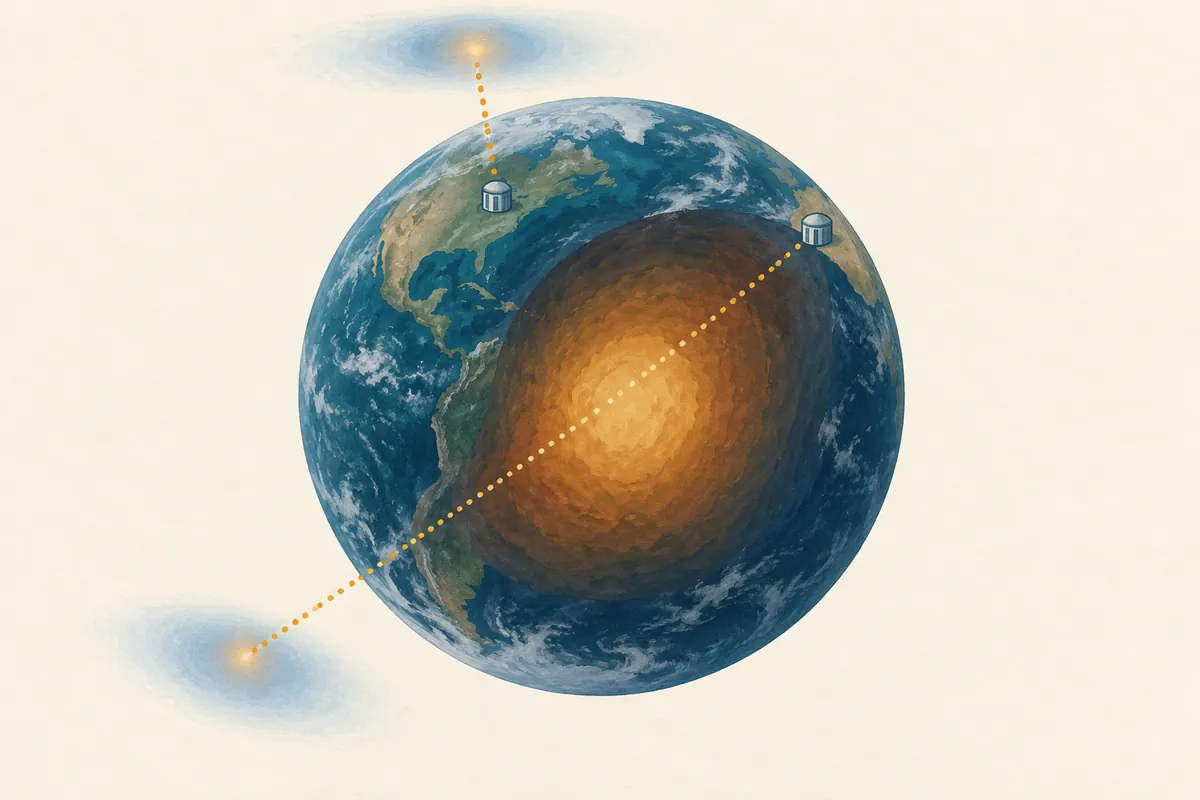
Neutrinos are observed in three flavors, named for the electron, muon, and tau particles produced alongside them in weak interactions. Yet the states that propagate with definite mass are not identical to these flavor states. A flavor state is a quantum mixture of mass states. As those components travel, they accumulate different phases; when they overlap again, the probability of detecting each flavor depends on distance and energy. This changing probability is called neutrino oscillation. A wave analogy can suggest how interference changes a pattern, but the quantitative account requires quantum-state mixing and propagation.
Atmospheric neutrinos begin when cosmic rays strike nuclei in the atmosphere and produce particles such as pions and muons, which then decay. Their decay chains create both muon-flavor and electron-flavor neutrinos. The production height and incoming direction set the approximate distance to an underground detector. Neutrinos produced in the atmosphere above the detector take a relatively short route, while those arriving from below have crossed much of Earth and traveled much farther. Comparing directions therefore gives experiments a way to test whether flavor composition changes with baseline.
Why the zenith-angle pattern matters more than one total count
In 1998, the Super-Kamiokande Collaboration reported data from a 535-day exposure of 33.0 kiloton-years. It found a zenith-angle-dependent deficit of muon neutrinos. The pattern was inconsistent with expectations based on atmospheric flux calculations, and uncertainties in fluxes and interaction cross sections could not explain the observation. The data were consistent with muon-to-tau oscillations in a two-flavor analysis, for which the paper reported parameter ranges at a stated confidence level. “Deficit” does not mean that every missing muon neutrino vanished; it means that the detected flavor proportions varied with direction and, roughly, path length. Original paper
Direction provides a rough baseline, while energy affects how much oscillation phase accumulates along it. Researchers therefore compare distributions across reconstructed directions and energies rather than relying on one overall event total. A low count in one direction alone would not establish oscillation. Detector efficiency, the predicted atmospheric-neutrino flux, energy reconstruction, and neutrino-nucleus interactions all need scrutiny. The strength of the evidence comes from the structured pattern and from testing whether plausible alternatives can reproduce it.
The detector records light, not a neutrino’s full identity
Neutrinos carry no electric charge and rarely interact, so most pass through a detector without a trace. In a large water Cherenkov detector, a rare interaction can produce a charged particle. If it travels through water faster than light travels in that medium, it emits Cherenkov light. Photomultiplier sensors around the tank record when the light arrives and how it is distributed. The shape of the light ring helps distinguish, statistically, an electron-like shower from the longer track of a muon-like particle.
That ring is an indirect clue, not a complete measurement of the incoming neutrino. Its energy must be inferred while accounting for undetected particles, nuclear recoil, and effects inside the target nucleus. Calibration, event selection, and interaction models also matter. This is why analyses evaluate detector and modeling uncertainties alongside the data. The numerical interval in the 1998 paper is conditional on that exposure, apparatus, analysis, and statistical model; it is not a timeless exact value for every oscillation parameter.
Expert perspective: evidence for oscillation is not a complete mass measurement
The Particle Data Group’s 2024 review by M. C. Gonzalez-Garcia and M. Yokoyama describes oscillation as the consequence of flavor and mass mixing. It places atmospheric results beside solar, accelerator, and reactor measurements, and also covers propagation through matter. In this broader expert account, Super-Kamiokande’s direction-dependent deficit is strong evidence for flavor change, but that single observation does not determine every mixing parameter or the absolute neutrino mass. Experiments using different energies and baselines provide complementary constraints that can be combined. Particle Data Group review
Oscillation measurements are sensitive to differences between squared masses. They do not, by themselves, directly set the common absolute mass scale. Nor should the paper’s two-flavor analysis be mistaken for the full modern three-flavor framework: it was a useful description of that data and question, not a substitute for later precision analyses. Keeping observation, explanatory model, and parameter constraint distinct avoids saying that neutrinos literally disappear while preserving why the directional pattern changed particle physics.